
Pokemon Mystery Packs: Are They Worth It?
Pokémon mystery packs can be worth buying for the surprise of the rip when the downside fits your budget and the product discloses its eligible cards, numeric probabilities for an identifiable population, value method, and possession terms. They are not a dependable way to acquire one exact card or guarantee a profitable opening. If any of those four disclosures is missing, treat the product as not assessable from the information provided—not automatically good, bad, legitimate, or fraudulent. A complete denominator, tier definition, coverage statement, and pool-change rule are still required for the probability disclosure to earn the audit’s full score.
This article covers collectible-card products only. It does not cover the Pokémon GO Mystery Box mechanic, Pokémon HOME, Pokémon Revolution Online, local-stock searches, or named-vendor rankings.
Are Pokemon Mystery Packs Worth It?
Buy a single when card identity matters most. Consider a mystery pack when the reveal itself has value and every disclosed outcome is acceptable. The pack still needs enough evidence to assess its promises; a chase image, stated floor, or seller’s value claim cannot establish favorable economics.
A known single fixes the card, printing, condition, and purchase price before money changes hands. A mystery pack preserves uncertainty, so the collector must judge the disclosed pool rather than the promoted hit. That tradeoff—not a universal return threshold—decides which format fits the collection.
Disclosure is a separate issue. A bounded pool and usable product terms can make a pack assessable without making it attractive, authentic, or profitable. Seller provenance, certificate checks, and randomization controls also answer different questions; the audit gives each one its own row.
Record an absent field as unknown and award no point for it. Do not turn a photograph into an eligible-outcome list, invent a denominator for published percentages, or read an unexplained “market value” as an observed sale.
Collectors still choosing between sealed products, singles, and alternative pack formats can use the broader Pokémon pack buying guide. The online card pack guide explains how digital reveals differ from receiving a sealed item.
How Pokemon Mystery Packs Work
A Pokémon mystery pack is a collectible-card product whose exact outcome is partly or wholly undisclosed before purchase. It may arrive as a sealed seller-created repack, contain one graded card, combine several raw cards, or reveal a physical card online. The seller—not Pokémon’s manufacturer packaging—defines the eligible contents, probabilities, valuation language, and fulfillment process.
A manufacturer booster and a third-party mystery product are different product classes. Pokémon Support says a current Scarlet & Violet-era manufacturer booster contains 10 game cards—four commons, three uncommons, and three foils—plus one Energy card and one code card. Its packaging artwork does not identify the particular cards inside, and Pokémon does not guarantee a specific character or card type in an individual pack. See the official booster-pack contents guidance.
Those manufacturer facts cannot be transferred to a seller-created repack. A repack could contain one slab, several loose cards, mixed eras, or another disclosed configuration. Its product page must supply its own evidence. The same boundary matters when reading Pokémon pack pull rates: manufacturer-product observations do not create a benchmark for third-party mystery products.
The three main card-product formats create different questions:
- Physical sealed repack: The buyer receives a sealed seller-created item and learns the contents after opening it. Inspect tamper evidence, item count, shipping terms, and return coverage.
- Graded-card pack: The outcome is presented as a third-party-graded card. Confirm the named grader, certificate record, card identity, grade, and holder details.
- Online reveal: The card is revealed through a platform, then held, shipped, traded where enabled, or otherwise handled under that platform’s terms. Ownership and custody matter as much as the reveal.
These products can also cross category lines. Broader hobby formats are covered under sports card packs; their terminology and card attributes should not be imported into Pokémon analysis without a reason.
Pokemon Mystery Pack Red Flags
Stop at the listing field that cannot be verified. The most consequential gaps are an unbounded eligible pool, probabilities detached from an identifiable population, value claims with no dated method, and missing possession or recourse terms. Chase-heavy images, active asking prices presented as sales, unmatched certificate details, and post-payment terms are additional warning signs.
| Listing symptom | Audit field affected |
|---|---|
| Examples appear without the full eligible class or documented exclusions | Eligible contents |
| Percentages have no product version, fixed-run definition, pool timestamp, or change policy | Outcome probabilities |
| A headline card appears without its count or concentration | Chase concentration |
| A value lacks its source, observation date, condition, printing, comparison method, or estimate label | Value method |
| Active asking prices stand in for completed transactions | Value method |
| Ownership, custody, shipment, returns, substitutions, or support routes remain unclear | Fulfillment and recourse |
| A certificate number is not matched to the database record, card, label, grade, and holder | Authenticity controls |
| Material rules appear only after payment or change without a dated version | Terms accessibility |
These observations document missing evidence; they are not accusations about a seller.
Pokémon Support confirms that counterfeit cards and packs exist. Its counterfeit guidance points collectors toward official-image comparison or specialist evaluation. An implausibly low price is a reason to inspect further, not a verdict.
The detailed fake Pokémon card inspection guide covers print quality, construction, card details, and provenance. Those checks remain necessary even when a product discloses every audit field.
Save the terms attached to the product version before purchase, including the published ownership, fulfillment, return, substitution, and recourse rules. A dated capture preserves what the buyer could inspect at that moment. This article does not extend those product terms into conclusions about every shipment dispute or statutory remedy.
Are Pokemon Mystery Packs Legit?
Preserve evidence before assigning a label: the seller’s identity and contact path, product provenance, dated terms, eligible outcomes, applicable marketplace rules, and support route. Those records make the operation easier to investigate. They do not authenticate a physical card, establish favorable value, or prove that every product claim is complete.
A seller can be identifiable while offering a poorly disclosed product. A listing can be detailed while the physical card remains suspect. Marketplace permission establishes only that the listing operates under that marketplace’s rules. Disclosure completeness, authenticity, and collector fit therefore need separate evidence.
The FTC’s advertising guidance says advertising must be truthful and non-deceptive, material claims require substantiation, and material omissions can mislead reasonable consumers. For this audit, that principle supports recording what a listing supplies and what it leaves unknown; it is not a product-specific legal finding.
The eBay Chance Listings Policy restricts qualifying trading-card repacks to pre-approved sellers and applies content rules to qualifying mystery-box or grab-bag listings. That source establishes eBay’s conditions for listings, not the transparency, authenticity, or suitability of an individual product.
Seller evidence worth preserving includes the business name, contact path, product SKU or version, dated terms, content source, custody explanation, and the listing as it appeared before purchase. Readers investigating Pullmarket itself can use the separate Pullmarket legitimacy review; this article assesses mystery-product disclosures rather than issuing a platform-wide trust verdict.
How Do I Assess a Pokemon Mystery Pack Before Buying?
Score ten disclosure tests from 0 to 2 using evidence visible before purchase: 0 means missing, 1 means partial, and 2 means decision-usable. Apply the four critical tests first. If eligible contents, outcome probabilities, value method, or fulfillment and recourse scores 0, classify the product as not assessable from disclosed information, regardless of its total.
The Pokemon Mystery Pack Disclosure Audit, methodology version 2026.08.1, turns a vague “looks fair” judgment into a reproducible record. It preserves source URLs or captures, observation dates, product versions, population identifiers, probability denominators, row notes, and the calculated result.
Download or inspect the artifact in these formats:
- Audit methodology in JSON
- Audit methodology in CSV
- Audit record schema in JSON
- Hypothetical worked example in JSON
- Hypothetical worked example in CSV
The four critical disclosure tests
1. Eligible contents or outcome pool
Score 0 when there is no bounded account of what can be received. Score 1 when the listing supplies categories or selected examples but withholds the complete pool or its boundary. Score 2 when it publishes the complete eligible pool, or a clearly bounded pool with documented exclusions.
This test establishes outcome identity. A gallery of attractive cards does not answer “What else is eligible?” A category such as “graded Pokémon card” is also incomplete if grader, grade range, card class, exclusions, or another material boundary remains unstated.
2. Outcome probabilities and population identity
| Score | Evidence required |
|---|---|
| 0 — missing | Defined outcome classes have no numeric probabilities, or the population behind the numbers cannot be identified. |
| 1 — partial | The population is identified, but the denominator, tier definitions, full-distribution coverage, or change rule is incomplete. |
| 2 — decision-usable | The disclosure supplies a versioned population ID, definition, observation time, change rule, denominator, defined tiers, and probabilities covering the whole distribution. |
A fixed production run and a changing pool can both support usable odds. The record must show which model applies and what population the numbers describe.
3. Value source, date, and method
| Score | Evidence required |
|---|---|
| 0 — missing | Material value claims have no named source, observation date, or method. |
| 1 — partial | Some context appears, but relevant comparables, timing, fees, condition, or estimate status remains unclear. |
| 2 — decision-usable | Every material claim identifies its source, date, comparison method, and whether the figure is an estimate or realizable amount. |
The score concerns traceability, not price stability. A reader should be able to reconstruct how the published figure was formed.
4. Fulfillment, ownership, and recourse
| Score | Evidence required |
|---|---|
| 0 — missing | The product does not explain what follows purchase or reveal. |
| 1 — partial | A possession or return route is mentioned, but eligibility, timing, fees, or exceptions are incomplete. |
| 2 — decision-usable | The applicable ownership, custody, shipment, return, alternative-settlement, fee, timing, and exception terms are stated. |
Format determines which terms apply. A mailed sealed product needs usable delivery and return information; an online reveal needs a clear route from reveal to possession or another disclosed resolution.
Six supporting tests
Three reader jobs account for the remaining rows:
Product claims
- Guaranteed floor definition: Identify the minimum item in card terms. A monetary floor must use the same dated value method applied elsewhere.
- Chase count and concentration: Record the number of promoted outcomes and their disclosed share of the product population or probability.
Card and assignment controls
- Authenticity and grading controls: Name who checks the cards, how certificates are verified, and the limits of that check.
- Randomization and operator control: Preserve the assignment method, custody, operator access, and any independent role. A bare “random” claim is incomplete.
Provenance and terms
- Seller provenance: Preserve seller identity, contact history, product origin, and available supply-chain or custody detail.
- Terms accessibility: Confirm that material terms appear before payment, carry a date, and remain available or versioned after changes.
Apply the critical gate before totaling the rows. Scores of 17–20 produce high disclosure, 12–16 partial disclosure, and 0–11 low disclosure. These bands are Pullmarket Editorial Team classifications for disclosure completeness, not industry standards or investment ratings.
The classification answers whether the product supplies enough inspectable information for further evaluation. It does not prove authenticity, seller trustworthiness, positive expected value, profitability, or a future opening outcome. Low disclosure does not establish fraud.
How to record an audit
| Record group | Fields to preserve |
|---|---|
| Product identity | Product name, seller, URL or SKU, product version, audit date, evaluator |
| Dated evidence | Evidence URL or capture, evidence observation time, row score, row notes |
| Probability population | Population ID and definition, population observation time, fixed-run or pool-change policy, denominator, coverage total, coverage unit, and whether the distribution reconciles to the whole population |
| Computed result | Critical-gate result, total score, disclosure band, override reason, final classification |
Create a separate record for each product version. Score only the evidence preserved for that version; another seller’s customary disclosure cannot fill a blank field. When the terms or pool change, start a new version instead of overwriting the dated observation.
The downloadable example is explicitly hypothetical. It describes a fictional fixed run of 100 one-card packs: 70 Common, 25 Premium, and 5 Chase outcomes. The numbers reconcile to the example population, so its probability row scores 2. Its ten rows total 16, producing “partial disclosure,” and all critical rows exceed 0, so the example is assessable. It does not describe or evaluate a real seller or product, certify authenticity, predict an opening, or establish favorable economics.
How to Read Pokemon Mystery Pack Odds
Usable mystery-pack odds connect defined outcomes to an identifiable population. A complete disclosure states the product version, population definition, observation time, denominator, tier boundaries, full-distribution coverage, and how changes are handled. Card examples, checklists, value floors, ceilings, and randomization controls answer different questions; none supplies an undisclosed probability.
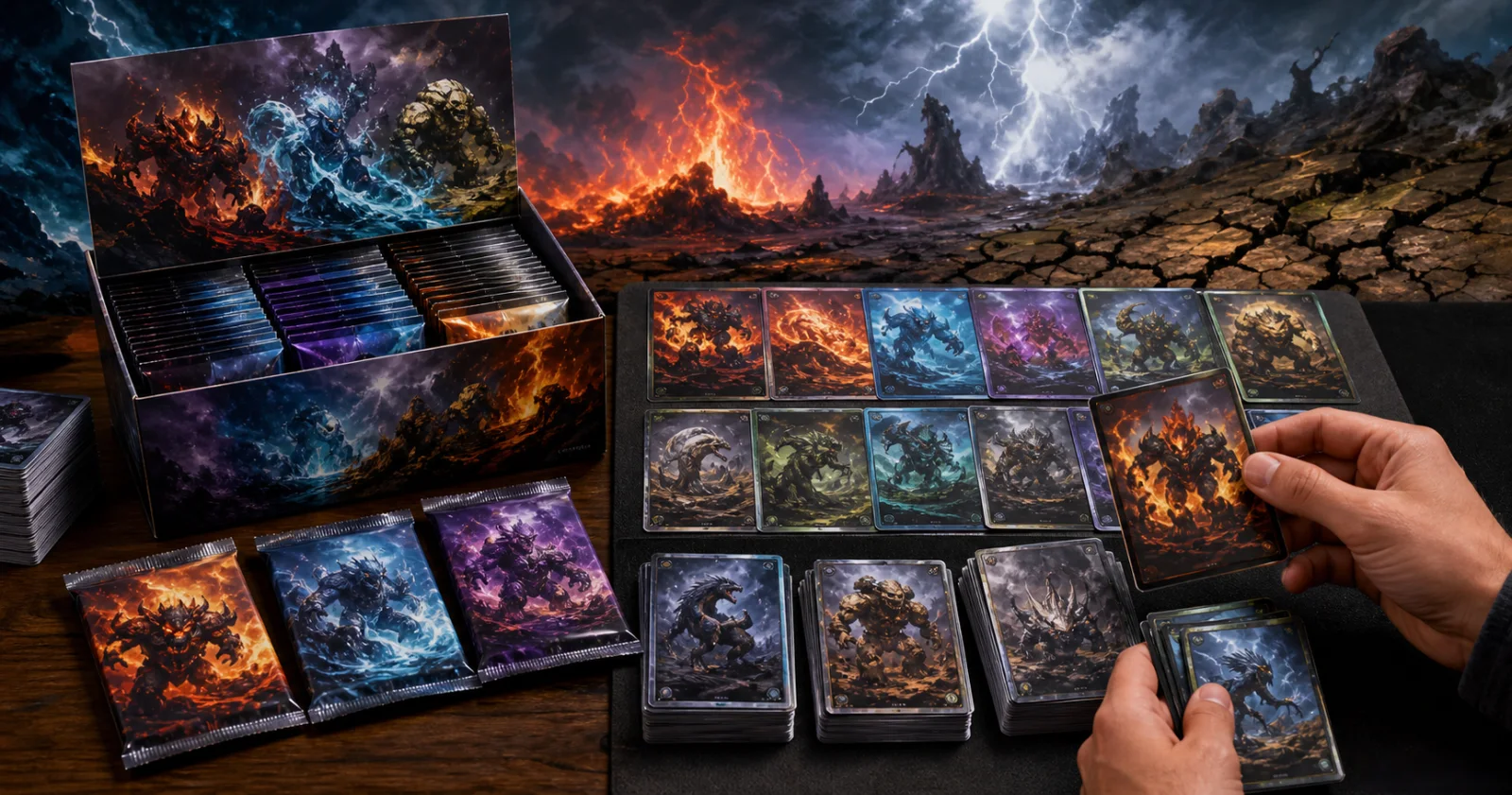
A chase gallery proves only that cards are being presented as examples unless the product separately establishes their eligibility and probabilities. Even a published tier percentage does not reveal one displayed card’s exact probability when multiple cards occupy that tier or the eligible pool can change.
A guaranteed floor is also not a distribution. It identifies a minimum promise if properly defined, but it says nothing by itself about the frequency of outcomes above that floor. A ceiling identifies a possible upper endpoint, not its concentration. The detailed online pack odds guide explains denominators and tier coverage, while the trading-card pack odds database preserves source-backed records for comparison.
Fixed runs and changing pools
The population record depends on what can change after the odds are published:
| Pool model | Evidence needed |
|---|---|
| Fixed run | A stable run ID, the production-run denominator, and rules for sales, removals, and cancellations. Changed contents require a new product version. |
| Changing pool | A timestamped denominator plus rules for replenishment, removal, reservation, substitution, and probability updates. |
Both models still need defined tiers measured in one common unit and coverage that reconciles to the whole distribution. If a table lists premium tiers but leaves out the ordinary tier, the missing share remains unknown.
Why chase concentration matters
Five featured cards are five promotions, not a concentration figure. Their share becomes measurable only when the product supplies applicable counts or probabilities. Record that evidence apart from the tier table; the images alone establish neither eligibility nor an exact-card probability.
Record both the number of chases and their disclosed concentration. If the seller supplies only images, score the evidence accordingly. The visual prominence of a card is not mathematical evidence.
PSA Verified reinforces the separation between controls and odds: its program reviews specified areas such as checklists, authenticity, randomization, packing, custody, and floor-or-ceiling claims for enrolled products, but PSA states that the program does not determine product probabilities.
Pokemon Mystery Pack Value Math
Expected value can be calculated only when the complete outcome distribution, reconciled probability for every outcome or class, identifiable population, and consistently measured card values are available. A floor, ceiling, selected chase list, or partial tier table cannot support the calculation. When any required input is missing, leave expected value unknown.
The basic structure is the sum of each outcome value multiplied by its probability. The arithmetic is easy; obtaining comparable inputs is the hard part. Values need to refer to the correct card, set, printing, language, condition, and grade at a stated observation date. Probabilities need to describe the same product population and cover it fully.
Do not insert a top advertised value, minimum value, and pack price into an improvised average. Those figures do not reveal the distribution between the endpoints. There is also no verified universal expected-value or return benchmark for third-party Pokémon repacks.
Market estimate, observed sale, and seller proceeds
TCGplayer’s price-point documentation distinguishes Market Price, based on recent completed TCGplayer transactions, from Listed Median, which is calculated from active listings. Condition and printing filters affect the displayed figures. An asking price is therefore not interchangeable with a completed sale.
Historical-sales tools can add context. Card Ladder provides searchable trading-card sales history, but an estimated present value modeled from an older transaction must still be labeled as an estimate rather than a directly observed sale.
A completed sale’s gross price is not the seller’s proceeds. TCGplayer’s fee examples separate item price, shipping, tax, marketplace commission, transaction fees, and total fees.
For that reason, “market estimate,” “observed sale,” “gross transaction price,” and “potential seller proceeds” should occupy separate fields. Collectors considering an exit can read the guide to selling sports cards online, while remembering that a published estimate is not a resale guarantee.
Physical vs. Online Pokemon Mystery Packs
A physical repack reaches the buyer as a sealed item. An online pack reveals a physical collectible while a platform controls the path to shipment or another permitted post-pull action. The useful comparison is therefore custody: when ownership begins, where the card sits, what shipment requires, and which return, substitution, trade, or sellback terms apply.
| Format | Questions that change the decision |
|---|---|
| Physical sealed repack | Who packed it? What tamper evidence is present? When does ownership transfer? Which shipping terms apply? What do the published terms cover for an unopened product, damage, or incorrect contents? |
| Online reveal | Who holds the card after the rip? Can it remain in a vault, ship to the owner, trade where enabled, or enter a stated buyback process? What fees, eligibility rules, and exceptions govern those paths? |
The card vault explainer covers the general custody concepts. Pullmarket’s specific operating paths belong in how Pullmarket works.
Pullmarket provides real physical collectibles, which may be raw/ungraded or third-party graded. Under Terms section 5.5, it uses hybrid fulfillment rather than 100% pre-stocked vault custody. Some cards are held in Pullmarket custody. Others are reserved against verified supplier inventory or partner-vault inventory and sourced on demand when redeemed.
If an exact card cannot be fulfilled as originally displayed, Pullmarket fulfills with the same item from another channel, a comparable collectible of equal or greater market value, or another remedy required by applicable law. That remedy should not be confused with a promise that every displayed card is already in one Pullmarket-controlled vault.
For every pull, the owner can hold the card in the Vault, ship the physical card, trade it where enabled, or sell it back to Pullmarket for a market-based buyback in Pullmarket Gems. Gems are non-cashable store credit, not cash or seller proceeds. No unverified shipment time, fee, return promise, or trade availability should be added to those terms.
Graded Pokemon Mystery Packs
A third-party grade supplies a recorded condition opinion and certificate number; it does not authenticate the entire mystery product. Compare the certificate record with the card, label, grade, and holder, inspect the physical item, and assess the product’s contents, probabilities, value method, and possession terms independently.
The useful distinction is narrower than “graded versus ungraded.” A raw pull leaves condition for the collector to assess directly. A slab supplies a grader’s assigned grade, which changes the relevant comparable sales, but says nothing by itself about how often that card can appear or what happens after the reveal.
The guide to graded and raw cards explains the condition tradeoff. For collector decisions beyond this mystery-pack audit, use the broader graded-card guide.
Card terminology must also stay tied to its actual category and set. For example, in ordinary Panini Prizm basketball, soccer, and post-2017 football sets, the standard rookie is the base-set card and Silver Prizm is an unnumbered parallel. The narrow 2016-17 Prizm Football exception gives rookie base cards a Silver-style finish and has no separate Silver rookie parallel. That sports-card exception has no role in identifying Pokémon parallels; it illustrates why a marketplace should not transfer another product line’s labels into Pokémon descriptions.
What certificate lookup can and cannot prove
A PSA certification lookup can confirm that a number matches PSA database information. PSA warns that this does not eliminate counterfeit risk because public certification numbers can be reused. Compare the database result with the card identity, label text, grade, holder, images, and any available provenance.
CGC offers a first-party certificate verification tool and publishes its CGC Guarantee. Review the current guarantee terms rather than treating the company name alone as blanket coverage.
The internal PSA vs. CGC vs. SGC comparison explains how grader standards and guarantees differ. A matching certificate record is useful evidence, not conclusive authentication of the physical item or holder.
What PSA Verified does not establish
PSA Verified describes controls for enrolled repack products, including checklist review, authenticity, randomization, packing, custody, and floor-or-ceiling review. It explicitly does not determine product probabilities. A PSA Verified mark therefore cannot replace a versioned probability table or justify an exact-card probability.
Randomization controls and probability disclosure perform different jobs. The first addresses how outcomes are assigned and controlled. The second tells the buyer how often defined outcomes occur within an identifiable population. Score them separately.
Who Should Buy Pokemon Mystery Packs?
Mystery packs fit collectors who value the surprise, set a firm spend ceiling, can accept the disclosed downside, and can verify all four critical disclosures. They fit poorly when the buyer needs one exact card, requires calculable expected value, or cannot determine what may be pulled, how probabilities work, how values were formed, or how possession works.
The collector who needs one specific card already knows the decisive constraint: identity. Buying the known single fixes that identity before purchase. A promoted chase does not do so, and its image supplies neither an eligible-pool boundary nor the card’s probability.
For a surprise-first collector, the reveal is part of the value. Set the spend ceiling, inspect the disclosed pool, and reject the product as not assessable if any critical field is missing. Once the gate passes, ask the practical question: would the disclosed range of outcomes still fit the collection?
An economics-first review stops when the population, complete distribution, or valuation method runs out. A floor and ceiling do not describe the middle, and an active asking price is not a completed sale. Slab preference adds a separate inspection job: match the grader, certificate record, card details, grade, and holder.
An online rip adds one buyer-specific check beyond the audit score: confirm the post-reveal path offered for that pack. Custody, shipment eligibility, enabled trade, substitution or remedy terms, and the form of sellback determine what the owner can actually do with the physical collectible.
Pullmarket lets collectors inspect the current category’s published odds and displayed examples before choosing a pack. Those fields support a disclosure check; Market Estimate is not guaranteed resale value or profit.
The category and applicable Terms were refreshed at 2026-08-28T04:40:07.651Z. Both returned HTTP 200; the category still exposed odds and Market Estimate language, while the Terms still documented section 5.5, supplier or partner-vault sourcing, hybrid fulfillment, trade only where enabled, and non-cashable Gems store credit.
That observation is dated evidence, not a permanent claim about the category page. Displayed examples do not establish availability, a complete pool, or an exact-card probability.



Browse online Pokemon card packs. New here? See how Pullmarket works.