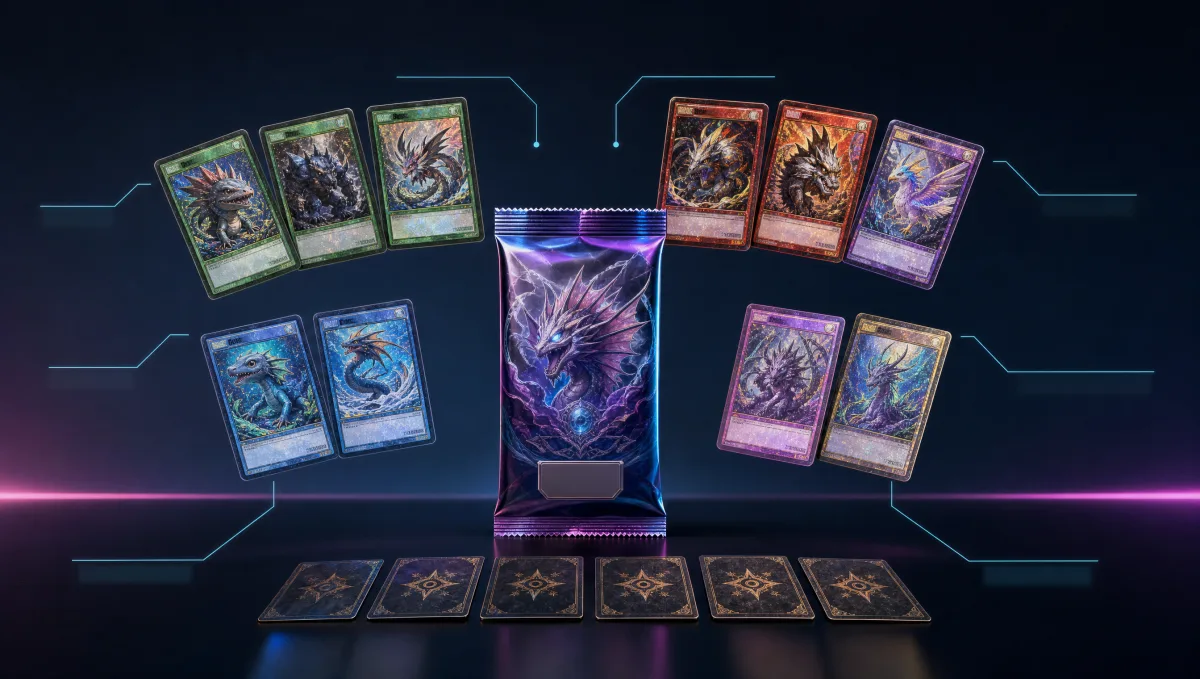
Pokémon Pack Pull Rates: How Odds Work and What Has the Best
The Pokémon Company has never officially published pull rates for English booster packs — every number you've seen was reverse-engineered from community samples. The "1 in 45 packs for a Special Illustration Rare in Prismatic Evolutions," the "1 in 86 for Chaos Rising," the "1 in 5 for an ex" — all of them come from collectors, content creators, and marketplaces like TCGplayer opening thousands of packs, tallying hits, and posting their methodology. That's the entire data layer the hobby runs on. This guide walks the modern Scarlet & Violet rarity ladder in plain English, ranks the 2024–2026 sets that actually pull the most chase cards (and the ones that don't), and is honest about variance — what "1 in 45" really means when you sit down with a booster box and crack the cellophane. A quick orientation note: this article covers the physical English TCG, not Pokémon TCG Pocket, the mobile game that contaminates the search results for this question.
Part of: Complete Pokémon Cards Guide — the pillar overview of every era from 1999 WOTC to the 2025 Mega Evolution Pokémon TCG.
How The Pokémon Company Decides What's in a Booster Pack
Among modern 2024–2026 English sets, Prismatic Evolutions (2025) carries the highest published Special Illustration Rare hit-rate at roughly 1 in 45 packs (per TCGplayer's 1,200-pack sample) — about double the SIR density of the prior set, Surging Sparks (~1 in 85–90). The Pokémon Company doesn't publish official rates for any of them. Every number is a community estimate.
A modern English Scarlet & Violet booster contains 10 cards in a fixed slot structure — what varies set-to-set is the weighting of the final "hit slot," and that weighting is exactly what The Pokémon Company doesn't publish. Pokémon Center prints the slot ratios on the back of every booster box and on its official product pages; the per-rarity probabilities inside the hit slot get inferred by community sampling.
The standard SV-era 10-card pack breaks down like this:
- Slots 1–4 — 4 commons (black-circle symbol)
- Slots 5–7 — 3 uncommons (black-diamond symbol)
- Slot 8 — 1 reverse holo of any common, uncommon, or rare
- Slot 9 — 1 rare or holo rare (black-star symbol)
- Slot 10 — the "hit slot" — Double Rare ex, Ultra Rare, Illustration Rare, Special Illustration Rare, Hyper Rare, or (in sets that include them) ACE SPEC, weighted by print run
The takeaway is simple. Every pack guarantees a slot-10 card from somewhere in that hit pool — but whether it's a $2 ex or a $300 SIR comes down to weights nobody officially publishes.
The Modern Rarity Ladder, in Plain English
The Scarlet & Violet ladder runs from common (every pack) to Hyper Rare / Gold (~1 in 100 packs). Special Illustration Rare is the widest band — anywhere from 1 in 32 on loaded special sets to 1 in 86 on tighter mainline sets — and is the row most "best rates" debates actually argue about.
The Scarlet & Violet rarity ladder added two tiers that didn't exist in the Sword & Shield era — Illustration Rare and Special Illustration Rare — and the chase-card conversation hasn't been the same since. Here's what the ladder looks like as community samples have averaged it across recent sets, with each row's source called out where a single methodology dominates.
| Rarity | Set-symbol look | Slot it lives in | Hit-density (SV-era average, community sources) |
|---|---|---|---|
| Common | Black circle | Slots 1–4 | every pack |
| Uncommon | Black diamond | Slots 5–7 | every pack |
| Rare / Holo Rare | Black star | Slot 9 | every pack |
| Double Rare (ex) | Two black stars | Hit slot | ~1 in 5 packs |
| Ultra Rare | Silver/gold star | Hit slot | ~1 in 9 packs |
| Illustration Rare (IR) | Gold star, full-art frame | Hit slot | ~1 in 10–12 packs |
| Special Illustration Rare (SIR) | Gold star, textured full-art | Hit slot | 1 in 32 to 1 in 86 packs depending on set |
| Hyper Rare / Gold | Black/gold textured | Hit slot | ~1 in 100 packs |
| ACE SPEC | Silver/red border | Hit slot | ~1 in 11 packs (sets that include them) |
Treat the row labels as averages across recent SV-era sets — each individual set falls within a wide band, and the spread on SIRs in particular (1 in 32 on the loaded special sets, 1 in 86 on tighter mainline sets) is the biggest source of "wait, my set wasn't that lucky" confusion in the hobby. TCGplayer publishes a per-set article for nearly every recent expansion with its own sample size disclosed — that's the most reliable place to confirm any specific number cited here.
Which 2024–2026 Sets Have the Strongest Hit Density
Prismatic Evolutions (2025) leads the modern era on Special Illustration Rare density at ~1 in 45 packs. Paldean Fates (2024) and Scarlet & Violet 151 (2023) round out the loaded special-set tier. Surging Sparks and Chaos Rising sit at the tight end (~1 in 85–86 SIR).
The leaderboard nobody in the top SERP results combines cleanly. These are the modern English sets with the highest published density of chase pulls — framed by hit-rate per booster slot, not by "best chance to win." Numbers are community-sampled; the source is named inline for each.
| Set | Release | SIR rate (community sample) | Why it ranks |
|---|---|---|---|
| Prismatic Evolutions | 2025 | ~1 in 45 packs | TPC roughly doubled the SIR rate vs prior sets (TCGplayer, 1,200-pack sample). Highest published rate of the modern era. |
| Paldean Fates | 2024 | Shiny-loaded special set | Every pack carries dense shiny output; SIR rates vary by source but consensus is "loaded." See our Charizard Paldean Fates guide for the per-card shiny picture. |
| Scarlet & Violet 151 | 2023 | Strong hit density | Nostalgia gen-1 reprint set with a high collector floor; see our Charizard 151 guide. |
| Mega Evolution | 2026 | ~1 in 5 packs for Double Rare ex | Modern Mega-era anchor set; see our Charizard UPC guide for the lineage context. |
| Phantasmal Flames | 2025 | Per-set rate published | Hyper Rare Charizard ex chase carries the set; see our Charizard Phantasmal Flames deep-dive. |
| Obsidian Flames | 2023 | Strong collector consensus | Solid hit density across collector picks; see our Charizard Obsidian Flames guide. |
And the toughest SIR rates of the modern era — included for honesty, because a "best rates" article that hides the hard sets isn't really telling you the story:
| Set | SIR rate (community sample) |
|---|---|
| Surging Sparks | ~1 in 85–90 packs |
| Chaos Rising | ~1 in 86 packs (per a 168-pack TCG Talk community sample — small sample, treat as anecdote-grade) |
| Twilight Masquerade | Tough (community consensus, no single dominant sample) |
| Paradox Rift | Tough (community consensus, no single dominant sample) |
Two notes on this leaderboard. First, special sets (Prismatic Evolutions, Paldean Fates, Crown Zenith) are intentionally print-structured with denser hits than main-series booster sets — don't compare a Prismatic SIR rate to a Surging Sparks SIR rate as if they're the same product. Second, every "loaded" call without a hard number is exactly that — a qualitative read from collector consensus, not a percentage to bank on.
What "1 in 45" Actually Means for One Rip
A 1-in-45 SIR rate across one 36-pack booster box of Prismatic Evolutions produces roughly 0.8 SIRs expected on average — meaning most boxes pull zero or one, a slice pull two, and the occasional run pulls three. The expected value isn't a guarantee; it's the long-run average across thousands of boxes.
A 1-in-45 SIR rate across one 36-pack booster box of Prismatic Evolutions produces roughly 0.8 SIRs expected on average — meaning most boxes pull either zero or one, a meaningful slice pull two, and the occasional run pulls three. The expected value isn't a guarantee; it's the long-run average across thousands of boxes. The chance of pulling a specific SIR — say, the one Eevee SIR you actually want from Prismatic's 32-card SIR pool — is closer to 1 in 1,440 packs. The chance of pulling any hit-slot card better than a Double Rare from a single pack sits around 1 in 6 to 1 in 10 depending on the set. None of these are coin flips.
Variance is the part most pull-rate articles skip. The same 1-in-45 SIR rate that produces 0.8 SIRs on average will produce zero SIRs in some boxes and three in others — both outcomes are statistically normal. One bad box is not evidence the set's rates are off; one great box is not evidence the set "got better." The rate is the long-run average, not a per-box promise.
Why The Pokémon Company Doesn't Publish Official Odds
TPC publishes pack slot structure (10 cards, 4/3/1/1/1 breakdown) — but never the per-rarity weights inside the hit slot. Sealed-box retailers don't publish odds either, because the manufacturer doesn't give them anything to publish. Every number you read online is reverse-engineered by a third party opening 1,000–5,000 packs.
The Pokémon Company publishes pack slot structure (on box backs and on Pokémon Center product pages) — the "10 cards, 4 commons, 3 uncommons, 1 reverse holo, 1 rare-or-better, 1 hit-slot card" guarantee — but it has never published the per-rarity weights inside the hit slot. Sealed-box retailers — Target, Walmart, Best Buy, Amazon, even most local card shops — publish nothing either, because the manufacturer doesn't give them anything to publish. The number a buyer sees on TCGplayer, on community wikis, on ScreenRant or PokéBeach, was reverse-engineered by a third party opening 1,000 to 5,000 packs of that set and counting the hits. That's the entire data layer.
This creates the central trust problem of physical pack-buying: the odds you read are an estimate with a confidence interval, not a guarantee, and the only people who know the real numbers don't talk. Larger samples narrow the band — TCGplayer's typical 1,200–2,000-pack methodology is the modern gold standard — but smaller samples (the 168-pack Chaos Rising estimate is a fair example) carry meaningful uncertainty that often goes unmentioned when the headline number gets reposted. The structural fix is to buy from a venue that publishes per-pack odds on the product page before purchase. That doesn't exist in sealed-box retail. It does exist in digital-first pack marketplaces — including Pullmarket — and it's the single biggest reason published-odds transparency matters in this hobby.
How to Read a Set's Pull-Rate Data Critically
Five literacy checks: confirm the sample size (≥1,200 packs for a useful estimate), confirm who opened them, separate the any-rarity rate from the specific-card rate, account for product type (special sets vs mainline boosters aren't comparable), and read the methodology page. If a number isn't sourced, don't trust it.
Most of the time you don't need to recompute anything — you just need to read a published rate with enough skepticism to know whether the headline number deserves the weight it's getting. Five quick literacy checks before you trust any "X has the best pull rates" claim:
- Check the sample size. A 168-pack sample is anecdote-grade; a 1,200–2,000-pack sample is the lower bound for a useful estimate. Bigger sample, narrower confidence interval.
- Check who opened the packs. TCGplayer, large content creators with verifiable opening footage, and pack-aggregator sites are the most reliable. A single Reddit thread or a "my buddy opened a case" anecdote isn't a methodology.
- Separate the any-SIR rate from the specific-SIR rate. A 1-in-45 set with 32 SIRs is still roughly 1-in-1,440 for the exact card you want. The headline rate gets you some SIR — not the one on your wishlist.
- Account for product type. Special sets (Prismatic Evolutions, Paldean Fates, Crown Zenith) are intentionally print-structured with denser hits than mainline booster sets. Don't compare across product types directly.
- Read the methodology page. Reputable sources publish their sample size and date. If a number isn't sourced, don't trust it — and don't repost it.
How Pullmarket Handles the Odds Problem
Every pack on the Pullmarket Pokémon catalog publishes its odds on the product page before purchase — full pre-purchase odds transparency. Every pull is a real third-party-graded card (PSA, CGC, or SGC) held in Pullmarket's insured custody or fulfilled through the Pullmarket Vault per Terms §5.5. Pullmarket Gems is store credit, not cash (Terms §9.1). Not a sweepstakes, lottery, or wagering product.
Pullmarket's structural answer to the "no published rates" problem is straightforward: every pack on the Pullmarket Pokémon catalog publishes its odds on the product page before purchase — full odds transparency, what the platform markets as "provably fair." Every pull is backed by a real third-party-graded physical card (PSA, CGC, or SGC), and per Terms §5.5 slabs are managed through the Pullmarket Vault workflow. Either way, what you pull is a real graded card. Per Terms §7, if the exact card pulled cannot be fulfilled as originally displayed, Pullmarket fulfills with the same item from another channel, a comparable collectible of equal or greater market value, or another remedy required by applicable law. The grading-cert lookups live on PSA and CGC — same workflow as any graded secondary purchase. Pullmarket Gems is store credit, not cash (Terms §9.1). Pullmarket isn't a sweepstakes, lottery, or wagering product — it's a marketplace for ripping packs of real graded cards with the odds disclosed up front. For the full operating-model walkthrough see is Pullmarket legit and how it works.
Pull Rates by Rarity — Quick Reference Card
SV-era averages: Double Rare ex ~1 in 5, Ultra Rare ~1 in 9, Illustration Rare ~1 in 10–12, Special Illustration Rare 1 in 32 to 1 in 86, Hyper Rare ~1 in 100. Use TCGplayer's per-set article for any specific set you're tracking.
A compact bookmarkable summary of where each modern rarity tier typically lands across the Scarlet & Violet era, with the source family for each row. Use TCGplayer's per-set article for the exact rate on any specific set you're tracking — these are SV-era averages, not promises:
- Double Rare (ex): ~1 in 5 packs — the bread-and-butter hit slot; nearly every modern set lands close to this rate. Source family: TCGplayer per-set samples.
- Ultra Rare: ~1 in 9 packs — gold-star full-arts of Trainers and supporters. Source family: TCGplayer per-set samples.
- Illustration Rare (IR): ~1 in 10–12 packs — the most-pulled "chase-tier" rarity. Source family: TCGplayer per-set samples.
- Special Illustration Rare (SIR): 1 in 32 to 1 in 86 packs — the biggest spread on the ladder. Loaded special sets (Prismatic Evolutions, ~1 in 45) sit near the top; tighter mainline sets (Surging Sparks, Chaos Rising, ~1 in 85–86) sit near the floor. Source family: TCGplayer per-set samples plus community aggregators.
- Hyper Rare (Gold): ~1 in 100 packs — gold-textured chase tier; the tightest of the regular rarities. Source family: TCGplayer per-set samples.
The single line worth remembering: the chase-tier ladder is wide. Two sets released a year apart can sit at the opposite ends of the SIR band, and "Pokémon pack odds" as a category isn't one number — it's a set of bands, per rarity, per set, all community-derived.
Ready to See the Odds Before You Rip?
Sealed-box retail can't tell you the odds. Pullmarket does. Browse the live Pokémon pack catalog with the per-pack odds in front of you, see exactly which graded slabs sit in each pack's possible-outcome pool, and decide per pack whether to rip, hold, or pass. Real cards. Real grades. Published odds.
Frequently asked questions
Across the modern English Scarlet & Violet era, Prismatic Evolutions (January 2025) carries the highest published Special Illustration Rare hit-rate — roughly 1 in 45 packs, per TCGplayer's 1,200-pack sample. Special sets like Prismatic Evolutions, Paldean Fates, and Crown Zenith are intentionally print-structured with denser hits than mainline booster sets. "Best" depends on which rarity tier you care about most — the leaderboard above ranks the modern 2024–2026 sets by community-sampled SIR rate, with the source named for each.
SIR rates in the Scarlet & Violet era range from roughly 1 in 32 packs on the loaded special sets to 1 in 85–86 on the tighter mainline sets like Surging Sparks and Chaos Rising. The any-SIR rate is the most-cited number; the specific-SIR rate — what's the chance of pulling the one SIR you actually want — is meaningfully harder because each set has 20–32 SIRs to allocate across. Treat every number as community-sampled, with the sample size posted by the source.
Illustration Rares land in roughly 1 in every 10–12 packs across modern Scarlet & Violet sets, making them the most-pulled chase-tier rarity. The exact rate varies by set; the most reliable check is TCGplayer's per-set pull-rate article for the specific set you're opening. As with SIRs, the headline rate gets you some IR — landing a specific one depends on the size of that set's IR pool.
Double Rare ex cards land roughly once every 5 packs in modern Scarlet & Violet sets — making them the most consistent "real hit" tier on the ladder. The ratio shifts with each set's card pool, especially in special sets where the ex slot can compete with Illustration Rare slots more aggressively. Mega-era sets like Mega Evolution and Phantasmal Flames hold close to the 1-in-5 community baseline per TCGplayer per-set samples.
No, not for English booster packs. The Pokémon Company publishes pack slot structure (the "10 cards, 4 commons, 3 uncommons, 1 reverse holo, 1 rare-or-better, 1 hit-slot card" guarantee on the back of every box) but has never published the per-rarity weights inside the hit slot. Every rate cited online is community-sampled — TCGplayer's typical 1,200–2,000-pack methodology is the modern gold standard. Retailers don't publish odds either, because the manufacturer doesn't give them anything to publish.
Two reasons. First, special sets like Prismatic Evolutions, Paldean Fates, and Crown Zenith are intentionally print-structured with denser hits than mainline booster sets — that's the product design, not luck. Second, the size of the chase-card pool dilutes per-card odds: a set with 32 SIRs has lower per-SIR odds than a set with 12, even at the same total SIR rate. Pull-rate comparisons across product types (special set vs mainline booster) aren't apples-to-apples — read each set on its own methodology.
Every pack on Pullmarket publishes its odds on the product page before purchase, and every pull is backed by a real third-party-graded card (PSA, CGC, or SGC) — managed through the Pullmarket Vault per Terms §5.5. Pullmarket Gems is store credit, not cash (Terms §9.1). It isn't a sweepstakes, lottery, or wagering product. The structural piece sealed-box retail can't match: retailers ship boxes whose per-pack odds even they don't fully know — Pullmarket posts them.
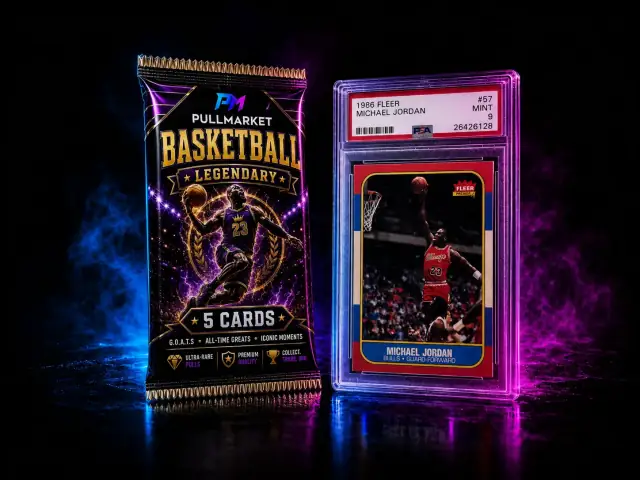


Pullmarket is an online collectible-card pack marketplace for instant online rips, graded-card chases, secure inventory, and shipping eligible cards to your door. Browse graded card packs online, or learn about Pullmarket LLC.