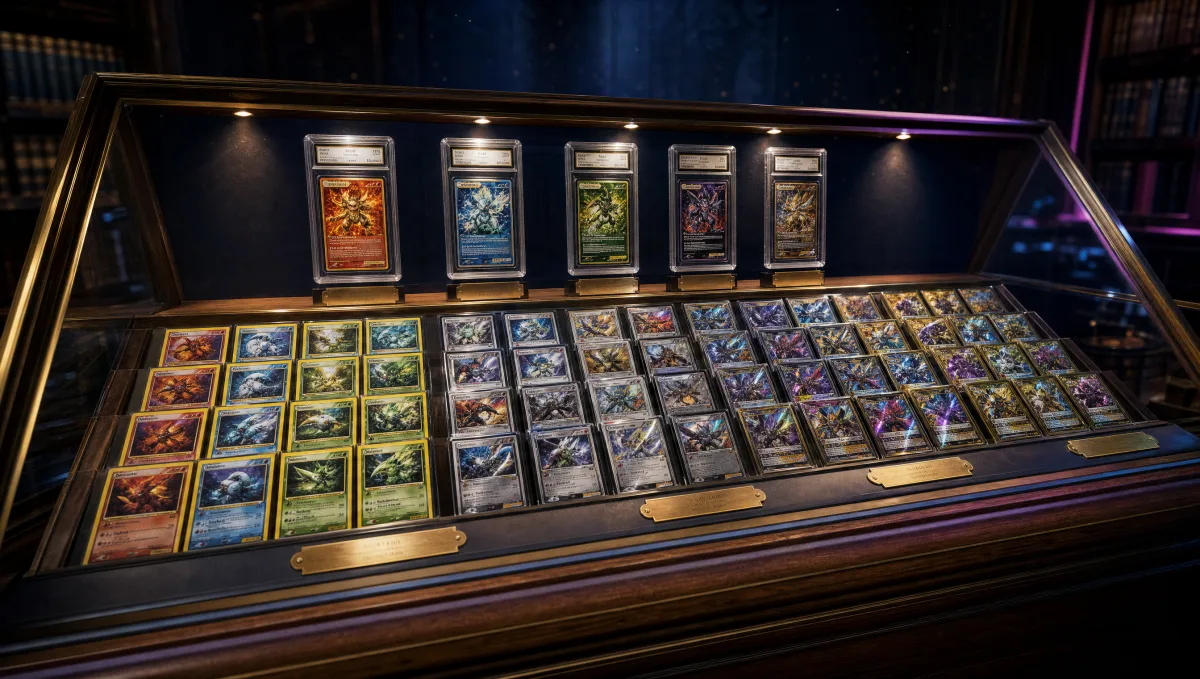
Pokémon Cards: Your Complete Guide to Sets, Rarities & Values
The Pokémon Trading Card Game has shipped continuously since its English-language launch in January 1999, spanning 12 distinct eras, more than 100 main expansions, and the freshly-launched Mega Evolution series that started in autumn 2025 with Phantasmal Flames. If you've searched "pokemon cards" in 2026, you've landed on a SERP that is almost entirely retailers and shopping carousels — useful if you want to add a booster to a cart, useless if you actually want to understand the hobby. This pillar is the orientation page that retailer SERP doesn't write: every era at a glance, how sets and product SKUs work, what rarity symbols actually mean, how value gets set, why Charizard dominates, what pull rates look like in 2026, the vintage WOTC market, grading basics, and a closing how-to-start for new collectors. Each section is the high-level synthesis; for the deep dive on any specific topic, this page hands you off to one of the 20 Pokémon articles already published in Pullmarket's /learn/ hub. Pullmarket — operated by Pullmarket LLC — covers Pokémon as part of an online pack-opening platform where every pull is a real, third-party-graded slab. The pillar is here for orientation, not the upsell.
What Pokémon Cards Actually Are (and Why People Collect)
Pokémon cards are the cards from the Pokémon Trading Card Game (TCG), launched in Japan in October 1996 and in English in January 1999 by Wizards of the Coast. Roughly 12 distinct eras have shipped since — WOTC, Gym/Neo, E-Card, EX, Diamond & Pearl, Platinum/HGSS, Black & White, XY, Sun & Moon, Sword & Shield, Scarlet & Violet, and the current Mega Evolution era — across more than 100 main English expansions plus dozens of promos. Collectors chase three things: set completion, favourite-character variants (especially Charizard), and graded high-grade copies of vintage and modern flagship cards.
Pokémon cards are the trading-card component of the Pokémon Trading Card Game — a two-player TCG launched in Japan in October 1996 by Media Factory and brought to the English-speaking market in January 1999 by Wizards of the Coast (WOTC). Since 2003, the game has been published worldwide by The Pokémon Company International, the licensing arm jointly owned by Nintendo, Game Freak, and Creatures Inc. Every modern booster ships under the official Pokémon TCG portal at pokemon.com, and product release calendars and SKU pages live at pokemoncenter.com.
Three motivations drive every Pokémon-card buyer in 2026. Players buy boosters and Battle Decks to build competitive decks for the Pokémon TCG and TCG Live. Collectors chase set completion (a binder of every card from Phantasmal Flames, or every card from the 1999 Base Set), specific characters (the Charizard-only collector, the Eeveelution completionist), or specific art styles (the Special Illustration Rare collector who only chases the modern alt-art tier). Chase-card hunters focus on the trophy slabs — 1st Edition Shadowless Charizard, Pikachu Illustrator, modern Special Illustration Rares — usually in graded form. This pillar is for the second and third groups; if you're here to play, the TCG rules pages on pokemon.com are the better starting point.
The 2026 context matters. The Mega Evolution era launched in autumn 2025, Phantasmal Flames shipped November 14, 2025, and 30th-anniversary product is dominating the 2026 release calendar. Hobby participation is still at the elevated levels it hit during the 2020–2021 boom, secondary-market pricing has matured rather than crashed, and pack-opening as a digital-first experience — Pullmarket included — is now a real fourth path alongside playing, collecting, and chasing. Every pull on Pullmarket's Pokémon pack catalog is a real, third-party-graded physical card.
Pokémon Card Eras at a Glance (1999 → 2026)
The Pokémon TCG is best understood as 12 eras rather than 100+ individual sets — WOTC (1999–2000), Gym/Neo (2000–2002), E-Card (2002–2003), EX (2003–2007), Diamond & Pearl (2007–2009), Platinum/HGSS (2009–2011), Black & White (2011–2013), XY (2014–2016), Sun & Moon (2017–2019), Sword & Shield (2020–2023), Scarlet & Violet (2023–2025), and the current Mega Evolution era (2025–present).
The Pokémon TCG is best understood as 12 eras rather than 100+ individual sets. Each era is defined by a publisher transition or a mechanic shift — WOTC printing through 2003, EX-tier Pokémon arriving in 2003, V/VMAX during Sword & Shield, ex returning during Scarlet & Violet, and Mega Evolution ex anchoring the current era. The table below is the synthesis Wargamer and Bulbapedia don't publish in one block; for the full chronological set list with release dates, Wikipedia maintains the official catalogue and Bulbapedia keeps the encyclopaedic per-set pages.
| Era | Years | Representative sets | Best-known chase cards | Signature mechanic |
|---|---|---|---|---|
| WOTC / Base | 1999–2000 | Base Set, Jungle, Fossil, Team Rocket | 1st Edition Shadowless Charizard | Hologram rares |
| Gym / Neo | 2000–2002 | Gym Heroes, Gym Challenge, Neo Genesis–Destiny | Neo Genesis Lugia | Neo era introduced 2nd-generation Pokémon |
| E-Card | 2002–2003 | Expedition, Aquapolis, Skyridge | Skyridge Charizard Crystal | E-Reader codes on cards |
| EX | 2003–2007 | EX Ruby & Sapphire → EX Power Keepers | Gold Star Pokémon, EX Dragon Frontiers Charizard | Pokémon-ex (2 prizes) |
| Diamond & Pearl | 2007–2009 | Diamond & Pearl, Stormfront | Stormfront Charizard, LV.X cards | Pokémon LV.X |
| Platinum / HGSS | 2009–2011 | Platinum, Arceus, HeartGold SoulSilver, Call of Legends | Lost Link Lugia, shiny variants | LEGEND cards |
| Black & White | 2011–2013 | Black & White, Plasma Blast | Full-Art Trainers, Charizard EX | Pokémon-EX (full-art) |
| XY | 2014–2016 | XY, Evolutions, Generations | Evolutions Charizard, Mega EX | Mega Evolution + BREAK |
| Sun & Moon | 2017–2019 | Sun & Moon, Hidden Fates, Cosmic Eclipse | Hidden Fates Shiny Charizard GX, Tag Team Charizard & Reshiram | Pokémon-GX, Tag Team |
| Sword & Shield | 2020–2023 | Sword & Shield, Champion's Path, Evolving Skies, Crown Zenith | Champion's Path Shiny Charizard V, Evolving Skies Rayquaza VMAX Alt Art | V, VMAX, VSTAR, Alt Art era |
| Scarlet & Violet | 2023–2025 | Scarlet & Violet, 151, Obsidian Flames, Paldean Fates, Surging Sparks | 151 Charizard SIR, Obsidian Flames Charizard ex, Paldean Fates Shiny Charizard ex | Pokémon ex returns, Special Illustration Rare + Illustration Rare |
| Mega Evolution | 2025–present | Phantasmal Flames, Mega Evolution, Destined Rivals, Journey Together | Mega Charizard X ex (MEP #023), Phantasmal Flames Charizard Hyper Rare | Mega Evolution ex |
Two patterns are worth naming. First, Charizard headlines almost every era — that's not coincidence; it's the most-collected character in the hobby and the deliberate flagship-character The Pokémon Company leans on for high-MSRP product. Second, mechanic names cluster by era: V/VMAX cards are Sword & Shield; ex (lowercase) means Scarlet & Violet onward; EX (uppercase) is the 2003–2007 or 2011–2013 vintage; GX is Sun & Moon. If a single card says "EX" or "ex," its capitalization tells you within a five-year window when it was printed.
For the full set-by-set breakdown including price-by-set charts on the original WOTC era — Base Set, Jungle, Fossil, Team Rocket, Gym, Neo — see the Pokémon original sets guide.
How Sets Work — Boosters, ETBs, UPCs, Premium Collections, Set Codes
The Pokémon TCG ships in roughly six retail SKU shapes — booster pack (~$5), booster box (36 packs, ~$160), Elite Trainer Box (8–10 packs + accessories, ~$50), Premium Collection (~$40), Ultra Premium Collection (16–18 packs + playmat + promos, ~$120), and the smaller tins, blisters, and Battle Decks. Set codes printed in the lower-left identify the source set on every modern card.
The Pokémon TCG ships in roughly six retail SKU shapes, each at a different price point and pack count. Knowing which SKU you're looking at is the first step in any buying decision — a $40 Premium Collection and a $120 Ultra-Premium Collection are very different products, and retailer listings frequently blur the line.
- Booster pack — 10 cards (modern Pokémon TCG packs ship with 10 cards, down from 11 in older eras), 1 guaranteed reverse holo, 1 guaranteed rare-or-better, ~$5 MSRP. The atomic unit; every other SKU is a bundle of these plus accessories.
- Booster box — 36 packs of a single set. ~$160 MSRP modern, climbing on secondary for popular sets. The set-completion vehicle for serious collectors.
- Elite Trainer Box (ETB) — 8–10 boosters + 65 sleeves + energy cards + dice + code card. ~$50 MSRP. The casual-buyer SKU; the playmat-less mid-tier.
- Premium Collection — boxed promo + 4–6 packs + smaller accessories. ~$40 MSRP. Built around a single foil promo card.
- Ultra Premium Collection (UPC) — flagship boxed product: 16–18 packs + 2–3 etched / foil promos + full-size playmat + 65 sleeves + deck box + coin + dice. ~$120 MSRP. The Charizard-themed UPC line is the headline example — see the Charizard UPC guide for every Charizard UPC from 2022 through 2025.
- Special collections, tins, blister packs, theme decks, Battle Decks — secondary SKUs at $15–$30 each, usually built around 1–4 packs plus a fixed promo or playable deck.
SWSH260 means Sword & Shield Black Star Promo #260. MEP #023 means Mega Evolution Promos #023 (the 2025 Mega Charizard X ex). OBF means Obsidian Flames. 151 means Scarlet & Violet 151. Memorising the prefix system lets you identify what's in your hand without looking at a listing title.
For modern pack-buying advice on what's actually worth opening right now, see the best Pokémon pack to buy guide and the deep dive on the most-loved set of the modern era, the Pokémon 151 pack guide.
The Rarity Hierarchy, in Plain English
A Pokémon card's rarity is encoded in the symbol in its lower-right corner — black circle (Common), black diamond (Uncommon), black star (Rare), then a splintering modern tier system (Holo Rare, Ultra Rare, Secret Rare, Illustration Rare, Special Illustration Rare, Hyper Rare). The symbol tells you which slot a card occupies; market rarity depends on print run and era.
A Pokémon card's rarity is encoded in the symbol in its lower-right corner. Black circle = Common. Black diamond = Uncommon. Black star = Rare. From there it splinters by era: Holo Rare, Ultra Rare, Secret Rare, Hyper Rare, Special Illustration Rare, and an expanding modern tier system that adds Illustration Rare and Special Art Rare on Japanese prints. The canonical rarity-symbol reference is CGC's rarity guide and Bulbapedia's rarity index; neither is worth trying to leapfrog as the authoritative taxonomy page — link to them, then differentiate on what's actually rare in market terms.
| Tier | Symbol (modern) | Era introduced | Typical pull rate | Notable examples |
|---|---|---|---|---|
| Common | Black circle | Base Set 1999 | ~6 per pack | Most basic Pokémon |
| Uncommon | Black diamond | Base Set 1999 | ~3 per pack | Most Stage 1 Pokémon |
| Rare | Black star | Base Set 1999 | 1 per pack guaranteed | Non-holo Stage 2 Pokémon |
| Holo Rare | Black star + holo | Base Set 1999 | ~1 in 3 packs | Base Set Charizard |
| Ultra Rare | Multi-star / mechanic-tier | EX era 2003 | low single-digit % | V, VMAX, ex, GX, EX |
| Secret Rare | Beyond set numbering | Various | ~1 in 36 packs | Gold-bordered cards, rainbow rares |
| Illustration Rare | Modern art-tier | Scarlet & Violet 2023 | low single-digit % | Full-art alt prints |
| Special Illustration Rare (SIR) | Modern flagship art-tier | Scarlet & Violet 2023 | very low single-digit % | 151 Charizard SIR, Paldean Fates Shiny ex |
| Hyper Rare | Gold/rainbow-bordered | Various | very low single-digit % | Phantasmal Flames Charizard Hyper Rare |
A note on real-world rarity: the pull-rate column above is conceptual — exact published rates by set live in the Pokémon pack pull rates guide, the satellite that is the source of truth for any specific rate claim. The rarity symbol tells you the slot a card occupies; the rarity in market terms depends on print run, era, and how many copies have made it to grading services. A modern Special Illustration Rare with a 1-in-50-pack pull rate is structurally less rare than a 1999 1st Edition Holo with a similar pull rate, because 1999 print runs were orders of magnitude smaller.
For the actual rarest cards in the hobby — Pikachu Illustrator, the Trophy promos, Prerelease Raichu, the No. 1–3 Trainer cards, and the misprint cornerstones — see the rarest Pokémon cards guide.
How Pokémon Card Values Actually Work
A Pokémon card's market value is the product of three drivers working together: print run (vintage WOTC is structurally scarce; modern flagships ship in millions), grade (PSA 10 vs PSA 9 can be a 5–20× gap on chase cards), and character + art + cultural moment (Charizard always commands a premium across every era). No single driver explains a card's price.
A Pokémon card's market value is the product of three drivers working in combination — not any one of them alone. A common 1999 Base Set card in played condition is worth pennies; the same card in a PSA 10 slab can be worth $200+. A modern Charizard Special Illustration Rare with a high-million print run can be worth $300 raw and $1,200 in PSA 10. The framework is consistent across the hobby:
- Print run. Vintage WOTC (especially 1st Edition) is structurally scarce — Base Set 1st Edition shipped in tiny volumes relative to modern Scarlet & Violet runs. Modern Special Illustration Rares ship in the millions but have low pull rates per pack, which keeps individual-card scarcity high on the chase tier even when the set itself is overprinted.
- Grade. PSA 10 vs PSA 9 can be a 5–20× value gap on chase cards. The 1999 Base Set 1st Edition Shadowless Charizard sells in the low five figures in PSA 9 and high five figures (occasionally six) in PSA 10. Cert numbers resolve at psacard.com, cgccards.com, and gosgc.com.
- Character + art + cultural moment. Charizard always commands a premium across every era. Eeveelution Special Illustration Rares (Sylveon, Umbreon, Espeon from Evolving Skies) are character-driven. Alt-art Trainers (Arven, Iono, Penny from Scarlet & Violet) are character-and-art-driven. A "what is this card worth" answer always asks: what character, what art tier, what cultural moment.
For real-time comp tracking, the hobby's primary pricing-data sources are Card Ladder (rolling sale-by-sale data with cohort filters) and Beckett's pricing database. Neither is a perfect oracle, but both beat a single eBay sold-listing for any serious decision. A note on volatility: card values move. Estimates here are not guarantees, and nothing in this pillar should be read as investment advice — collect because you want the cards, then enjoy the upside if it materialises.
For the top trophy-tier cards by historical sale price — from $5M+ Pikachu Illustrator down through the modern $30k Hyper Rare flagships — see the most expensive Pokémon cards guide.
The Charizard Story — Why One Character Dominates the Hobby
Charizard is the most-collected Pokémon character in the trading-card hobby, full stop. Every era from 1999 forward has shipped at least one flagship Charizard product. The 1st Edition Shadowless Base Set Charizard is the icon of the entire hobby; the 2025 Mega Charizard X ex (MEP #023) is the icon of the current era. Pullmarket's 13-article Charizard sub-cluster covers the lineage exhaustively.
Charizard is the most-collected Pokémon character in the trading-card hobby, full stop. Searches for "Charizard" and Charizard-variant terms consistently account for the largest share of any single character's search volume across both Ahrefs and Google Trends data, and every era from 1999 forward has shipped at least one flagship Charizard product — Base Set Holo, Skyridge Crystal, Stormfront, Evolutions, Hidden Fates Shiny GX, Champion's Path Shiny V, 151 Special Illustration Rare, Obsidian Flames ex, Paldean Fates Shiny ex, Phantasmal Flames Hyper Rare, and now Mega Charizard X ex in the 2025 Mega Evolution era. The 1st Edition Shadowless Base Set Charizard is the icon of the entire hobby; the 2025 Mega Charizard X ex (MEP #023) is the icon of the current era. Pullmarket's 13-article Charizard sub-cluster covers the lineage exhaustively — the table below is the single strongest internal-link surface on the entire pullmarket.io domain.
| Topic | Satellite article |
|---|---|
| The full set-by-set Charizard lineage (parent of the sub-cluster) | Charizard Pokémon Card: Complete Set-by-Set Guide |
| Charizard ex — modern Scarlet & Violet variants | Charizard ex Guide |
| Charizard VMAX — Sword & Shield era flagship | Charizard VMAX Guide |
| Shiny Charizard — every shiny print | Shiny Charizard Guide |
| Mega Charizard ex — 2025 Mega Evolution era | Mega Charizard ex Guide |
| Rainbow Charizard — rainbow rare variants | Rainbow Charizard Price Guide |
| 1st Edition Charizard — the WOTC grail | 1st Edition Charizard Guide |
| Base Set Charizard — Shadowless, Base Set 2 | Base Set Charizard Guide |
| Charizard in the Scarlet & Violet 151 set | Charizard 151 Guide |
| Charizard Obsidian Flames | Charizard Obsidian Flames Guide |
| Charizard Paldean Fates — shiny ex | Charizard Paldean Fates Guide |
| Charizard Phantasmal Flames — Hyper Rare + Mega | Charizard Phantasmal Flames Guide |
| Charizard Ultra Premium Collection — every box 2022 → 2025 | Charizard UPC Guide |
If you're a Charizard-only collector, the parent guide is the starting point and the 12 variant-specific articles fill in the era-by-era and product-by-product depth. If you're orienting on the hobby generally, the takeaway is simpler: any era's flagship Charizard is the highest-demand card of that era, and the gap between PSA 9 and PSA 10 on a Charizard is consistently among the widest grade-spread multiples in the hobby. For the buyer-perspective takeaway: a Charizard is rarely the "value EV" pick in a sealed box, but it's almost always the chase card that anchors the box's secondary market.
Pull Rates — What to Actually Expect From a Pack
A modern 10-card Pokémon booster pack is built around roughly six commons, three uncommons, one reverse holo, and one rare-or-better. Most packs you open will yield exactly one card you'd call "interesting" — the rare slot — and the rest is set-completion filler. Chase cards (Special Illustration Rare, Hyper Rare, Mega Evolution ex) sit at low single-digit percent pull rates per pack.
A modern 10-card Pokémon booster pack is designed around a roughly fixed slot structure: about six commons, three uncommons, one reverse-holo, and one rare-or-better. Most packs you open will yield exactly one card you'd call "interesting" — the rare-slot card — and the rest is set-completion filler. The chase cards (Special Illustration Rare, Hyper Rare, Mega Evolution ex) sit at low single-digit percent pull rates per pack, with some sets (Paldean Fates and 151 in particular) running noticeably elevated chase odds and some (Obsidian Flames) on a standard distribution. Specific published rates by set live in the Pokémon pack pull rates guide — the pillar deliberately stays at the conceptual level because pull-rate numbers move when The Pokémon Company adjusts print mixes between print waves.
A few honest framings that retailers won't say out loud:
- Most packs do not contain a chase card. A single $5 booster has, conceptually, low single-digit percent odds of yielding a flagship card. That's the math at retail.
- The "god pack" is a real but rare anomaly. A god pack is a booster where every card in the slot structure is a holo or rare — extremely rare on modern distributions, with documented examples on hobby forums and YouTube. See the Pokémon god pack explainer for the deeper breakdown.
- Pull rates vary by set within an era. Within Scarlet & Violet alone, Obsidian Flames pulled on a roughly standard ex/SIR distribution while Paldean Fates was structured around a higher shiny-pull frequency. Always check the per-set rate before deciding what to open.
- Pack distributions can shift between print waves. A set printed in November and reprinted in February can pull differently; community pull-rate datasets average across all waves and smooth this out.
For the buyer's takeaway: pack-opening is for the experience and the chance at a chase. Singles purchase via TCGplayer or eBay always beats pack-opening on dollar-efficiency for set completion, period. If you want a specific card, buy it. If you want the rip, rip a pack.
Buying Packs in 2026 — What's Actually Worth Opening Right Now
The 2026 pack-buying landscape splits across three buyer types — chase-card hunters (Phantasmal Flames, Mega Evolution), set-completion collectors (151 for nostalgia, Paldean Fates for shinies, Obsidian Flames for Charizard ex), and pure rip-experience buyers (Pullmarket's published-odds packs). Singles purchase beats pack-opening on dollar-efficiency; pack-opening is for the experience.
The 2026 pack-buying landscape splits cleanly across three buyer types — chase-card hunters, set-completion collectors, and pure rip-experience buyers — and each maps to a different set. The honest read on what's worth opening right now, as of May 31, 2026:
- For Mega Evolution era flagships: Phantasmal Flames (released November 14, 2025) and Mega Evolution are the chase. The headline card is Mega Charizard X ex (MEP #023) from the 2025 Ultra-Premium Collection, with the Phantasmal Flames Charizard Hyper Rare as the in-set chase. See the Charizard Phantasmal Flames guide and the Mega Charizard ex guide.
- For Scarlet & Violet era set-completion: 151 remains the most collector-beloved set of the modern era — the original 151 Pokémon in a single set hits a nostalgia chord no other modern release matches. Paldean Fates is the shiny-chaser set; Obsidian Flames carries the most-loved Charizard ex of the era. See the Pokémon 151 pack guide, the Charizard Paldean Fates guide, and the Charizard Obsidian Flames guide.
- For Charizard ex modern hunters: the Charizard ex guide walks every modern ex print, and the 151 Charizard guide covers the 151-set Charizard variants.
- For pure pack-EV skeptics: singles purchase via TCGplayer or eBay beats pack-opening on dollar-efficiency, period. Pack-opening is for the experience and the chance at a chase, not for set completion.
- For the rip experience without buying a $120–$200 sealed UPC: Pullmarket's Pokémon pack catalog rips real graded singles into your account against verified inventory, with published per-pack odds before purchase.
For the full 2026 set-by-set buyer's verdict — every set rated for what to open right now versus what to skip — see the best Pokémon pack to buy guide.
Vintage WOTC Collecting — Base Set Through Neo Destiny
The WOTC era — Wizards of the Coast as the English-language publisher from January 1999 through Neo Destiny in 2003 — is the icon period of Pokémon collecting. Sealed Base Set Unlimited boosters trade in the $300+ range in 2026; 1st Edition boxes are $20k+ when they surface. 1st Edition stamps and Shadowless variants carry the premium; common Unlimited prints in played condition are usually worth a few dollars.
The WOTC era — Wizards of the Coast as the English-language publisher from January 1999 through Neo Destiny in 2003 — is the icon period of Pokémon collecting. Sealed Base Set Unlimited boosters trade in the $300+ range on the open market in 2026; 1st Edition Base Set boosters are multiples higher; sealed booster boxes from the 1st Edition wave are $20k+ when they surface at all. The print-run dynamics that make 1st Edition Shadowless Charizard the icon of the entire hobby are simple: 1999 print runs were tiny relative to even modest modern reprints, every surviving copy has weathered 27 years of handling, and only a fraction of the originally printed population has survived in mint condition.
A few honest framings for the vintage market:
- 1st Edition matters most. The 1st Edition stamp (lower-left of the card art) marks the original print run; Unlimited prints (no stamp) came after. 1st Edition Shadowless Charizard is the grail; Unlimited Shadowless and then Unlimited prints follow in descending order.
- Authentication is non-trivial. Sealed pack authentication requires weight checks, wrapper-stamp analysis, and ideally provenance. Resealed packs (a pack opened, the best card swapped, then heat-sealed back to look factory) are a real and growing market problem. Buy from reputable sealed-pack dealers with returns, never from a random eBay listing without a track record.
- Graded singles are easier than sealed. A PSA-certified 1st Edition Shadowless Charizard with a verifiable cert at psacard.com is dramatically easier to buy safely than a sealed pack that might be resealed. For most vintage buyers, graded singles are the safer path.
- Common vintage isn't valuable. A played-condition 1999 Base Set Squirtle is worth a few dollars. Vintage Charizard, vintage holos, and 1st Edition stamps carry the premium; the rest of the era is mostly modest.
For the deep dive on opening sealed vintage WOTC packs today, see the Pokémon original sets guide. On the WOTC Charizard grail itself, see the Base Set Charizard guide and the 1st Edition Charizard guide.
Grading Basics — PSA, CGC, SGC, BGS
Grading is the process of submitting a raw card to a third-party authentication service, which encapsulates ("slabs") the card in a sealed acrylic holder and assigns it a 1–10 condition grade. Grading authenticates the card and locks in verified condition — letting buyers price off a single number. PSA is the industry leader; CGC, SGC, and BGS are the other major options. Roughly $15–$25 per card at standard tiers.
Grading is the process of submitting a raw card to a third-party authentication and grading service, which encapsulates ("slabs") the card in a sealed acrylic holder and assigns it a 1–10 condition grade. Grading does two things: it authenticates the card (counterfeit-proof), and it locks in a verified condition — which lets buyers price the card off a single number rather than negotiating subjective "near-mint" claims.
- Why grade? Authentication (the grader certifies the card is real), condition lock-in (a PSA 10 is unambiguous), and resale premium on high grades. A raw "near-mint" Base Set Charizard sells for one number; a PSA 10 sells for many multiples of that number.
- The major graders: PSA is the industry leader with the longest tenure on Pokémon and the deepest market acceptance. CGC is strong on vintage with growing modern share. SGC is fast, growing market share, and well-regarded on sports. BGS (Beckett Grading Services) is declining on TCG but historically the authority on subgrade detail.
- The 1–10 scale. A PSA 10 (Gem Mint) is a flawless example; PSA 9 (Mint) is near-flawless with minor imperfections; PSA 8 (NM-Mint) is solid but visible flaws. The single-point gap between PSA 9 and PSA 10 can be a 5–20× value swing on chase cards because true Gem Mint population stays small.
- Cost framing. Roughly $15–$25 per card grading fee at PSA's standard service tiers, plus inbound and outbound shipping. Only worth grading if expected resale price exceeds the all-in grading cost.
- Cert verification. Every legitimate slab carries a cert number that resolves on the grader's own website. PSA cert lookup at psacard.com, CGC at cgccards.com, SGC at gosgc.com. If a seller can't produce a working cert lookup for a graded copy, do not buy.
Pullmarket's model is built around graded ownership: every pull is a real third-party-graded slab held in Pullmarket's own insured custody or fulfilled through the Pullmarket Vault per Terms §5.5. The full Vault workflow disclosure lives at Is Pullmarket Legit?, and a dedicated grading-101 guide will ship as part of a forthcoming wave.
How to Start Collecting Pokémon Cards in 2026
The fastest way to lose money in Pokémon-card collecting is to spend $500 in your first month with no plan. The fastest way to build a collection you love is six or seven small, deliberate decisions before spending anything — pick a goal, anchor an era, set a budget, protect everything from day one, buy singles for known wants, grade only when the math works, and track everything.
The fastest way to lose money in Pokémon-card collecting is to spend $500 in your first month with no plan. The fastest way to build a collection you actually love is to make six or seven small, deliberate decisions before spending anything. The closing how-to:
- Pick a goal. Set completion (every card from one set), character chase (every Charizard, every Eeveelution), era anchor (every Base Set holo), modern flagships (every Special Illustration Rare from Scarlet & Violet), or play (build a competitive TCG deck). Different goals → different budgets. Don't pretend you'll do all five.
- Pick an era to anchor. Modern (Mega Evolution / Scarlet & Violet) for affordability and active product. Vintage WOTC for icon collecting and long-horizon hold. Sun & Moon era shinies (Hidden Fates especially) for under-appreciated value. Sword & Shield Evolving Skies for alt-art chase. Each era has its own buy-in and its own market dynamics.
- Set a budget. Hobby norm for casual collectors is $50–$200 per month. Grail-chasers go higher; play-focused buyers might spend less. Whatever the number, write it down — collection-level spend discipline beats impulse-rip discipline every time.
- Protect everything from day one. Penny sleeves on any card worth $1+. Toploaders on any card worth $10+. Binders or one-touches for chase cards. A $50 Special Illustration Rare in a binder is worth $50; the same card loose in a deck box for two months is worth $30.
- Buy singles for known wants; rip packs for experience. Don't try to chase a $300 Charizard SIR with $300 of boosters — buy the single from TCGplayer. Rip packs because you want the rip, not because you think you'll EV your way to set completion. (Pullmarket's pack catalog is built around exactly this distinction — the experience of opening a pack with published odds, and a real graded slab as the outcome.)
- Grade only when the math works. A $40 card at PSA 9 might net $50 after grading fees and shipping — barely worth it. A $200 card that grades PSA 10 frequently doubles. Be surgical; grade the chase, not the bulk.
- Track everything. Card Ladder, PriceCharting, or a simple spreadsheet — collection-level visibility prevents impulse spend and surfaces sell decisions you'd otherwise miss. A collector who knows what they own at PSA-10 comp values makes better buy/hold/sell calls than one who just remembers buying things.
Pullmarket is built around step 5 — rip packs because you want the rip, then hold the pull in the Vault, ship the physical slab home, trade it, or sell it back to Pullmarket for store-credit Gems. Every pack publishes its odds before purchase, and every pull is a real third-party-graded slab held in Pullmarket's own insured custody or fulfilled through the Pullmarket Vault per Terms §5.5. The full walkthrough lives at how Pullmarket works. Pullmarket Gems is store credit, not cash (Terms §9.1).
Ready to Rip a Real Pokémon Pack?
Twenty in-depth Pokémon articles live in Pullmarket's /learn/ hub — this pillar is the door, those satellites are the rooms. If you came here to chase Charizard, the 13-article Charizard cluster is the deepest single-character resource on the open web. If you came here to figure out what to open in 2026, the best-packs and 151 guides are the buyer-perspective takes. If you came here to start collecting, step 5 of the section above is where the rip experience lives — at Pullmarket, with published odds and real graded slabs.
Open a Pokémon Pack — See the Published Odds
Browse the live catalog with the published odds in front of you, see exactly which graded slabs sit in each pack's possible-outcome pool, and decide per pack whether to rip, hold, or pass. Real cards. Real grades. Your decision per pull.
Frequently asked questions
The most valuable Pokémon card is the Pikachu Illustrator promo — a 1998 CoroCoro Comic Illustration Contest prize card with only 39 known copies. The Logan Paul–owned PSA 10 famously exchanged hands in a private sale at $5.275 million in July 2022, the highest publicly confirmed sale of any Pokémon card to date. Below the Illustrator, trophy promos (No. 1 / No. 2 / No. 3 Trainer, Tropical Mega Battle), 1st Edition Shadowless Charizard in PSA 10, and modern Hyper Rare flagships in PSA 10 round out the top tier. For the full trophy-class breakdown by historical sale price, see the most expensive Pokémon cards guide.
Some are; most aren't. 1st Edition Shadowless Base Set holos — especially Charizard — and the WOTC-era trophy promos can be worth thousands in graded condition. Unlimited-print common and uncommon cards from any era, including most "old" 1999–2002 cards in played condition, are usually worth a few dollars at most. The two factors that override age are edition (1st Edition stamp, Shadowless variant) and grade (PSA 9 or PSA 10). A played-condition Unlimited 1999 Squirtle is a $5 card; a PSA 10 1st Edition Shadowless Squirtle is a much different story.
"Rarest" differs from "most valuable" — rarest by print run is typically a tournament trophy card. Pikachu Illustrator sits at 39 known copies. The No. 1 Trainer Tropical Mega Battle trophies are in single-digit counts. Family Event Kangaskhan sits in the low dozens. Prerelease Raichu is famously fewer than 10 known copies (rumoured to be around four). Print-run rarity and market value correlate but aren't identical — some rare trophy cards trade quietly because the buyer pool is tiny. For the full rarity-by-print-run taxonomy, see the rarest Pokémon cards guide.
Over 100 main English expansions across 12 eras since January 1999, plus dozens of promo sets, Premium Collections, Ultra Premium Collections, special-release boxes, and Black Star Promo numbered runs. The era table above maps the 12-era structure; the per-era set count ranges from four or five (WOTC) to a dozen-plus (Scarlet & Violet). For the full chronological set list with release dates and expansion counts, Wikipedia maintains the official catalogue and Bulbapedia maintains the encyclopaedic per-set reference.
For modern chase: Phantasmal Flames (November 2025) and the broader Mega Evolution era, anchored by Mega Charizard X ex (MEP #023). For set-completion nostalgia: the 151 set, the most collector-beloved Scarlet & Violet release. For shiny-hunters: Paldean Fates. For pure Charizard collectors: the entire Charizard cluster from the modern era, especially Obsidian Flames and the 151 Charizard SIR. The best set depends on your goal — set completion, character chase, or flagship-card chase. See the best Pokémon pack to buy guide for the full 2026 set-by-set verdict.
An Elite Trainer Box (ETB) is the casual entry SKU at roughly $50 MSRP: 8–10 booster packs, 65 sleeves, energy cards, dice, and a TCG Live code card. It does not include a full-size playmat. An Ultra Premium Collection (UPC) is the flagship boxed product at roughly $120 MSRP: 16–18 booster packs, 2–3 foil promos, a full-size playmat, 65 sleeves, deck box, coin, dice, and a player's guide. A Premium Collection sits between them at roughly $40 with a single promo and 4–6 packs. For the UPC deep dive across the Charizard line, see the Charizard UPC guide.
Only if the expected PSA 9 or PSA 10 resale clears the all-in grading cost — roughly $15–$25 per card at PSA's standard tiers, plus shipping. Most modern common and uncommon cards never clear; chase cards (Special Illustration Rare, Hyper Rare, modern Charizard ex) and vintage WOTC holos usually do. The math is simple: estimated PSA 10 comp minus grading fee minus shipping minus the risk of a PSA 9 (which often clears barely above raw). Verify any existing slab at psacard.com, cgccards.com, or gosgc.com before buying graded.
As pure expected value, no — singles purchase via TCGplayer or eBay usually beats pack-opening on dollar-efficiency for set completion. As an experience, yes — the rip is the point of opening packs, and the chance at a chase card is real if low. Pullmarket's Pokémon pack catalog publishes per-pack odds before purchase and every pull is a real third-party-graded slab held in Pullmarket's own insured custody or fulfilled through the Pullmarket Vault per Terms §5.5, which is a structurally different value proposition from a $5 retail booster. Pick the experience you actually want.
Pullmarket is an online collectible-card pack marketplace for instant online rips, graded-card chases, secure inventory, and shipping eligible cards to your door. Open card packs online at Pullmarket, or learn about Pullmarket LLC.