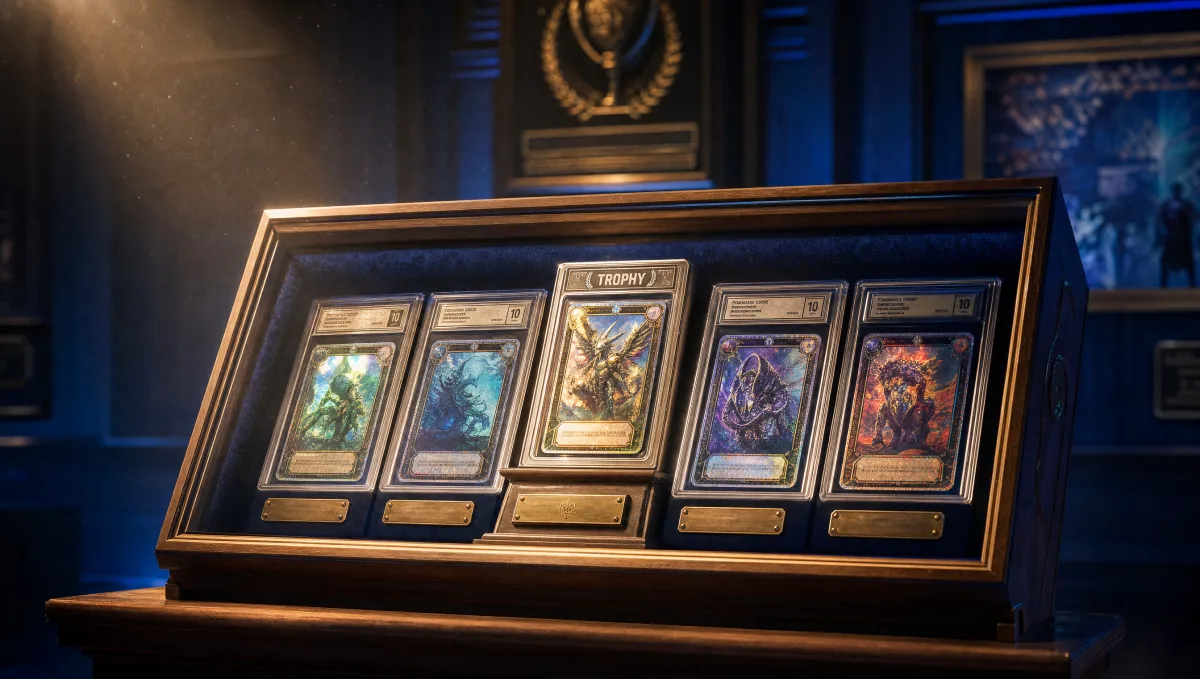
The Rarest Pokemon Cards in the Hobby, by Category
The Pokémon Trading Card Game has produced more than 18,000 distinct cards since 1996, and the difference between the rare ones — the ones with PSA pop reports in the single digits — and the truly rare ones comes down to how they were made: contest winners, tournament trophies, print errors, staff-only gifts, or just a print run small enough that twenty-five years later only a few dozen survive in collectible grade. Every listicle on the first page of Google ranks "rarest" by sale price and calls the result a rarity list. That's the wrong sort key. A 1998 Pikachu Illustrator with roughly 39 ever distributed is rare in a fundamentally different way than a 1999 1st Edition Charizard with thousands printed and 121 PSA 10s. This guide names the five categories that explain why a card is rare, sorts every famous "rarest" card into the right bucket, and ends on the attainable end of the spectrum — the modern chase cards a 2026 collector can actually own. A note before you start: this article ranks by rarity. For the price-led ranking — the eight-figure auction sales, the comp histories, the value drivers — see our sister guide on the most expensive Pokémon cards.
Part of: Complete Pokémon Cards Guide — the pillar overview of every era from 1999 WOTC to the 2025 Mega Evolution Pokémon TCG.
The rarest Pokémon card is the Pikachu Illustrator — a 1998 CoroCoro illustration-contest promo with roughly 39 officially distributed copies (approximately 41 known today). One PSA 10 exists. Logan Paul's PSA 10 copy sold for $16,492,000 at Goldin Auctions in February 2026 — the highest price ever paid for any trading card. Rarer cards exist by raw copy count (the Prerelease Raichu has 2 CGC-authenticated copies; some trophy variants under 10), but Pikachu Illustrator is the rarest recognized card with sustained auction demand.
What "Rarest" Actually Means in the Pokémon Hobby
Rarity in the Pokémon TCG is not one thing — it is at least five, and treating them as one is the reason every listicle on this SERP ends up arguing in a circle. The five categories below explain every famous "rarest" card you've ever seen on an auction-headline screenshot. Three of them describe cards that were never sold to the public at all. One describes cards that escaped a print run that wasn't supposed to exist. Only the last describes cards a real-world collector can realistically chase in 2026.
- Trophy & tournament rarity — awarded to a few competitors at sanctioned events; never sold (No. 1/2/3 Trainer Trophy Pikachu, Secret Super Battle Mewtwo, Master's Key, Worlds No. 1 Trainer).
- Contest & creator rarity — awarded to contest winners or to artists themselves, not players (Pikachu Illustrator, Snap photo-contest cards, Family Event Trophy Kangaskhan).
- Misprint & error rarity — escaped a print run that wasn't supposed to exist (Prerelease Raichu, Commissioned Presentation Blastoise, gold-border test prints, Topsun Charizard variants).
- Promo & private-distribution rarity — short-run promos given to staff, partners, or commemorative-event attendees (Tsunekazu Ishihara GX, Tropical Wind, Disco Holofoil Charizard, Extra Battle Day Lillie).
- Print-run + population rarity (the gradable category) — sold to the public in a small early print run, where only a handful survive in top grade (1st Edition Shadowless Charizard, 1st Edition Lugia, Topsun Charizard).
Trophy Cards: Cards You Can't Buy Because No One Ever Sold Them
The Pokémon Company's tournament-prize lineage is the rarest intentional category — these cards were minted in print runs of under twenty, awarded by hand to first-, second-, and third-place finishers at sanctioned championships, and were never available at retail in any market or any year. Several were illustrated by Mitsuhiro Arita — the same artist behind the Base Set Charizard — which is part of why this category has the cultural pull it does on the collector side.
- No. 1 Trainer Trophy Pikachu (Gold) — 1997–98 Lizardon Mega Battle. Approximately 15 known. A PSA 9 copy sold via eBay seller Stephychu025 for $3,000,000 in September 2025 (the highest-ever public sale of a trophy card). Cited by WarGamer.
- No. 2 Trainer Trophy Pikachu (Silver) — same tournament series, approximately 14 known, recent comps in the ~$440,000 range.
- No. 3 Trainer Trophy Pikachu (Bronze) — same series, approximately 4–5 known, recent comps in the ~$300,000 range.
- Secret Super Battle No. 1 Trainer Mewtwo — 1999, 7–9 copies, recent comps $90,000–$156,000.
- Tropical Mega Battle No. 1/2/3 Trainer — 1999–2001 Honolulu invitational, 50-player field per year. The No. 2 Trainer Tropical has a recent comp around $81,000.
- Battle Roads No. 1–3 Trainer — 2002, the last of the customized-art tournament-prize cards. Approximately 109 copies of the No. 1 in circulation.
- Worlds Championship No. 1 Trainer — 2006 (3 copies, ~$110,000) and 2010 (3 copies, ~$60,000).
Note that trophy and Worlds programs are ongoing — the No. 1 Trainer category keeps expanding every championship year. Print counts here are mostly compiled by the collector community; for the canonical sourcing on trophy cards, PSA's trophy-cards authority article is the closest thing to a definitive reference.
Contest & Creator Cards: Pikachu Illustrator and Its Siblings
The category most readers came here to read about — and the one where the print counts are genuinely fixed, because the contests are over and nothing new will ever enter the supply. The Pikachu Illustrator is the headline, but it is part of a small handful of contest-derived cards that follow the same structural pattern: a Japanese magazine ran an art or photo contest in the late 1990s, a tiny number of winners received a one-off promo, and that's the entire supply forever.
- Pikachu Illustrator — 1997 and 1998 CoroCoro illustration contests. The breakdown (per Bulbapedia, the community-canonical source for the per-contest accounting): the 1997 contest awarded 3 Best winners 20 cards each + 1 personal copy each + 20 Excellence winners 1 card each; the 1998 Mewtwo Counterattack contest awarded 1 Best + 7 Excellence; the 1998 Pikachu Summer Vacation contest awarded 4 Excellence (no Best — the would-be winner was unreachable). Officially distributed: 39, with 2 additional surface copies confirmed since 2020 (total known ~41). PSA 10 population: 1. Illustrated by Atsuko Nishida, the original Pikachu designer. Logan Paul's PSA 10 copy sold for $16,492,000 at Goldin in February 2026 — the highest sale price ever for any trading card.
- 64 Mario Stadium Pokémon Snap promos — 1999 Pokémon Snap photo-contest finalist cards. Approximately 20 copies each of Bulbasaur (Snap CoroCoro), Pikachu, Magikarp, and Squirtle. Recent comps range from $73,000 to $270,000 depending on which Pokémon and which grade.
- Family Event Trophy Kangaskhan — May 1998 Japanese parent-child tournament prize. Approximately 56 graded, ~12 in PSA 10. Recent comps $150,000–$175,000.
- Tsunekazu Ishihara Signed GX promo — 2017 Pokémon Company CEO birthday gift. Estimated 30–60 copies (no publicly confirmed count). Recent comp around $247,000.
The structural takeaway for this category: print count is fixed forever and population is known down to the individual collector for several of these cards. The David Persin Prerelease Raichu pair is a famous example of one private collector holding the entire authenticated supply of a card.
Misprints, Test Prints, and Cards That Shouldn't Exist
The error-card category sits structurally apart from every other type of rarity, because the print run was supposed to be zero. These are cards that escaped a manufacturing process that wasn't sanctioned, and that fact makes authentication — grader's pop report, chain-of-custody documentation, materials testing — more important here than in any other category in the hobby.
- Prerelease Raichu — 1999 print error. Base Set Raichu sheets accidentally received the Prerelease holo stamp that was meant for the Clefable run; WotC staff took the survivors home. First publicly seen at the 1999 Tropical Mega Battle in Honolulu (Aug 24–27). Andrew Finch, the WotC manager whose name is attached to the event, places the original count at approximately 11. CGC has authenticated exactly 2 as of 2024, using infrared imaging, 42× magnification, and X-ray fluorescence — both held by collector David Persin. Recent comp around $550,000. CGC's 2024 authentication article is the single canonical chain-of-custody source for this card.
- Commissioned Presentation Blastoise (Galaxy Star Holo) — 1998 retailer presentation print. Approximately 2 confirmed copies. Recent comp ~$360,000.
- Test Print Blastoise (Gold Border) — 1998 internal Wizards of the Coast test print. Few known. Recent comp ~$216,000.
- Topsun Charizard (Blue Back) — 1997 Japanese gum-card insert; small surviving population. Approximately 31 known. Recent comp ~$493,000.
The Topsun Charizard sits on the fence between misprint rarity and population rarity — it was a sold product, but the surviving graded population is small enough to play like a contest card. For the full Topsun and pre-Base context, see our complete Charizard set-by-set guide.
Promos and Private-Distribution Cards
The promo category is a wide net for cards that were given, not sold — usually to a small invited group at a championship, a finalist's table, a staff event, or a regional partner program. The structural reason the population stays small is the same in every case: there was no retail channel. The card exists because it was handed across a table to a finite number of people.
- Tropical Wind — 1999–2001 Tropical Mega Battle finalist / participation promo. Approximately 74 copies known. Recent comps $65,000–$81,000.
- Master's Key — 2010 World Championships finalist prize. 36 copies. Recent comp around $30,000.
- Master's Scroll — 2010 Daisuke Club final promo. Recent comp around $35,000.
- Victory Orb Mew — 2005 Battle Road finals prize. 21 copies. Recent comp around $40,000.
- Disco Holofoil Charizard — Japanese event promo. Recent comp around $113,000.
- Extra Battle Day Full Art Lillie (Japanese) — 2018 Japanese event promo. Recent comp around $108,000.
- Snap Pikachu — 1999 Pokémon Snap contest, 20 copies. An early sale of a low-grade copy hit ~$270,000.
- Snap Bulbasaur (CoroCoro) — 20 copies. Recent comps $80,000–$200,000.
For verified comp data on any of the figures above, Card Ladder tracks sale-by-sale data better than any single eBay sold-listing search; treat any standalone listing skeptically and triangulate against Card Ladder or Beckett before quoting a number.
The Gradable Rares: Print-Run + Population Rarity
This is the category 99% of readers will ever realistically encounter at auction, on eBay, or in a graded marketplace. It is also the category where the distinction this article spent four sections building actually starts to matter — print run versus graded-survivor population. A 1999 1st Edition Shadowless Charizard was printed in the thousands; the reason a PSA 10 commands six figures is that only 121 have ever graded clean (per the PSA pop report at time of writing — verify live before publication). A 2000 Neo Genesis 1st Edition Lugia was printed in much higher numbers, but the BGS 10 Pristine pop is 3. Both are rare. They are rare for different reasons and at different stages of the card's life.
| Card | Year | Print run (approx.) | Top-grade pop | Why it's rare |
|---|---|---|---|---|
| 1st Edition Shadowless Holo Charizard | 1999 | ~3,000–5,000 | 121 PSA 10 (per PSA pop report — verify before publish) | Tiny first print, condition-sensitive holo |
| 1st Edition Shadowless Holo Blastoise / Venusaur | 1999 | similar | similar | Same first-print logic, lower demand |
| 1st Edition Holo Lugia (Neo Genesis) | 2000 | larger run than Base Set | ~41 PSA 10, 3 BGS 10 Pristine | Grade-rare more than print-rare |
| Gold Star Umbreon / Espeon | 2005 | unknown; fan-club distribution | low | Required 40,000 Pokémon Players Club EXP to earn |
| Topsun Charizard (Blue Back) | 1997 | unknown; small surviving population | ~31 known | Survivor-rare; pre-Base Japanese gum insert |
These are the cards a real-world collector can actually chase. They show up at Goldin, at PWCC, on eBay graded, in the modern Charizard SKUs at the high end, and inside the deeper hobby-shop showcases. The Charizard hub covers each variant in set-level depth — start with the 1st Edition Charizard guide, then read the Charizard cornerstone guide for the full set lineage and the Charizard 151 guide for the modern-era parallels.
Modern Chase Cards: Where Rarity Meets the 2026 Market
You've just read about $16M trophies and 2-copy print errors. The ground-level reality: modern alt-art, hyper-rare, and gold-card Charizard ex variants pull into the four- and low-five-figure range, are PSA- and CGC-gradable, are findable in retail product (or as graded singles), and are the actual collectible target for a hobbyist with a real budget in 2026. The reason this matters is structural: the hobby is healthier and more interesting when the rarity ladder is climbable. Trophy cards and contest promos are the top rung of an artifact ladder you can read about but not stand on. The modern hyper-rares are the rung you can actually reach.
- 2025 Mega Charizard X ex (Phantasmal Flames, MEP #023) — the chase of the most recent Charizard Ultra-Premium Collection.
- 2022 Sword & Shield etched-foil trio (Charizard V SWSH260, VMAX SWSH261, VSTAR SWSH262) — the predecessor lineage. The full sealed-box context lives in our Charizard UPC guide.
- Rainbow Charizard variants — the rainbow-rare parallels across modern sets.
- Pokémon 151 Charizard ex — the white-hot 2023 set's chase. Covered in the Charizard 151 guide.
- Obsidian Flames and Paldean Fates Charizards — modern Scarlet & Violet-era variants.
- Mega Charizard ex (X / Y full lineage) — every Mega variant across modern sets.
- Charizard VMAX (Shiny Vault and Rainbow variants) — the Sword & Shield-era Charizard parallels each have their own set release and current comps.
- Charizard ex Premium Collection promos — the smaller-SKU Charizard chases that ship without the full UPC accessories.
The 13-piece Charizard cornerstone hub does the actual set-level product depth — this section funnels the head-term curiosity-driven traffic into that hub.
How to Actually Own a Rare Pokémon Card in 2026
There are exactly four honest paths for a collector who wants real ownership of a real rare Pokémon card in 2026, and the path you pick depends on your budget, your patience, and whether you want the rip experience or the certainty of a known slab. None of these paths leads to a Pikachu Illustrator — that card is auction-only and the supply is fixed at ~41. What they do lead to is a credible, slabbed, gradable, eventually-resellable rare card from the modern era of the hobby.
| Path | What you get | What it costs | Who it's for |
|---|---|---|---|
| Buy a graded single | A specific known slab from Goldin, PWCC, TCGplayer, eBay, or the Card Ladder marketplace. No ripping involved. | Spot market price + buyer's premium + shipping. The card is known. | Collectors who already know which slab they want. |
| Open sealed product | The whole UPC / ETB / booster-box experience, plus whatever you pull. Could be a chase; could be commons. | $40–$220 per box plus grading fees if you slab the chase. Real overprint risk on some SKUs. | Hobbyists who want the rip experience and the sealed object. |
| Open a Pokémon pack on Pullmarket | A real third-party-graded slab — PSA, CGC, or SGC — allocated to your account from a Pokémon-curated pack with published per-pack odds before purchase. | Per-pack price. The decision per pull is yours within a defined window. | Collectors who want the rip without the sealed-box gamble or the secondary-market markup. |
| Build the supporting collection | Sleeves, screw-downs, magnetic cases, vault custody on what you already own. | Modest, ongoing. | Long-haul collectors building toward a graded set. |
A short, plain note on the Pullmarket model. Every pull is a real third-party-graded physical card. Pullmarket runs a Pullmarket Vault fulfillment model per Terms §5.5 — pulled slabs are managed through the Pullmarket Vault workflow. Either way, what you pull is a real PSA, CGC, or SGC slab with a verifiable cert number. Every pack publishes its odds before purchase. Pullmarket Gems is store credit, not cash (Terms §9.1). Pullmarket isn't a sweepstakes, lottery, or wagering product — it's a card-collecting platform with a rip experience on top. The how it works walkthrough covers the full rip → decide → vault/ship/sell-back flow, and the trust page covers the operating model in detail.
Why "Rarest" and "Most Expensive" Aren't the Same Question
Every listicle on this SERP treats rarest and most expensive as synonyms. They aren't. They are correlated — extreme rarity often produces extreme prices, because there's no supply to meet a determined buyer — but they break apart in both directions, and a hobby-native reader should be able to name the breakages on sight.
- The Pikachu Illustrator is both the rarest-by-distribution card with significant demand and the most-expensive trading card ever sold. They line up here. This is the cleanest case where the two questions have the same answer.
- The 1st Edition Shadowless Charizard is the most expensive card most collectors will ever realistically encounter at auction, but it is not the rarest by print run — there are likely 3,000+ printed and roughly 121 in PSA 10. It's grade-rare and demand-rich, not print-rare.
- The Tropical Wind has approximately 74 known copies — far rarer by print run than the 1st Edition Charizard — but trades for a fraction of the price, because the demand pool is thinner outside of vintage-trophy specialists.
- The Prerelease Raichu is rarer than almost anything in the hobby (2 CGC-authenticated copies) but trades below Pikachu Illustrator because the recognition gap is enormous — the average collector has heard of Pikachu Illustrator and has not heard of the Prerelease Raichu.
The honest sort key is rarity × demand = price. Rarity is supply. Demand is recognition plus chase factor plus narrative. This article ranks on the supply side. For the demand-side ranking — the cards with the headline auction sales, the comp histories, the all-time price records — see the sister article on the most expensive Pokémon cards.
Where to Go From Here
Rarity in Pokémon is five different problems wearing one label. Trophy cards and contest promos are artifacts you can read about and probably never own. Misprints are authentication puzzles. Promos are private-distribution stories. The gradable rares — 1st Edition Charizard, 1st Edition Lugia, Topsun Charizard, Gold Star Umbreon — are the rung of the ladder where the hobby actually trades.
If you want to climb the attainable rung of the ladder, three resources do most of the work: the live Pokémon pack catalog with published odds, the deepest internal hub for the rare-Charizard end of the question in the full Charizard set-by-set guide, and the sister article — same cast, price-led sort — on the most-expensive Pokémon cards.
Ready to Climb the Attainable Rung of the Rarity Ladder?
Trophy cards and contest promos are auction-only artifacts. Modern hyper-rares are not. Browse the live Pullmarket catalog with the published odds in front of you, see exactly which graded slabs sit in each pack's possible-outcome pool, and decide per pack whether to rip, hold, or pass. Real cards. Real grades. Your decision per pull.
Frequently asked questions
The rarest Pokémon card with significant auction demand is the Pikachu Illustrator — a 1998 CoroCoro illustration-contest promo with approximately 39 officially distributed copies and approximately 41 known today. Only one PSA 10 exists. It was illustrated by Atsuko Nishida, the original Pikachu designer. Logan Paul's PSA 10 copy sold for $16,492,000 at Goldin Auctions in February 2026 — the highest price ever paid for any trading card. Rarer cards exist by raw copy count (the Prerelease Raichu has only 2 CGC-authenticated copies), but Pikachu Illustrator is the rarest recognized card.
The No. 1 Trainer Trophy Pikachu (Gold) is the first-place prize card from the 1997–98 Lizardon Mega Battle, the Pokémon Company's earliest sanctioned Japanese tournament series. Approximately 15 copies are known. Illustrated by Mitsuhiro Arita (the same artist behind the Base Set Charizard), the card features a gold-trophy variant of the standard Pikachu trophy treatment. A PSA 9 copy sold via eBay seller Stephychu025 for $3,000,000 in September 2025 — the highest public sale ever recorded for a trophy card.
Several are. The Kangaskhan Family Event Trophy has approximately 56 graded copies. Several Worlds Championship No. 1 Trainer cards have under 10 known copies (2006 Worlds No. 1 Trainer = 3 copies; Secret Super Battle Mewtwo = 7–9 copies). Pikachu Illustrator has approximately 41 known, so by raw count it is rarer than Kangaskhan but less rare than the rarest Worlds promos. The reason Pikachu Illustrator commands the headline auction prices is demand and recognition, not the lowest absolute supply. Rarer doesn't always mean more expensive.
The Prerelease Raichu is a 1999 print error where Base Set Raichu sheets accidentally received the holo prerelease stamp that was meant for the Clefable run. Wizards of the Coast staff kept the survivors; the card was first publicly seen at the 1999 Tropical Mega Battle in Honolulu (Aug 24–27). Andrew Finch, the WotC manager attached to the event, places the original count at approximately 11. CGC has authenticated exactly 2 copies as of 2024, using infrared imaging, 42× magnification, and X-ray fluorescence — both held by collector David Persin. Recent comp around $550,000.
The 1999 Pokémon Snap photo contest, run by Nintendo and 64 Mario Stadium magazine to celebrate the Pokémon Snap video game, awarded approximately 20 copies each of four photo-themed cards — Bulbasaur (Snap CoroCoro), Pikachu, Magikarp, and Squirtle. Each card features a stylized photographed-Pokémon art treatment unique to this contest. PSA population is in the single digits per Pokémon per grade. Recent comps range from $73,000 to $270,000 depending on which Snap card and which grade. The supply is structurally fixed — the contest is long over.
From sealed retail product, yes — modern hyper-rares, alt arts, and gold cards from sets like Phantasmal Flames, Pokémon 151, and Obsidian Flames are pack-pullable and gradable. From Pullmarket's Pokémon packs, every pull is a real third-party-graded physical card with published per-pack odds before purchase. Vintage trophy cards, contest promos, and Pikachu Illustrator are not in any pack product anywhere — those are auction-only acquisitions. The honest path to a rare modern Pokémon card is sealed product, graded singles, or Pullmarket's pack catalog with published odds.
Rarity is about supply — how many copies exist in the world. Expense is about supply × demand. A rare card with no demand sells for nothing; a card with thousands of copies but enormous demand (the 1st Edition Shadowless Charizard, with approximately 3,000–5,000 printed and 121 PSA 10s) sells for hundreds of thousands. The Tropical Wind has only ~74 known copies but trades for a fraction of the 1st Edition Charizard because the demand pool is thinner. Rare is the supply side; expensive is the supply-and-demand product. This article ranks the supply side.




Pullmarket is an online collectible-card pack marketplace for instant online rips, graded-card chases, secure inventory, and shipping eligible cards to your door. Browse online Pokemon card packs, or learn about Pullmarket LLC.