
Base Set Charizard: Shadowless, Unlimited, and Base Set 2 Explained
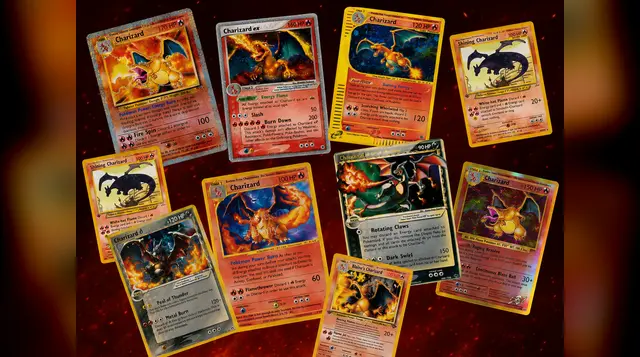
The Charizard 4/102 Holo from Wizards of the Coast's 1999 Base Set was printed in three distinct production runs (1st Edition Shadowless, Shadowless Unlimited, and Unlimited), then reprinted twice more before the Pokémon license moved to Nintendo — as Charizard 4/130 in Base Set 2 (February 2000) and as Charizard 3/110 in Legendary Collection (May 2002). Five different cards, five different value ceilings, one dropped shadow that separates two of them by roughly $10,000. This guide walks all five WotC-era prints in release order, gives you the visual tells per print, sweeps honest values across the lineage, and resolves the two misconceptions behind most "wait, what is this?" confusion in the hobby.
Part of: Complete Pokémon Cards Guide — the pillar overview of every era from 1999 WOTC to the 2025 Mega Evolution Pokémon TCG.
There are five Wizards-of-the-Coast-era Base Set Charizards, in release order: 1st Edition Shadowless (1999, 4/102, with the left-of-art stamp, no drop shadow), Shadowless Unlimited (1999, 4/102, no stamp, no shadow), Unlimited (1999–2000, 4/102, no stamp, drop shadow added + 99 inserted in the copyright), Base Set 2 (February 2000, 4/130, no 1st Ed print exists), and Legendary Collection (May 2002, 3/110, Holo + Reverse Holo). "Shadowless" alone is a printing layout — it covers BOTH the 1st Ed and the un-stamped bridge run. Card number is the fastest tell: 4/102 = Base Set, 4/130 = Base Set 2, 3/110 = Legendary Collection.
The Five WotC-Era Base Set Charizards, At a Glance
If you only read one section, read this one. The lineage the SERP is missing, in one frame:
| # | Year | Set / number | 1st Ed stamp? | Drop shadow? | Copyright line ends | Approx. PSA 10 comp tier | |
|---|---|---|---|---|---|---|---|
| 1 | 1st Edition Shadowless | 1999 | Base Set 4/102 | YES (left of art) | NO | …©1999 Wizards. | Six-figure grail |
| 2 | Shadowless Unlimited | 1999 | Base Set 4/102 | NO | NO | …©1999 Wizards. | High-five-figure |
| 3 | Unlimited ("Shadowed") | 1999–2000 | Base Set 4/102 | NO | YES | …99 Wizards. (added 99) | Low-five / high-four-figure |
| 4 | Base Set 2 | 2000 | Base Set 2 4/130 | NO | YES | Base Set 2 set symbol (stylized "2") | Low-four-figure |
| 5 | Legendary Collection | 2002 | LC 3/110 | NO | YES | LC set symbol (crown) | Low-four-figure (Holo) / mid-three-figure (Reverse Holo) |
The card number alone resolves most confusion: a 4/102 belongs to rows 1–3, a 4/130 is row 4, a 3/110 is row 5. Everything else in the table is the tie-breaker between Shadowless and Unlimited on a 4/102. Tier ranges are intentionally bands, not numbers — live comps are linked further down. Set codes and copyright-line endings are cross-referenced against PSA Cardfacts.
Print #1: 1st Edition Shadowless (January 9, 1999)
The 1st Edition Shadowless Base Set Charizard is the headline grail of the entire English Pokémon TCG — released January 9, 1999 as part of the very first English-language Wizards of the Coast print run. It carries the small black "Edition 1" emblem on the left of the art window (WotC-era stamps live left of the illustration box, never anywhere else), no drop shadow on the art frame, the original …©1999 Wizards. copyright with no extra year tacked on, and a print run small enough that surviving high-grade copies sit comfortably in six-figure territory.
- Stamp: "Edition 1" emblem, left of art. Drop shadow: none.
- Copyright: ends
…©1999 Wizards.HP / border: thinner red, lighter yellow than Unlimited.
For the stamp itself — font geometry, forgery tells, PSA / CGC / SGC pop reports, and the PSA-10 1st Edition value engine — see our 1st Edition Charizard guide. This article handles chronology and visual ID; stamp authentication and value-engine depth live there.
Print #2: Shadowless Unlimited (Spring 1999)
Shadowless Unlimited is the most-confused print in vintage Pokémon. It's a Base Set 4/102 Charizard with no stamp, no drop shadow, and the same ©1999 Wizards. copyright as 1st Edition Shadowless — produced in the narrow window between the 1st Edition run selling out and Wizards adding the drop shadow to the plates. Roughly 5×–10× rarer than Unlimited at the same grade tier, it sits in the high-five / low-six-figure PSA 10 band and is constantly mis-listed as "1st Ed Shadowless" (it isn't — no stamp) or "Unlimited" (it isn't — no shadow).
- The crucial nuance: "Shadowless" alone is a printing layout that applies to both 1st Edition Shadowless and Shadowless Unlimited. When someone says "I have a Shadowless Charizard" without specifying which, the implied value swings ~5×.
- Identify before quoting. No stamp + no shadow = Shadowless Unlimited. Stamp + no shadow = 1st Edition Shadowless. Don't conflate.
- Live comps: Card Ladder; official population + APR data on psacard.com.
Print #3: Unlimited / "Shadowed" (Mid-1999 → 2000)
Unlimited — the print most collectors actually own — is what landed when Wizards added a soft gray drop shadow to the art frame and inserted a 99 into the copyright line (now ©1995, 96, 98, 99 Wizards.). Border tint deepens marginally, the red 120 HP runs slightly bolder, print volume goes up enormously. This is the print 1999-era kids ripped at Toys "R" Us — the print eBay is flooded with, and the only one where a PSA 10 is realistically attainable below five figures.
- Drop shadow: yes — gray bar on the right of the art box. Copyright:
…99 Wizards. - Honest values: raw NM low-four-figure; PSA 9 high-three / low-four; PSA 10 low-five / high-four-figure tier. PSA Cardfacts spec 544027 on psacard.com; aggregator data on PriceCharting.
For a graded vintage Charizard slab without paying grail money, an Unlimited Holo PSA 9 is the most attainable entry point in the WotC-era lineage. Collectors targeting that tier sometimes prefer to open a Pokémon pack at PullMarket — see the published odds rather than chase raw eBay listings, since every PullMarket pull is allocated as a real third-party-graded slab against verified inventory.
How to Tell Shadowless From Unlimited in 5 Seconds
Five visual checks that resolve the Shadowless / Unlimited confusion on any 4/102 Holo:
- Right edge of the illustration box. Soft gray bar = Unlimited / Shadowed. No bar = Shadowless.
- Copyright line.
…©1999 Wizards.(no extra99) = Shadowless.…99 Wizards.with the99inserted = Unlimited. - HP font weight. Thinner red on
120 HP= Shadowless. Thicker / bolder = Unlimited. - Border tint. Slightly lighter yellow = Shadowless. Marginally deeper yellow = Unlimited.
- 1st Edition stamp (small "Edition 1" emblem) on the left of the art. Stamp + Shadowless layout = 1st Ed Shadowless. No stamp + Shadowless layout = Shadowless Unlimited. No stamp + drop shadow = Unlimited.
99 in the copyright line — or a stamp with mismatched font geometry — is a red flag for either a misprint or a counterfeit. The fastest path is a PSA, CGC, or SGC submission; each grader publishes a free cert lookup so any slabbed card resolves on the grader's own site (PSA, CGC, SGC). For the deep dive on stamp forgeries and font tells — including the "1" weight, the "EDITION" letter rendering, and the alignment issues counterfeits typically miss — see our 1st Edition Charizard guide.
Print #4: Base Set 2 (4/130, February 24, 2000)
Base Set 2 is the second-biggest misconception in the lineage. When Wizards reprinted the most popular cards from Base Set and Jungle in early 2000, Charizard came back as 4/130 — same Mitsuhiro Arita art, different card — with a stylized "2" diagonal set symbol and the Unlimited drop shadow already baked in. There is no 1st Edition print of Base Set 2 Charizard. If a seller offers one, it doesn't exist; walk.
- Card number:
4/130— fastest tie-break. A 4/130 cannot be 1999 Base Set. - Set symbol: stylized "2" in the lower-right symbol box. Drop shadow: present. 1st Ed stamp: never exists.
- "2nd Edition Charizard" confusion: there is no "2nd Edition Charizard." Wizards-era Pokémon TCG never used an explicit "2nd Edition" designation; Base Set 2 is a reprint set, not a 2nd Edition.
- Honest values: raw NM low-three; PSA 9 mid-three; PSA 10 low-four-figure tier (PriceCharting, Card Ladder).
Amazon's own organic listing for "Pokémon - Charizard (4) - Base Set 2 - Holo" ranks in the top 10 SERP for base set charizard despite being a different card entirely — the confusion is real.
Print #5: Legendary Collection (3/110, May 24, 2002)
Legendary Collection is the WotC-era reprint everyone forgets. Released May 24, 2002 — the last set Wizards published before the Pokémon license moved to Nintendo — it reprinted Charizard at 3/110 with a crown set symbol. Two variants in the same set: a regular Holo (art-window holo, the chase) and a Reverse Holo — the first reverse-holo Charizard ever printed, with the entire card glistening except the art window. Reverse holos were rarer per pack than regular holos at LC rates, inverting the usual rarity logic and pushing Reverse Holo PSA 10 comps to a meaningful premium over Holo PSA 10.
- Card number:
3/110. Set symbol: crown. 1st Edition stamp: none. - Variants: Holo (art-window holo) vs Reverse Holo (everything-but-art-window holo). Reverse Holo is the harder pull.
- Honest values: Holo PSA 10 low-to-mid-four-figure; Reverse Holo PSA 10 a noticeable premium above per Card Ladder and PSA APR.
"What About Team Rocket 4/82, Stormfront 103/100, Celebrations, or TCG Classic?"
Several non-Base-Set Charizards get conflated with this lineage. They aren't part of it — short list, with hand-offs:
- Team Rocket Dark Charizard (4/82, April 2000) — different card entirely. Dark-typing, scarred art. Charizard set-by-set pillar.
- Neo Destiny Shining Charizard (107/105, February 2002) — first official shiny Charizard the TCG ever printed. Shiny Charizard guide.
- Stormfront 103/100 (November 2008) — Secret Rare reprint with Base Set art on a 2008 frame. Pillar.
- Celebrations 25th Anniversary (4/25, October 2021) — anniversary reprint with a
25stamp. Pillar. - Pokémon TCG Classic (June 2024) — premium-product reprint in the Classic deck box. Pillar.
The WotC-era Base Set Charizard lineage starts January 9, 1999 with 1st Edition Shadowless and stops May 24, 2002 with Legendary Collection. Everything else is a different card.
What Each Print Is Actually Worth in 2026
Honest cross-print value sweep with linked sources in place of fabricated numbers. Every figure is a starting point — comps move weekly.
1st Edition Shadowless — raw NM deep-five-figure; PSA 9 high-five / low-six; PSA 10 the headline grail. Auction-record history + the PSA 10 value-engine deep-dive live in the 1st Edition Charizard guide.
Shadowless Unlimited — the "hidden value" print. Raw NM four-to-five-figure; PSA 9 five-figure; PSA 10 high-five / low-six-figure tier.
Unlimited (Shadowed) — the realistically attainable WotC Base Set Holo slab. Raw NM low-four; PSA 9 high-three / low-four; PSA 10 low-five / high-four-figure tier. Spec 544027; PriceCharting.
Base Set 2 (4/130) — most affordable WotC-era graded Base Set Charizard slab. Raw NM low-three; PSA 9 mid-three; PSA 10 low-four-figure tier.
Legendary Collection (3/110) — Holo PSA 10 low-to-mid-four-figure; Reverse Holo PSA 10 a meaningful premium above.
Grading economics — PSA standard runs roughly $15–$25 + shipping (psacard.com for live fees); declared values north of $10,000 route into higher tiers at hundreds-to-low-thousands per submission. The PSA 9 → PSA 10 multiplier on every print here runs 5×–20×; submission math works on Shadowless and Unlimited copies that grade realistically, thin on LP / MP.
How to Identify a Base Set Charizard in Under a Minute
The decision tree that collapses the five-print chronology into a minute with the card in hand:
- Read the card number.
4/102→ Base Set (rows 1–3).4/130→ Base Set 2.3/110→ Legendary Collection. Anything else → not this lineage; check the Charizard set-by-set pillar. - If 4/102, check the 1st Edition stamp + drop shadow. Stamp + no shadow = 1st Ed Shadowless. No stamp + no shadow = Shadowless Unlimited. No stamp + shadow = Unlimited.
- If 4/130, check the set symbol. Stylized
2diagonal = Base Set 2. (No 1st Edition exists.) - If 3/110, check the symbol + holo pattern. Crown + art-window-only holo = LC Holo. Crown + everything-but-art-window holo = LC Reverse Holo.
- Verify the copyright line. A mismatch between layout and copyright text (e.g., Shadowless layout with
…99 Wizards.) is a counterfeit signal — submit to PSA, CGC, or SGC before transacting.
Should You Grade It, Hold It Raw, Sell It, or Rip a Pack?
Four legitimate paths once you've identified your card. The right one depends on the print, the condition, and what you actually want:
| Path | What you get | What it costs | Who it's for |
|---|---|---|---|
| Submit to PSA / CGC / SGC | Authenticated, encapsulated, graded slab + full market liquidity | $15–$50 standard; hundreds-to-low-thousands at high declared-value tiers; weeks to months | Unlimited-or-better holders that grade realistically NM+ raw |
| Hold it raw | Zero fees; full optionality | Storage / damage risk; lower resale liquidity | LP / MP holders where grading won't clear fees |
| Sell it raw | Immediate liquidity at raw-NM comp band | Leaves the PSA 9 / 10 upside on the table | Holders who need cash now |
| Open a PullMarket Pokémon pack | Real third-party-graded singles (PSA / CGC / SGC) allocated to your account from a Pokémon-curated pack with published odds before purchase; held in PullMarket's own insured custody or fulfilled through the Pullmarket Vault per Terms §5.5 | Per-pack price (well below grail-tier secondary) | Collectors who want graded vintage exposure without paying six-figure 1st Ed money |
PullMarket runs a Pullmarket Vault fulfillment model — every pulled card is a real third-party-graded slab, managed through the Pullmarket Vault workflow per Terms §5.5. PullMarket Gems is store credit, not cash; PullMarket isn't a sweepstakes, lottery, or wagering product. Full operating model on our trust & safety page. We can't promise any specific card pull — what we promise is that whatever you pull is a real graded slab and the odds are published before you commit.
Frequently asked questions
Anywhere from low three figures (Unlimited LP raw) to deep into the seven figures (PSA 10 1st Edition Shadowless). The value depends entirely on which of the five WotC-era prints you're holding and what grade it's in. The master table and values walk-through above range each print tier by tier; live comps run on Card Ladder, PSA Auction Prices Realized, and PriceCharting. The 1st Edition Shadowless value engine sits in our 1st Edition Charizard guide.
A soft gray drop shadow on the right and bottom edges of the art frame, a 99 added to the copyright line, slightly thicker red HP type, and a marginally deeper yellow border. Shadowless = no shadow + the original ©1999 Wizards. copyright. Unlimited = visible shadow + the …99 Wizards. copyright with the 99 inserted. Either tell alone is enough; both together resolve the print in seconds. Both layouts exist as 4/102 Holos, so the card number alone doesn't disambiguate.
No, and this is the single most-confused point in vintage Pokémon. "Shadowless" is a printing layout — no drop shadow plus the original copyright line — that applies to BOTH 1st Edition Shadowless (which carries the small "Edition 1" stamp left of the art) AND Shadowless Unlimited (no stamp at all). 1st Edition Shadowless is the grail; Shadowless Unlimited is the bridge print Wizards produced before adding the drop shadow to the plates. The stamp is the binary tell — present or absent, no in-between.
No. 4/130 is Base Set 2 — a February 2000 Wizards reprint of the most popular cards from Base Set and Jungle. The original 1999 Base Set Charizard is 4/102. Base Set 2 is its own card with its own values and a stylized "2" set symbol in the lower-right of the art box. There is no 1st Edition print of Base Set 2 — if a seller offers a "1st Edition Base Set 2 Charizard," walk. The card doesn't exist.
A May 24, 2002 Wizards reprint at 3/110 with a crown set symbol — the last Charizard Wizards printed before the Pokémon license moved to Nintendo. It ships in two variants: a regular Holo (art-window holo, the chase) and a Reverse Holo — the first reverse-holo Charizard ever printed, with the entire card glistening except the art window. Reverse Holo PSA 10 comps typically command a meaningful premium over Holo PSA 10, inverting the usual rarity hierarchy.
The per-pack pull rate for the rare-Holo slot in 1999 Base Set was roughly 1 in 64 booster packs. Print volumes were massive across Unlimited but tight on both 1st Edition and Shadowless Unlimited — which is why surviving high-grade copies of the latter two trade so heavily premium. PSA, CGC, and SGC population reports give a current proxy for survivor counts; the 1st Edition Holo pop deep-dive (cross-grader comparison + survivor-count math) lives in our 1st Edition Charizard guide.
Pullmarket is an online collectible-card pack marketplace for instant online rips, graded-card chases, secure inventory, and shipping eligible cards to your door. Collectors can open card packs online, or learn about Pullmarket LLC.