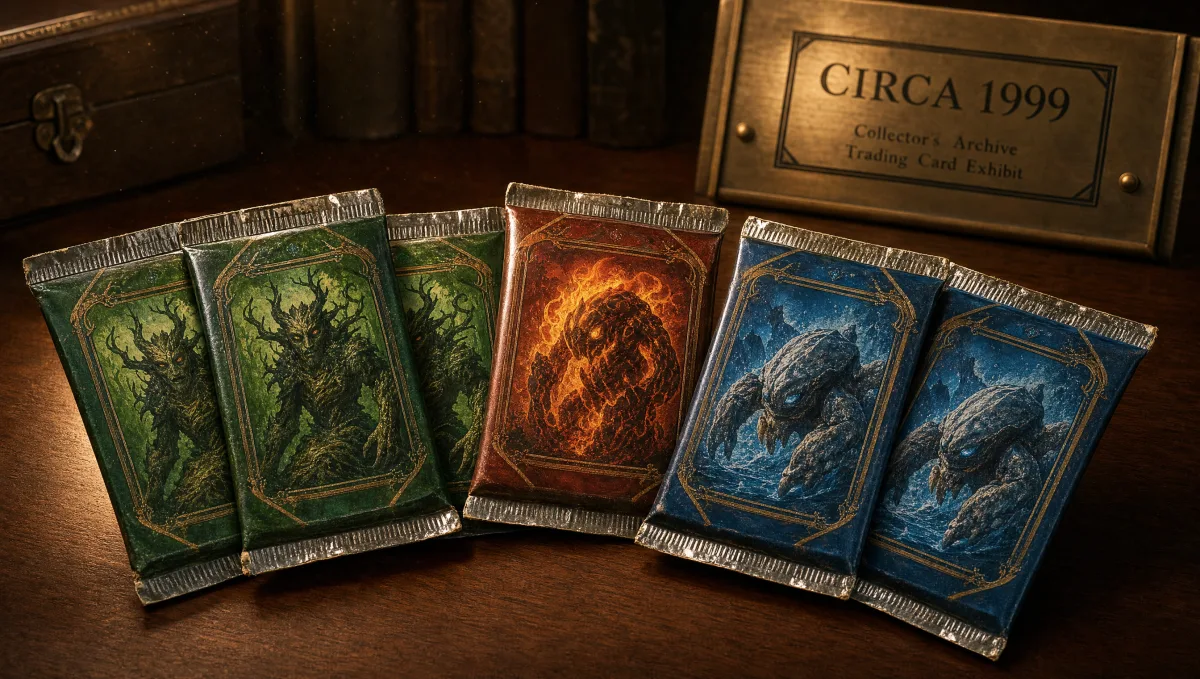
Pokémon Fossil, Jungle, Base Set — Sealed Pack Buyer's Guide
Wizards of the Coast printed five original-era English Pokémon TCG sets between January 9, 1999 and April 24, 2000 — Base Set (102 cards), Jungle (64 cards), Fossil (62 cards), Base Set 2 (130 cards), and Team Rocket (82 cards plus one Secret Rare) — and a sealed booster pack from any of them now trades for anywhere between roughly $80 and $3,000+ in 2026, depending on the set, the edition, and the seller. This guide walks every original-era WOTC pack in release order, gives you honest 2026 sealed-pack pricing per set and per edition, a 60-second authenticity checklist that doesn't rely on weighing, and an honest sealed-vs-crack-vs-rip decision section at the end.
Part of: Complete Pokémon Cards Guide — the pillar overview of every era from 1999 WOTC to the 2025 Mega Evolution Pokémon TCG.
The five original-era WOTC sealed Pokémon booster packs are Base Set (Jan 1999, 102 cards, Charizard 4/102), Jungle (Jun 1999, 64 cards, Holo Snorlax + Scyther), Fossil (Oct 1999, 62 cards, Holo Dragonite + Gengar + Articuno + Lapras), Base Set 2 (Feb 2000, 130 cards, Charizard 4/130 reprint), and Team Rocket (Apr 2000, 82 cards + Dark Raichu Secret Rare, Dark Charizard 4/82). Sealed-pack pricing in 2026 ranges roughly $80–$200 (Base Set 2) to $1,500–$3,000+ (Base Set 1st Edition). Base Set 2 has no 1st Edition print — if a seller offers one, walk. Pack-weighing exists in the community but PullMarket does not recommend buying based on weight.
The Five Original-Era WOTC Sets, at a Glance
If you read one section, read this one. The original-era sealed-pack lineage the SERP doesn't lay out in one frame:
| # | Set | Released | Set size | Pack art(s) | Headline chase card(s) |
|---|---|---|---|---|---|
| 1 | Base Set | Jan 9, 1999 | 102 | Charizard (red), Blastoise (blue), Venusaur (green) | Charizard 4/102 Holo |
| 2 | Jungle | Jun 16, 1999 | 64 | Flareon, Scyther, Wigglytuff, Mr. Mime, Pinsir | Holo Snorlax, Holo Scyther, Wigglytuff (no-symbol error) |
| 3 | Fossil | Oct 10, 1999 | 62 | Zapdos, Lapras, Aerodactyl | Holo Dragonite, Holo Gengar, Holo Articuno, Holo Lapras |
| 4 | Base Set 2 | Feb 24, 2000 | 130 | Charizard, Mewtwo | Charizard 4/130 (Base Set + Jungle reprint mash-up) |
| 5 | Team Rocket | Apr 24, 2000 | 82 + 1 SR | Giovanni, Rocket Boss (multiple pack arts) | Dark Charizard 4/82, Holo Dark Dragonite, Rocket's Zapdos |
Every WOTC-era pack is the same 11-card spec — 7 commons, 3 uncommons, 1 rare (with a roughly 1-in-3 chance the rare slot is a Holo). For the deepest dives on Base Set Charizard's print-run chronology and the 1st Edition stamp itself, this article hands you off to the two siblings: the Base Set Charizard print-run guide and the 1st Edition Charizard authentication guide.
Base Set Packs (1999) — The Original
Base Set is the set that started the English Pokémon TCG — released January 9, 1999, 102 cards, with the now-iconic Charizard 4/102 Holo as the headline chase. At the sealed-pack level the practical decision is 1st Edition vs Shadowless Unlimited vs Unlimited: 1st Edition packs carry the small "Edition 1" stamp on the front of the foil wrapper and are an order of magnitude scarcer than Unlimited; "Shadowless" sealed packs are the un-stamped bridge run that came between 1st Edition and full Unlimited production.
- 1st Edition sealed pack: ~$1,500–$3,000+ depending on weight, pack art, and seller — PSA / CGC / SGC slabbed sealed packs trade meaningfully above raw. Live eBay asking listings span single packs from the high-three-figures into the low-four-figures, with slabbed examples higher. Source: PriceCharting Base Set 1st Edition pack page.
- Shadowless sealed pack: ~$400–$900 — the bridge print between 1st Ed and full Unlimited.
- Unlimited sealed pack: ~$200–$400 — the most attainable Base Set pack to find sealed in 2026.
For the card-level "is my opened Charizard from this set 1st Ed, Shadowless, or Unlimited?" deep-dive, the Base Set Charizard print-run guide walks the drop-shadow / copyright-line / stamp tells; for the 1st Edition stamp itself and the forgery vector, see the 1st Edition Charizard guide. The Base Set Charizard 4/102 PSA 10 sits among the most expensive Pokémon cards ever sold.
Jungle Packs (1999) — The Second Set
Jungle released June 16, 1999 as the second original-era English Pokémon set — 64 cards, five pack arts (Flareon, Scyther, Wigglytuff, Mr. Mime, Pinsir), and the famous Wigglytuff "no-symbol" error variant that's one of the most-hunted printing mistakes in the rarest Pokémon cards ever printed. Jungle's 1st Edition print run was meaningfully larger than Base Set 1st Edition — which is why Jungle 1st Ed packs trade at a fraction of Base Set 1st Ed packs.
- 1st Edition sealed pack: ~$200–$400 typical asking range, with seller-listed "heavy" packs asking up into the $300–$600+ band. PullMarket does not recommend buying based on listed weight — see the authenticity section below. Source: PriceCharting Jungle 1st Edition pack page.
- Unlimited sealed pack: ~$80–$180.
- Headline chase cards: Holo Snorlax, Holo Scyther, Holo Mr. Mime, Holo Vaporeon — plus the no-symbol Wigglytuff misprint that surfaces in the rare slot.
Fossil Packs (1999) — The Third Set
Fossil released October 10, 1999 as the third original-era English Pokémon set — 62 cards, three pack arts (Zapdos, Lapras, Aerodactyl — collectors call the complete trio "the three-pack-art set"), and a chase-card lineup as deep as any vintage WOTC release: Holo Dragonite (the four-to-five-figure PSA APR chase that lands the card on the most expensive Pokémon cards list), Holo Gengar, Holo Articuno, and Holo Lapras. A rare Australian red-logo variant pack also exists — the Pokémon logo printed red instead of yellow and missing the back-side Nintendo Seal — but data is too thin to range.
- 1st Edition sealed pack — "light" listings: ~$250 typical asking.
- 1st Edition sealed pack — "heavy" listings: ~$370 typical asking. PullMarket does not recommend buying based on the light/heavy split — see the authenticity section below.
- Unlimited sealed pack: ~$190–$230 across the light/heavy spread.
- Red-logo Australian variant: collector-rare, insufficient public data to range.
Sources: PriceCharting Fossil 1st Edition pack page; per-card APR data on PSA APR; trailing comps on Card Ladder; the PSA Set Registry feature on Fossil 1st Edition.
Base Set 2 Packs (2000) — The Reprint
Base Set 2 released February 24, 2000 as a Wizards reprint set — 130 cards, combining the most popular cards from Base Set and Jungle into one new release. Charizard returns as 4/130 (not 4/102, the original) with the Unlimited drop shadow already baked in. There is no 1st Edition print of Base Set 2 — if any seller is offering a "1st Edition Base Set 2" pack or card, walk away. The card and the pack do not exist.
- Sealed pack (Unlimited only — the only version that exists): ~$80–$200.
- Most affordable sealed WOTC-era pack of the five original-era sets.
- Charizard 4/130 confusion — a Base Set 2 Charizard is its own card with its own values; the print-run-by-print-run breakdown lives in the Base Set Charizard print-run guide.
Source: PriceCharting Base Set 2 pack page.
Team Rocket Packs (2000) — The Fourth Main Set
Team Rocket released April 24, 2000 — 82 cards plus one Secret Rare (Dark Raichu 83/82, the first Secret Rare in any English Pokémon set, and a fixture on the rarest Pokémon cards list). Multiple pack arts (Giovanni, Rocket Boss, and others), with the Giovanni pack art pulling a premium over the others. Headline chase cards: Dark Charizard 4/82 Holo (one of the most-loved villain-flavor Pokémon cards ever printed and a fixture of the broader Charizard set-by-set lineage), Holo Dark Dragonite, and Holo Rocket's Zapdos.
- 1st Edition sealed pack: ~$300–$600+ depending on pack art (Giovanni art commands a premium); PSA / CGC / SGC slabbed examples can exceed $1,000.
- Unlimited sealed pack: ~$100–$250.
- Dark Raichu 83/82 Secret Rare is the first Secret Rare in any English Pokémon set — a print-run milestone.
Source: PriceCharting Team Rocket 1st Edition pack page; trailing comps on Card Ladder.
How to Verify a Sealed Pack Is Real (60-Second Checklist)
The authenticity workflow the aggregator-dominated SERP doesn't build cleanly anywhere. Run this top-to-bottom before sending money on any sealed WOTC pack — and do not rely on pack weight as your primary tell (see the pack-weighing callout below):
- Wrapper texture and foil sheen. Authentic WOTC wrappers carry a specific holographic-foil sheen on the central character art. Counterfeit reseals are often slightly matte or too uniformly glossy.
- Crimp-seal alignment. Real factory crimps run perfectly straight along the top and bottom edges of the pack. Resealed packs show subtle misalignment, double-crimping, or visible glue residue under raking light.
- Pack-art print registration. Authentic packs hold tight color registration on the central character art (Zapdos / Lapras / Aerodactyl on Fossil; Flareon / Scyther on Jungle; Charizard / Blastoise / Venusaur on Base Set). Misaligned color plates or fuzzy edges are a counterfeit signal.
- Back-side Nintendo Seal of Quality. Authentic WOTC packs carry the gold Nintendo Seal on the back. Missing seal = either a rare Australian red-logo variant (Fossil-era specifically) or a counterfeit; verify against pack art and seller provenance.
- Slab the deal-makers. For any sealed pack over a few hundred dollars, the safest path is a PSA / CGC / SGC graded-slab pack from a reputable seller — every cert resolves on the grader's own site: psacard.com, cgccards.com, gosgc.com.
1st Edition vs Unlimited vs Shadowless at the Sealed-Pack Level
A fast disambiguation specifically for sealed packs (the card-level treatment lives in the two Charizard sibling articles):
- 1st Edition pack — pack front carries the small "Edition 1" stamp printed on the foil wrapper. Wizards' first production run of each set. Scarcest and most expensive. Exists for Base Set, Jungle, Fossil, and Team Rocket — NOT for Base Set 2.
- Shadowless pack — Base Set only. No "Edition 1" stamp; second production run; the cards inside use the Base Set Shadowless layout (no drop shadow on the art frame, original copyright line). Rarer than Unlimited, much more common than 1st Edition.
- Unlimited pack — the bulk-print version. No stamp. The most common sealed pack to find and the most attainable across all five sets.
Sealed-Hold vs Crack-and-Grade vs Rip on PullMarket
Three honest paths once you've decided you want vintage WOTC exposure. No judgment on which is right — it depends on what you actually want from the hobby.
| Path | What you get | What it costs you | Who it's for |
|---|---|---|---|
| Hold sealed | The sealed pack stays intact; potential long-term appreciation if print-run survivor counts stay constrained; the wrapper as the collectible object | Capital tied up ($80–$3,000+ per pack); counterfeit and reseal risk if not slabbed; storage exposure to humidity, light, pressure | Collectors who want the sealed object itself, not what's inside |
| Crack and grade | The 11 cards inside, then submitted to PSA / CGC / SGC as graded singles; a chance at a chase Holo | Grading fees of roughly $15–$50/card per standard tier + shipping, with higher tiers at high declared value; weeks-to-months turnaround; the moment you crack, the sealed-pack value is gone | Hobbyists who'd rather own the slabs than the wrapper |
| Rip equivalents on PullMarket | Real third-party-graded singles allocated to your account from a Pokémon-curated pack with published odds before you buy; held in PullMarket's own insured custody or fulfilled through the Pullmarket Vault per Terms §5.5 | Pack price (well below a sealed-vintage rip) | Collectors who want the rip experience without buying and risking a $200–$3,000 sealed vintage pack on the open market |
PullMarket runs a Pullmarket Vault fulfillment model — every pulled card is a real third-party-graded slab, managed through the Pullmarket Vault workflow per Terms §5.5. Every pack publishes its odds before purchase. PullMarket Gems is store credit, not cash — PullMarket is not a sweepstakes, lottery, or wagering product. Full operating model on the trust & safety page. We can't promise any specific vintage chase pull — what we promise is that whatever you pull is a real graded slab and the odds were published before you committed.
Frequently asked questions
A sealed Fossil Unlimited booster trades roughly $190–$230, and a sealed Fossil 1st Edition booster trades roughly $250–$370, depending on seller, pack art, and listing. Sources for the ranges: PriceCharting trailing comps, live eBay sold listings, and per-card PSA APR data on psacard.com. PSA / CGC / SGC slabbed sealed packs can carry meaningful premiums over raw sealed packs because authentication risk is removed.
The 1st Edition foil wrapper carries the small "Edition 1" stamp on the front of the pack. 1st Edition packs are Wizards' first production run of each set and are an order of magnitude scarcer than Unlimited — which is why 1st Edition Base Set packs trade in the four-figures while Unlimited Base Set packs trade in the low-three-figures. Base Set 2 has no 1st Edition print — only Unlimited. If a seller offers a "1st Edition Base Set 2" pack, the product does not exist.
Yes — both resealed packs (real wrapper, swapped-out cards) and full counterfeit wrappers exist, especially at higher price points where the margin justifies the work. The 60-second checklist above covers the visual tells (crimp alignment, foil sheen, print registration, back-side Nintendo Seal). For any sealed pack over a few hundred dollars, the safest path is a PSA / CGC / SGC slabbed pack from a reputable seller — every cert resolves on the grader's own site for free.
PullMarket does not recommend it. Pack-weighing exists and you'll see sellers list "light" and "heavy" packs at different prices, but the practice cherry-picks value from a print run that was sold randomly — every "heavy" pack means somebody else paid the same price for the corresponding "light" dud. The Pokémon Company has publicly called weighers cheaters. Repeated scale-handling can damage cards inside the pack. And light-pack reseals weigh as confidently as a real heavy pack — weight cannot rule out a fake. Use weight only as an authentication red flag.
Sealed WOTC packs have appreciated meaningfully since the 2020 vintage Pokémon market run-up — but like any collectible, prices move both directions. Authenticity risk (counterfeits, reseals), storage risk (humidity, light, pressure, crushing), and liquidity risk (a $2,000+ pack is a slow sell) are all real. PullMarket doesn't promise investment returns on any collectible. If you're buying because you want the sealed object as a piece of TCG history, that's a real reason; if you're buying purely as speculation, treat it like any speculative asset.

Pullmarket is an online collectible-card pack marketplace for instant online rips, graded-card chases, secure inventory, and shipping eligible cards to your door. Collectors can open card packs online, or learn about Pullmarket LLC.