Graded vs Raw Cards: Which Should You Buy?
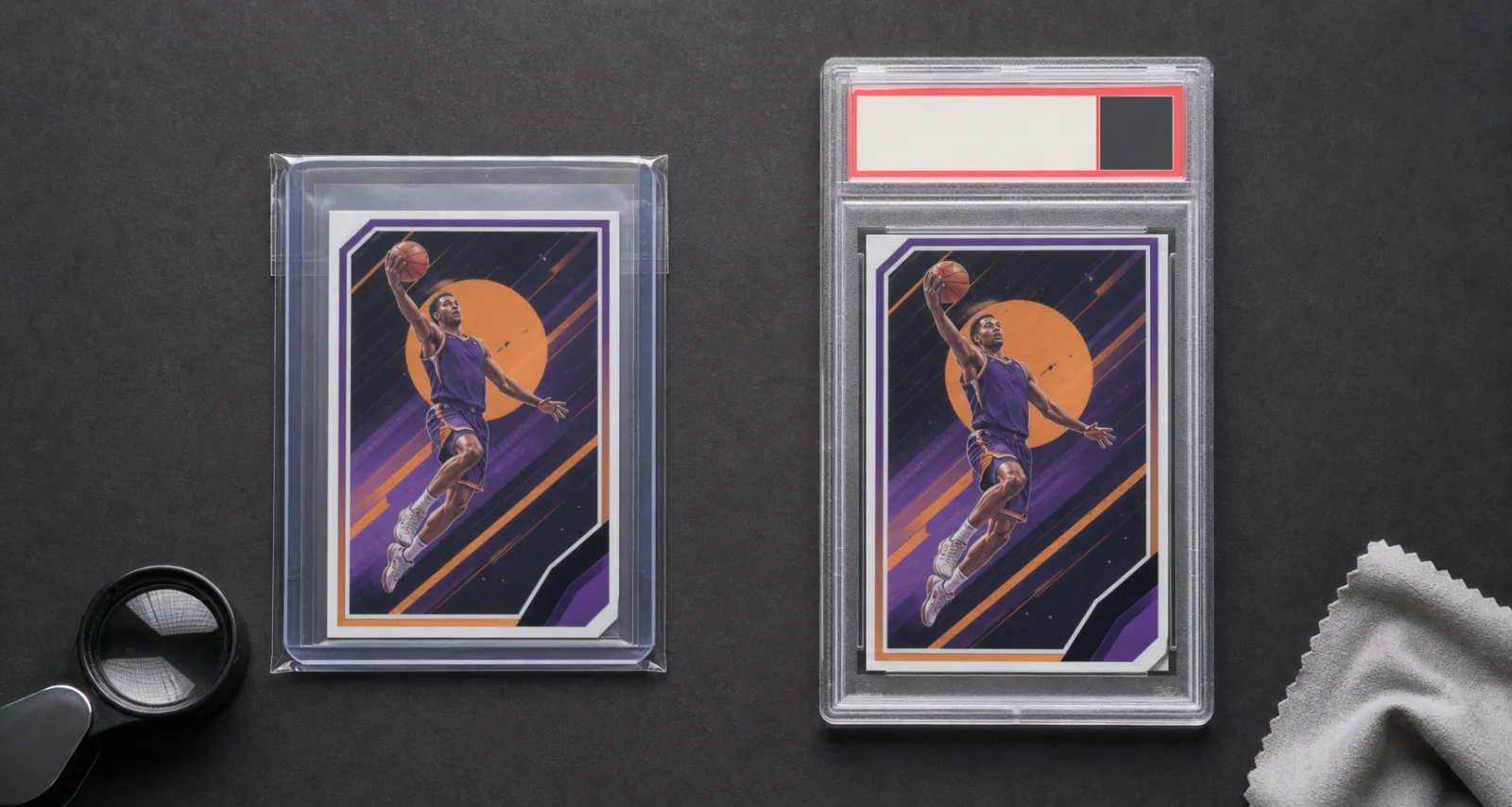
A raw card asks you to judge the copy in front of you. A slab adds a named grader’s authentication review, condition opinion, certification record, and holder. Choose raw when inspection, binder use, handling, or a later submission matters most. Choose graded when you want the assigned opinion and encapsulated format already in place. The comparison still has to be made card by card.
Graded vs Raw Cards: The Short Answer
Buy graded when you want an assigned third-party condition opinion, authentication review, certification record, and encapsulated holder. Buy raw when direct inspection, binder storage, handling, or submitting the card yourself matters more. Neither format is automatically the better buy. Match the exact card and variant, interpret a slab under the issuing grader’s standards, verify its certification record, and check completed sales for like-for-like copies.
A raw card lacks a third-party numeric grade. A graded card has passed through a grading service’s authentication and condition-review process and is sealed in a labeled holder. Format alone does not prove which copy is the stronger purchase.
The useful decision is documented condition versus collector flexibility:
| Decision factor | Raw card | Graded card |
|---|---|---|
| Condition evidence | The buyer evaluates the card, photographs, and seller’s description | An assigned third-party condition opinion appears on the label |
| Authentication | Depends on the transaction and its supporting evidence | The grader’s process includes an authentication review before grading |
| Protection | Depends on the sleeve, toploader, binder, or other storage | The card is sealed in an encapsulated holder |
| Certification | No grader certificate tied to a numeric grade | The label and certification record identify the graded item |
| Collection use | Suits binders, direct handling, personal inspection, or later submission | Suits slab displays and collections organized around assigned grades |
| Grading friction | No submission is required unless the owner chooses one later | The displayed grade has already been assigned |
| Question left for the buyer | Is the card’s identity and apparent condition represented accurately? | Do the exact card, grader, full grade, certificate, holder, and asking price align? |
“Raw” describes grading status, not authenticity or condition. A raw card is not automatically fake, damaged, untouched, or unverified through every other process. It simply has no numeric grade from a third-party grading service.
The goal is to choose a format without paying for slab features your collection does not need or treating a clean-looking raw card as an assumed future top grade. Someone building a binder set may value access and consistent storage. Someone building a grade-specific run may need the grader, complete label, and certification number to remain attached to each card.
Price does not settle that choice at the category level. The evidence reviewed for this page supports neither shortcut: raw cards are not always cheaper, and a slab does not always deserve a premium. When comparing singles or browsing online card packs, establish the exact collectible and its format before judging the individual copy.
What Am I Paying for When I Buy the Slab?
A front-only listing can show sharp corners while leaving the reverse, edges, and glare-hidden surface marks unseen. With a slab, a named service has already examined the physical copy, reviewed authenticity, assigned a condition grade under its own standard, created a certification entry, and encapsulated the card. You can inspect that finished record before buying. It does not establish a fair asking price or predict another grader’s conclusion.
On a PSA submission, the number is not the first question. PSA initially evaluates whether the card is genuine and checks for alterations such as trimming or recoloring. Condition grading follows. PSA documents that order in its published trading-card authentication and grading process, which means a genuine card can pass the authentication review and still receive a modest condition grade.
Sharp corners cannot carry the entire condition case. PSA’s grading standards also address centering, focus, gloss, staining, alterations, and eye appeal. PSA’s submission guidance directs collectors to inspect surfaces and edges as well.
A straight-on photograph may help with centering but reveal little about an edge problem or indentation. Glare can wash out a surface mark. Without a reverse image, one whole side remains unseen. The grader eventually examines the physical card, not the cleanest photograph selected for the listing.
A raw buyer therefore works with the seller’s description, available images, and whatever direct inspection the transaction permits. A slab carries a condition opinion from a named service and ties that opinion to a certification number. PSA says grading combines measurable criteria with subjective judgment. The assigned grade is a recorded assessment of that copy; another service does not have to reproduce it.
The finished fields are easy to see in CGC’s published grading process. Multiple professionals examine the card and reach a consensus final grade. The label then identifies the card, assigned grade, certification number, and QR code.
A buyer can compare those fields with the offered slab. The year, set, card number, variant, full grade label, and certification number should describe the same collectible. Where a certification lookup provides an image, that image adds another comparison point.
The holder does a narrower job than the grade. PSA and CGC describe physical-protection and security features intended to deter tampering, but encapsulation does not determine the card’s market value. The holder’s condition and the seller’s price still need their own checks.
Keep the service name attached to any grade you record. The PSA versus CGC versus SGC guide examines why grader names and labels matter.
Why Is a Raw Card Not an Assumed PSA Grade?
A raw card has no PSA grade. Photographs and inspection can reveal condition evidence, but they cannot establish the number PSA would assign after reviewing the card’s centering, surfaces, edges, stains, creases, alterations, and other details. Compare and price the copy as raw until PSA issues a grade.
“Looks clean” is an inspection note, not a grade. Glare may hide a surface defect. A scan can make an indentation hard to see. A front-only image leaves the back and much of the edge condition unanswered. PSA’s guidance specifically warns that an apparently strong card will not necessarily receive a gem-grade result.
No numeric grade also does not make a raw card automatically suspect. Separate authenticity evidence may exist without a condition number. The boundary is simpler: seller confidence and sharp photographs cannot issue a third-party grade. Until a grading service does so, no such number belongs to the card.
Even an issued grade needs its published definition. PSA calls a PSA 10 “virtually perfect,” not literally flawless, and its standard permits a slight printing imperfection when the issue does not impair overall appeal. PSA also says its process combines objective measurements with subjective judgment.
Read a PSA 10 as PSA defines it. The label does not establish that no defect could exist, and it does not bind another grading service to the same conclusion.
A comp sheet that records only “10” cannot tell you which result changed hands. CGC’s grading scale distinguishes Pristine 10 from Gem Mint 10. PSA applies its own definitions, and a card graded under SGC’s published scale must retain the SGC name. Grades below 10 need the same treatment.
The slab photograph should supply the service and complete label. Check those details against the certification entry’s grader, grade, and card description. If the label is cropped and the available entry does not restore the missing words, the grade remains incomplete. Do not patch that gap with a seller title.
Write the result as issued: “PSA 10,” “CGC Pristine 10,” or the applicable service and full label. A shared number does not turn separate grading results into equivalent standards or market values. The grader comparison guide covers the service differences.
Should I Buy Raw and Grade the Card Myself?
A binder, set, or ungraded display does not require a submission merely because the card is raw. Submit only when choosing the grading service matters enough to accept the charge, wait, and unknown result. Until a service assigns a grade, judge the existing card by its identity and visible condition rather than pricing it with an unissued label.
Start with the collection slot. A raw card can be sleeved and placed with the rest of a binder set without acquiring a numeric grade. It also preserves direct handling. If that format already fits the collection, grading is an optional change rather than unfinished work.
A run organized by a named service and complete grade creates another requirement. The certification entry and holder can be part of the target, not incidental packaging. Submission allows the collector to choose the service and timing. It does not allow the collector to choose the final grade.
Condition inspection still matters before that submission. Turn the card over. PSA advises examining both sides for surface and edge issues, centering, folds, creases, stains, and other damage. Those observations describe what is visible on the raw card now. They do not reserve a future label.
Submitting later introduces a service fee, waiting time, and an unresolved result. PSA publishes turnaround estimates rather than guarantees. Fees and estimates can change, so current service pages—not a fixed rule in this article—should provide those inputs.
A useful stress test is blunt: would you still want the card if it missed the grade you hope for? A purchase that works only after penciling in an unissued top grade is resting on an unsupported outcome.
That does not prove raw is always cheaper. Identity, variant, apparent condition, and seller documentation may differ between two listings before grading enters the comparison. Confirm that both listings represent the same collectible.
Raw/Graded Decision Worksheet: Fix the Card Before the Costs
Ignore price until the collectible is settled. A base card and its parallel may feature the same player or character and nearly identical artwork, but their sales belong in different groups. Autograph versions stay in their own groups as well.
Use one identity line for the target: year, manufacturer or brand, set, card number, player or character, parallel or variation, autograph status, and serial numbering where applicable. Admit a candidate sale only when it matches that line. Put mismatches aside instead of adjusting for them later.
Choose the transaction that is actually available:
| Decision lane | Evidence to record | Question it answers |
|---|---|---|
| Keep or buy raw | Exact raw identity, apparent condition evidence, matched completed raw sales, and intended binder, set, display, or handling use | Does the card work in its present ungraded form? |
| Buy graded | Exact identity, grader, complete grade label, certification record, holder condition, and matched completed sales for that same service and label | Is the documented slab the copy and condition record you actually want? |
| Buy raw and submit | Raw acquisition cost if not already owned, all-in grading cost, waiting time, possible grade and no-grade scenarios, and matched grade-specific completed sales | Does taking on submission cost and uncertainty improve the decision? |
The raw-and-submit lane splits on ownership. If you plan to buy the raw card, enter its acquisition price before adding grading expenses. That money must be committed to reach the submission stage. Omitting it understates the cost by making a planned purchase look like a card already in the collection.
An already-owned card starts from another position. Its old purchase price is not a new submission expense. Compare the net available from selling it raw now with each possible grade-specific net after submission costs; the current raw value matters because a raw sale remains available. Buying a finished slab bypasses the submission lane.
Do not stop at the advertised service charge. Shipping, insurance, preparation or supplies, quantity requirements, the eligible service tier, and other documented submission charges may belong in the total. Use the card grading cost calculator for the separate fee and break-even work. Current service pages should supply changing availability, value ceilings, minimums, and turnaround estimates.
Sold evidence must obey the same identity line. eBay Product Research reports actual sold prices, accepted Best Offers, shipping costs, date filters, and other transaction fields. Save those fields with each admitted record and note why any candidate sale was excluded. A sale for another parallel does not belong. Neither does an active listing, even when its card identity matches.
A raw card does not arrive with a known submission result. Give each plausible result its own worksheet row: the card stays raw, receives a lower grade, reaches the target grade, or receives no numeric grade. Any percentages attached to those rows are assumptions entered by the user. They are not facts hidden inside the listing.
Missing market inputs stop the calculation. If matched comps, current costs, or defensible assumptions are unavailable, write insufficient evidence. Do not convert a blank cell to zero or borrow a price from another variant. The worksheet cannot support a result more precise than its admitted records.
Collection use belongs beside that result, not inside the market cells. A binder owner may keep a satisfactory copy even if another lane produces a stronger calculated net. A grade-specific run may require a finished slab. A collector who wants to choose the service may accept the wait. Those are collection requirements, not price inputs.
Which Graded Card Advantages Matter Most?
Read the collection requirement literally. If it names a grader and complete grade, the target includes more than the underlying card: it includes the matching label, certification record, and encapsulated copy. A binder slot may need none of those additions. Direct handling, another grader, or another holder can make the finished slab the wrong format for that collection.
Year, set, card number, and variant establish the raw card’s identity. They do not supply a grading service, complete label, certificate, or holder. A raw copy can therefore be the correct collectible and still fail to complete a grade-specific run.
Buying the finished slab removes the need for a new submission. It also locks in work you may not have chosen yourself. If the service and label match the collection, that is useful. If you wanted another company or holder, the completed submission can be a constraint. Neither conclusion says anything about whether the asking price is justified.
Treat verification as a comparison among records and objects. The card and label shown in the listing should agree with the certification entry. Inspect the photographed holder for cracks, damage, or signs of interference. CGC’s graded-card verification guidance says eligible cards may have post-encapsulation images available through its certification system.
A matching database result is useful, but it does not finish the inspection. PSA’s certificate verification page warns that genuine certification numbers can be copied. Compare the physical card, holder, label details and typography, certification entry, any available record image, and the seller’s transaction evidence. A valid number cannot make the wrong card match the record or explain a suspicious holder.
Encapsulation reduces direct handling and supplies a purpose-built display format. It does not make the card immune from every hazard, establish the seller’s price, or remove the need to inspect the holder.
Certification evidence and market evidence have separate jobs. The first helps identify the grader’s recorded result. The second depends on completed sales for the exact card, variant, grader, full grade, and relevant holder condition. A valid certificate cannot manufacture a market-wide premium, liquidity advantage, resale result, or investment case.
Collectors who want those documented slab features can use Pullmarket’s graded-card category to reach current pack and outcome disclosures. The category does not promise that a particular card, grader, grade, or pack is available.
How Should You Compare the Exact Card Before Buying?
Put a raw base card beside a slabbed parallel and the price comparison stops before either amount matters. Shared artwork or the same player or character does not erase the parallel. An autograph and a non-autograph belong on separate lines too.
Build the line from fixed details: year, manufacturer or brand, set, card number, and the exact parallel, variation, or other identifier. The slab adds three more fields—the grader, complete grade label, and certification number. Its photographed label should agree with the available certification entry.
Now test the raw listing against that line. A player or character name is not enough. One conflicting fixed field excludes the sale. “Mint” in a seller title describes the seller’s view of condition; it is not a numeric grade.
Only after the identity matches should completed transactions be sorted. Ungraded sales go into the raw group. The slab group accepts the same collectible only when the issuing grader and complete grade label match as well. Submission costs and hoped-for future results do not belong in either group.
Do not create a general “10” bucket. PSA 10, CGC Gem Mint 10, CGC Pristine 10, and SGC 10 remain separate results under their respective services and published definitions. Matching the underlying card does not allow a PSA 10 sale into a CGC Gem Mint 10 group. A different parallel belongs in neither group.
The certification entry tells you what the grader recorded. It cannot inspect the slab offered in the listing. Compare the pictured card, label, and holder with the entry and any available record image. A holder that appears undamaged still has to contain the collectible described by that certification record.
An empty comp group stays empty. Completed raw transactions cannot stand in for a missing service-and-grade sale, and graded transactions cannot supply a raw comp. An active asking price, a nearby parallel, or an imagined future grade does not repair the gap. Record the market evidence as limited and leave the comparison unresolved.
Collectors deciding what to do after acquiring a card can consult the guide to selling sports cards online. Keep that cash-market research separate from Pullmarket sellbacks, which use non-cashable Pullmarket Gems store credit.
How Pullmarket Fits a Graded-Card Preference
Start with the live pack, because that is where the current outcome formats appear. Pullmarket pulls are real physical collectible cards, but a displayed outcome may be raw or ungraded, or it may carry a professional grade from a recognized service such as PSA, CGC, or SGC.
From the graded-card browse path, open the pack you are considering and read its outcome details and published odds. The category is a navigation path. It does not confirm that a particular card, pack, service, or grade is available.
A pulled card can remain in the Vault, ship as a physical card, trade where enabled, or be sold back to Pullmarket at a market-based buyback for Pullmarket Gems. Gems are non-cashable store credit. See how the Pullmarket Vault works for holding and shipping choices, or how Pullmarket works for the broader pack-opening process.
Pullmarket does not operate as an entirely pre-stocked in-house vault. Some pulled cards are held in Pullmarket custody. Others are reserved against verified supplier or partner-vault inventory and sourced on demand at redemption. The legitimacy and verification overview provides more detail about that operating model.
No current inventory record for this article verifies a named card, pack, grader, or grade. Use the live category and pack disclosures to see what Pullmarket presents now rather than treating an example or general statement here as an availability promise.

Browse graded card packs online. New here? See how Pullmarket works.