
PSA vs CGC vs SGC: Which Grading Company Fits Your Cards?
There is no source-supported universal winner among PSA, CGC and SGC. Choose by the exact card, complete grade designation, registry goal, current service-tier conditions, and matched sales for that same card and designation. PSA 10 is Gem Mint; CGC and SGC each distinguish Gem Mint 10 from Pristine 10. PSA also uses half grades from 1.5 through 8.5, but not 9.5.
Buying a finished slab and submitting a raw card expose different problems. A buyer has to reconcile the card, its full label, the certification record and comparable sales. A submitter must also check whether the issue is accepted, which value limit applies, what the order costs, how timing is measured and what happens if the card is altered or unsupported. Mutable service information in this guide is dated August 10, 2026.
Which Is Better: PSA, CGC or SGC?
No company clears every test for every collector. The useful choice is the grader that accepts the exact issue, provides the label you want to own, fits a real registry goal, has a workable current service tier and can be evaluated with relevant matched sales. A familiar brand name cannot answer those card-level questions.
A buyer should start with the object already in front of them. Confirm the year, manufacturer, set, card number, parallel or variation, language, autograph status, serial numbering, grader, and complete grade designation. Then use the issuing grader's certification tool and inspect the pictured slab. Only after identity is clean should sale prices enter the decision.
A submitter starts one step earlier. The raw card's condition matters, but so do issue-level eligibility, holder fit, declared or insured value, service access, minimum quantities, and the grader's treatment of alterations. The company with the lowest visible fee can be unusable if the card exceeds that tier's value band or fails its acceptance rules. Our graded-versus-raw card guide explains why grading cost should be weighed against the actual card rather than against a generic upside story.
This research did not establish that PSA is universally best for modern sports cards, CGC for Pokemon, or SGC for vintage. All three cover broad card categories, but broad coverage does not guarantee that every issue, size, material, alteration, or autograph is eligible. It also does not establish which label buyers will pay more for on a specific card.
The practical verdict is conditional:
The PSA vs CGC vs SGC choice therefore starts with a card and a purpose, not a brand slogan.
- Prefer a grader's registry path when the card must fill a documented slot in that grader's set-building system.
- Prefer the eligible current service tier when you are submitting and its complete terms fit the card and order.
- Prefer the specific slab when you are buying and its card identity, certification record, label, condition, and price all survive verification.
- Defer the decision when the exact issue's eligibility or the market evidence is unresolved.
SGC vs PSA Grading Scale and CGC Labels
The three scales cannot be reduced to one shared number. PSA 10 is Gem Mint. CGC publishes both Gem Mint 10 and Pristine 10. SGC publishes 10 GM and 10 PRI. PSA uses half grades from 1.5 through 8.5, CGC and SGC use half points below 10, and the full company-specific designation must remain attached.
The number 10 describes at least four distinct current labels in this comparison: PSA Gem Mint 10, CGC Gem Mint 10, CGC Pristine 10, SGC 10 GM, and SGC 10 PRI. That is actually five labels, not one interchangeable market bucket. The official PSA grading standards, CGC Cards grading scale, and SGC grading scale define their own terms. None of those pages creates a cross-company conversion chart.
PSA's half-grade rule deserves special attention because the older version of this page implied that PSA did not use half grades. PSA announced half-point grades effective February 1, 2008, covering 1.5 through 8.5. The company did not add a 9.5. Pre-existing whole-number grades remained valid, and cards could be submitted for review rather than being automatically renumbered. The dated PSA half-grade announcement is the source for that boundary.
Do not copy a numeric grade from one company into another company's condition vocabulary. A PSA 8.5, CGC 8.5, and SGC 8.5 are decisions under different published standards and processes. Even when the labels share a number, a market comparison still requires separate grader-and-designation groups.
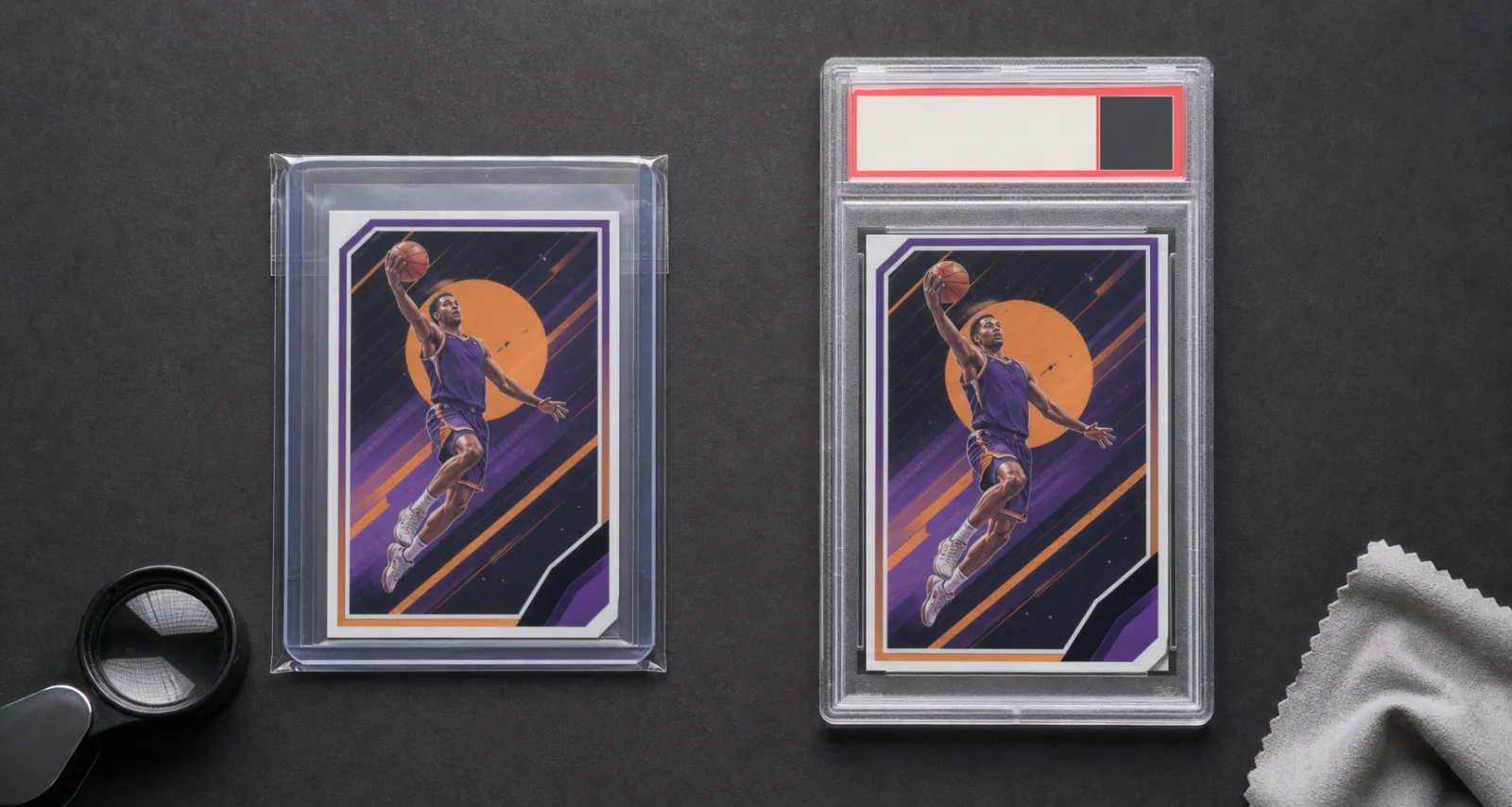
Condition also remains visible through the holder. A slab does not erase centering, corners, edges, surface, print defects, or eye appeal. If a listing image makes the label legible but not the card, it is insufficient for a buying decision. Use the graded versus raw card guide to inspect the card itself instead of treating the grade as a substitute for the object.
PSA, CGC and SGC Comparison Matrix
This matrix compares the fields that can be verified without inventing a universal ranking: current top-grade labels, half-grade structure, eligibility boundary, service denominator, official tools, legacy-label rules, and resale-evidence status. Service facts were observed August 10, 2026 and must be rechecked before submission.
| Decision field | PSA | CGC Cards | SGC |
|---|---|---|---|
| Current top labels | Gem Mint 10 | Gem Mint 10; Pristine 10 | 10 GM; 10 PRI |
| Half grades | 1.5 through 8.5; no 9.5 | Half points below 10 | Half points below 10 |
| Broad card scope | Sports, non-sports and TCG coverage, subject to catalog, research and holder limits | Broad sports, TCG and non-sports coverage with published exclusions and holder limits | Broad submission language with case-by-case refusal and material limits |
| Altered or unsupported outcomes | Numeric grade may be refused; grader-specific Authentic or Authentic Altered outcomes can apply at discretion; questionable authenticity is not encapsulated | Altered, counterfeit, replica, cleaned or restored cards do not receive a numeric grade and are not encapsulated under the inspected rules | Terms reserve refusal for altered, counterfeit, oversized, custom-cut, non-standard or fragile items |
| Active direct-service denominator | Four active captured tiers; Value services were paused | Six active captured tiers; Bulk has a 25-card minimum | Eight active captured value-band rows; no minimum was published in the captured table |
| Official value term | Max Insured Value | Max. Value per Card (USD) | MAXIMUM DECLARED VALUE |
| Turnaround unit | Estimated business days | Estimated working days | Estimated business days; clock starts after unboxing and logging |
| Cert lookup | Public PSA cert input; PSA warns a database match does not eliminate counterfeit risk | Public CGC cert lookup; security verification may appear | Public SGC code lookup with reCAPTCHA and label-specific code formats |
| Population report | Official entry redirected to account sign-in on the observation date | Public CGC report; grader-specific counts | Public SGC report with reCAPTCHA and an official historical-data warning |
| Registry or collection tool | Official Set Registry link verified; current feature page was not captured through its access boundary | CGC Trading Cards Registry requires a membership, including Free, to participate | No competitive set registry found on inspected surfaces; My Cards is collection management, not relabeled as one |
| Corporate boundary | Collectors brand | CGC card-grading division within Certified Collectibles Group | Collectors brand with distinct SGC customer-facing operations |
| Universal resale rank | Not established | Not established | Not established |
The matrix is deliberately uneven where the evidence is uneven. “Unknown” or an access boundary is more accurate than filling a cell from reputation. PSA and SGC appearing in the same Collectors brand portfolio does not merge their graders, standards, guarantees, submission systems, certification databases, or population reports. CGC belongs to a different group structure in the inspected official sources.
The service row count is also a denominator, not a quality score. Four PSA rows, six CGC rows, and eight SGC rows do not mean one grader offers a better service. The rows use different value bands, fee models, timing units, and availability states. For a calculation using the full dated tier database, use Pullmarket's card-grading cost calculator.
Best Sports Card Grading Company: Fee and Turnaround Test
Headline fees are not directly comparable until the card fits the same decision denominator: active tier, card quantity, official value limit, fee formula, included services, access condition, timing unit, and clock boundary. The figures below were captured August 10, 2026 and are observations, not evergreen recommendations or promised completion dates.
PSA: The captured direct table showed Value services temporarily paused. Active rows began with Regular at $79.99 per card, a $1,500 Max Insured Value, and an estimated 40 to 50 business days. Express was $149 with a $2,500 maximum and 20 to 30 business days; Super Express was $349 with a $5,000 maximum and 10 to 15 business days; Walk-Through was $599 with a $10,000 maximum and 7 to 10 business days. PSA's official page calls the timing estimates. It also varies inclusions such as imaging and grader notes by tier. Read the current PSA trading-card service page before preparing an order.
CGC Cards: The captured direct table contained six active rows. Bulk was $17 per card, limited to $500 Max. Value per Card, carried a 25-card minimum, and showed 150 working days. That bulk price is not a one-card offer. Other captured flat-fee rows increased through Economy, Standard, Express and WalkThrough. Unlimited Value used a $300 base fee plus 1% of FMV, with the packet retaining uncertainty about how membership discounts apply across both components. CGC states that additional identification research can extend estimates, and its declared-value policy allows tier reassignment and an added fee when a card does not qualify for the selected tier. Consult CGC's live services and fees rather than carrying the captured figures forward.
SGC: The captured table contained eight direct value-band rows. The lowest observed base fee was $15, attached to a specific maximum-declared-value row, while a standard row through $3,500 was $85 at an estimated 75+ business days. The expedited row through $3,500 was $150 at 2 to 3 business days. Higher expedited bands rose with maximum declared value. Above $100,000, the page showed a $3,750 base plus $375 for each additional $10,000, but did not publish how a partial increment is rounded. SGC says its clock starts after an order is unboxed and logged, not when the parcel is handed to a carrier, and its terms say timeframes are not guarantees. Recheck the SGC pricing table on submission day.
A defensible fee comparison has four totals: grading service, grader add-ons, order-level costs, and outbound or return logistics. A per-card headline excludes any cost that the service card does not explicitly include. The fee artifact left fixed order fees, shipping, insurance, supplies, taxes, and several minimum rules unknown rather than silently treating them as zero.
This is why the “cheapest” and “fastest” labels are blocked. A CGC bulk row and an SGC standard row do not share a quantity minimum, value term, or timing unit. PSA's captured entry tier was affected by a temporary pause. The right comparison is the total for your order under the live rules, not the smallest number visible on three pages.
CGC vs PSA Card Grading: Eligibility and Rejections
All three grade broad categories, but exact-card eligibility remains issue-specific. Check the card's catalog identity, size, thickness, cut, autograph type, material and alteration status against the live grader rules. A broad statement that a company grades sports cards or TCG cards does not promise acceptance of every issue.
PSA says it grades most cards cataloged in major sports-card publications and describes sports, non-sports, modern, vintage and TCG coverage. The boundary is real: catalog research and holder fit can control acceptance. Its cards PSA grades page directs uncertain issues toward research and identifies specific limitations. PSA may grade a card intended to be hand-cut from a panel or box if the required border survives, while a traditional sheet-cut copy of an issue normally sold as individual cards is excluded under the inspected standards.
PSA's no-grade codes distinguish several reasons rather than one generic rejection. Trimming, restoration, recoloring, altered stock, cleaning, minimum-size problems and miscuts can prevent a numeric grade; Authentic or Authentic Altered outcomes may be available for some categories at grader discretion when requested. Questionable authenticity does not qualify for encapsulation. Those outcomes matter before spending money on a raw card described as “gradeable.”
CGC says it grades virtually all sports, TCG and non-sports cards and all card languages, then publishes both physical limits and named exclusions. The captured CGC cards-we-grade page specified a size and thickness envelope and warned that irregular thick cards can still be impossible to encapsulate. Factory-cut odd sizes may qualify if they fit safely. Hand-cut cards can receive a numeric grade when cataloged measurements are met, while undersized examples can be limited to Authentic with a Hand Cut attribute.
CGC's inspected rules excluded or restricted altered, counterfeit, replica, cleaned, restored, rebacked and clipped cards, along with multiple named issues. Pack-pulled manufacturer-certified autographs and other autograph pathways do not share one automatic rule. The exact autograph type must be checked against current CGC or CGC x JSA requirements.
SGC's inspected terms use broad submission language but reserve case-by-case refusal. Altered, counterfeit, oversized, custom-cut, non-standard or fragile items can fall outside grading or encapsulation. Unlike the normalized 138-row eligibility audit available behind this page, SGC's public materials did not provide one exhaustive current issue-level acceptance list. That missing list should not be replaced with an assumption.
Before mailing, put the full submission identity in writing: year, set, number, parallel, language, variation, autograph status, serial status, officially documented dimensions and the specific eligibility concern. An unresolved field belongs in a question to the grader, not in a guess on the order form. The same identity check applies to sports-card packs: rarity, condition and value only become meaningful after the product and card are correctly identified.
CGC vs PSA Slabs: What Verification Tools Prove
A certification lookup checks the grader's database record for a number. A population report counts that grader's recorded certifications. A registry organizes eligible certified cards under its own rules. A collection-management app records holdings. None of these tools, by itself, proves a pictured slab is genuine, total surviving supply, rarity, value, or cross-grader equivalence.
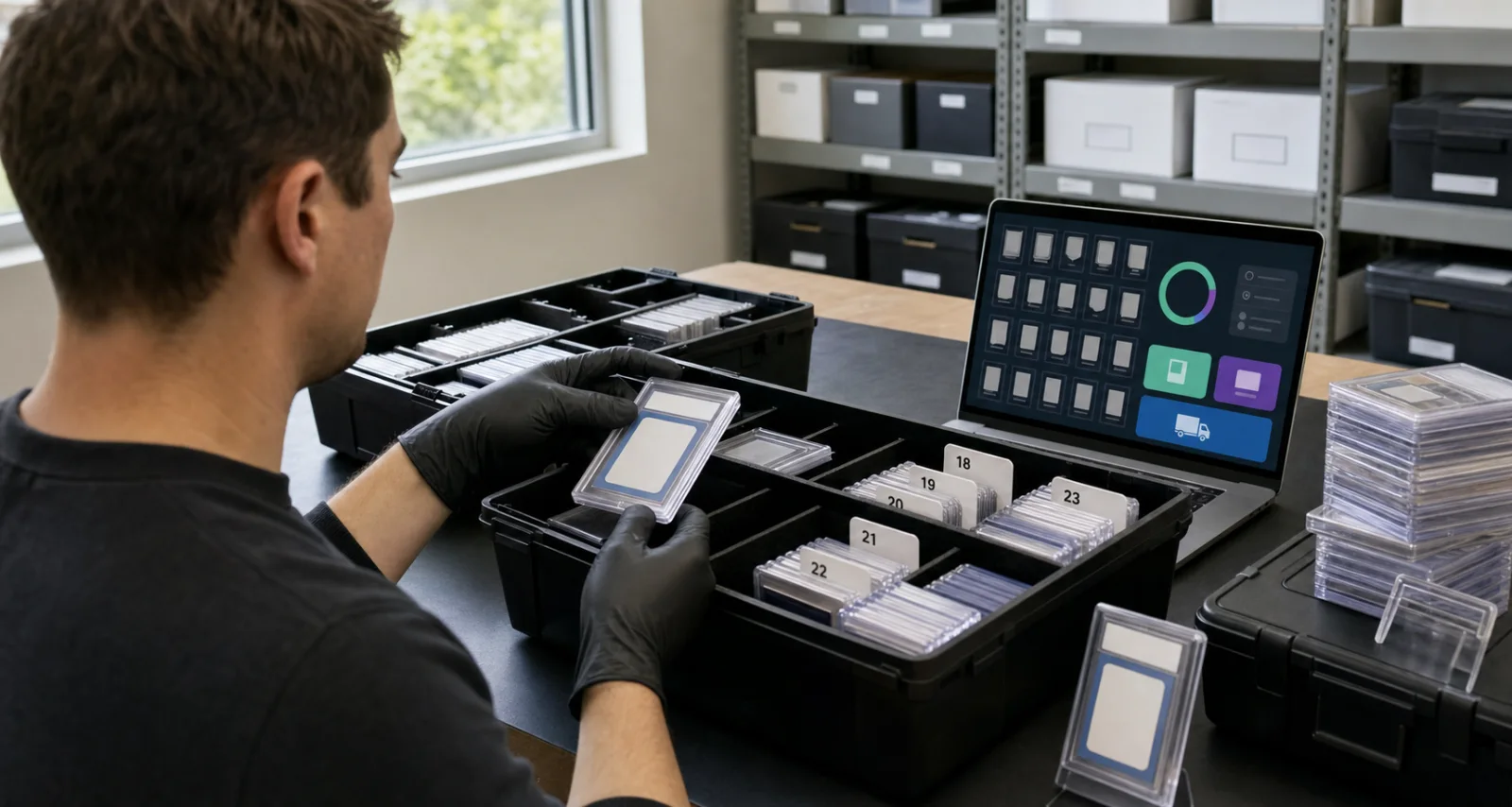
For a slab purchase, use a three-way check:
- Read the label. Capture grader, complete grade designation, certification number, year, set, card number, parallel or variation, and any autograph or serial details.
- Open the issuing grader's record. Compare every available identity field. PSA's cert page expressly warns that matching database information does not eliminate counterfeit risk.
- Compare the pictured object. The card and holder shown by the seller must agree with both label and database record. A valid number attached to the wrong photo is still a failed buying check.
The database is a record, not remote authentication of the item on screen. This boundary matters on marketplace listings, where a title can omit a parallel and a stock photo can hide the actual holder. For a broader view of Pullmarket's physical-card and fulfillment model, Is Pullmarket legit? explains what happens after a pull.
A population report counts records inside one grader's catalog. It leaves out ungraded cards, copies certified by another company, unmatched catalog entries and every surviving copy that never entered that grader's system. CGC expressly says its figures do not indicate rarity or value. SGC adds a different warning: historical report data may contain inconsistencies or duplicates.
Access also differs. PSA's population-report entry redirected to account sign-in during the August 10 inspection, so this audit does not claim to have inspected the authenticated report. That access result is enough to describe the boundary, not the data behind it.
Registries solve a collection problem rather than a population problem. If a collector is building documented slots inside one grader's system, registry support can affect the choice. CGC allowed public browsing, while participation required a membership that could include the Free tier. PSA's official Set Registry link was verified, but the audit did not capture current feature details past the access boundary. On the SGC surfaces inspected, My Cards appeared as a collection-management tool; a competitive set registry was not verified. That is a finding about the inspected surfaces, not a claim that one could never exist.
CGC Grading Value vs PSA and SGC: The Evidence Test
No current universal resale ranking for PSA, CGC and SGC emerged from this research. To compare value, collect completed sales for one exact card and one complete grade designation during the same declared window. Fees, shipping, accepted offers, lots, returns, duplicates and outliers need the same treatment in every grader group.
Start by defining the card identity narrowly: year, manufacturer, set, card number, base or parallel, language, variation, autograph status and serial-number status. Then define the grade groups. CGC Gem Mint 10 and CGC Pristine 10 are separate groups. SGC 10 GM and SGC 10 PRI are separate groups. A PSA 10 is not relabeled as either one.
Next, keep only completed arm's-length transactions. Record sale date, currency, venue, sale type, buyer premium, shipping, and whether the accepted price is known. Active asking prices do not show what a buyer paid. A crossed-out listing with an undisclosed accepted offer is not an exact sale price. Lots and single-card sales cannot be pooled without a declared allocation rule.
Finally, apply one observation window and a minimum sample rule to every grader. Publish counts, medians and uncertainty, not just the highest sale. If one group has two records and another has forty, the difference in evidence strength belongs beside the result.
The packet audited a 2020 Sports Card Investor PSA-versus-SGC article rather than dismissing it. The page contained card-level examples and enough disclosed figures to reconstruct some calculations, but it did not expose a raw sold-item ledger or item URLs. Several examples used unequal windows, one-card personal sales, estimated accepted offers, different sale channels, or different percentage denominators.
One illustration shows why denominator labels matter. For the article's reported 2019 Prizm Zion Williamson averages, $385 for SGC and $610 for PSA, the $225 difference is a 36.89% SGC discount from PSA but a 58.44% PSA premium over SGC. Calling both “about 40%” erases the denominator. The calculation can be checked; the underlying sale sample cannot be fully reproduced from the article alone.
That historical two-grader snapshot cannot support a current three-grader hierarchy. It can teach the method: retain exact cards and designations, equalize windows, disclose raw transactions, name the denominator, and stop when the evidence is too thin. Collectors planning an exit can use Pullmarket's guide to selling sports cards online for the transaction questions that sit outside a grading label.
CGC Graded Cards vs PSA and SGC: Legacy Labels
Read an older slab by the issuing grader's dated rules. PSA kept old whole grades valid after adding half grades in 2008. CGC's 2023 materials define selected CSG and CGC Trading Cards transitions. SGC's historical population display literally maps 98 to 10, not to an inferred 10 GM. These are company-specific records, not cross-grader conversions.
PSA made two separate changes in February 2008. The half-grade policy added points from 1.5 through 8.5 without renumbering whole grades already assigned. A February 12 label update then placed the grade number below the written description on post-launch labels. Those announcements identify a transition; they do not catalog every PSA holder generation.
A different-looking label therefore needs more than visual pattern matching. Check the certification record, the holder and the card. Label appearance alone cannot authenticate the slab.
Current CGC Cards holders sit after both CGC Trading Cards and CSG labels, and the official merger documents do not treat every legacy fact the same way. Selected Gem Mint 9.5 labels have stated online-display treatment. Perfect 10 has its own rules. The label already on a holder, the designation shown online and the result of a reholder request must be recorded separately.
“CSG” should remain “CSG” when describing a legacy sports-card slab. Current CGC Cards may have published transition rules for its record or reholder, but that does not change the visible company name on the original label. It also supplies no conversion to PSA or SGC. Use the dated CGC rule that applies to the holder in hand.
SGC's certification tool expects different code formats for black labels and green or white labels. Its deployed population interface supplied another kind of reference: an old-to-current display key whose literal entries include 98 to 10. The key does not say “10 GM.” It does not promise a reholder result and says nothing about equivalence to a PSA or CGC grade.
Shared ownership cannot fill those gaps. Collectors presents PSA and SGC as brands in the same portfolio, yet each keeps its own public site, submission path, support, certification lookup and population system. Their old labels and current grades remain separate. When browsing online card packs, copy the grader and visible designation exactly instead of reducing the slab to its number.
A Buyer-versus-Submitter Decision Workflow
The slab buyer and the raw-card submitter should not use the same sequence.
If you are buying a graded card
- Pin down the card before reviewing price: year, set, number and every variation field that could place it in a different market group.
- Copy the grader's full designation. Pristine, Gem Mint, GM and PRI cannot be reduced to a generic numeric grade.
- Open the certification record and compare it with both the label and the pictured card. Any conflict remains unresolved.
- Look through the holder at the card itself; the assigned grade does not replace that inspection.
- Build the comp set from completed sales of the same card and designation under one documented method.
- Let a registry or collection tool influence the purchase only when it serves the collection you are actually building.
If you are submitting a raw card
- Start with acceptance. Confirm the issue, size, cut, material, autograph and alteration rules that apply to this card.
- Assess condition conservatively, then name the job grading is meant to do: collection, protection, authentication or sale.
- Use a live tier whose official value term covers the card's current value.
- Price the order as an order. Include minimum quantities, formulas, add-ons, logistics and insurance where applicable.
- Read both the turnaround unit and the point when its clock begins. Published timeframes remain estimates.
- Keep the terms and observation date used for the submission decision; the service table may change before a later order.
The graded-card page on Pullmarket does not establish that a particular PSA, CGC or SGC slab is currently available. It is a category browse path. A live pack can include raw or third-party-graded outcomes, so its displayed details and published odds—not this comparison—determine what is currently shown. Review those fields before opening rather than treating the article as an inventory list.
Pullmarket lets collectors browse packs containing real physical card outcomes, inspect published odds before opening, and then hold a pull in the Vault, request shipment, trade where enabled, or accept a market-based buyback in Pullmarket Gems store credit. Gems are non-cashable. Pullmarket uses hybrid fulfillment, so some cards are held in its custody while others are reserved through verified supplier or partner-vault inventory until redemption. How Pullmarket works describes that ownership flow, and the graded-versus-raw guide helps evaluate the card after the reveal.

Browse online sports card packs. New here? See how Pullmarket works.