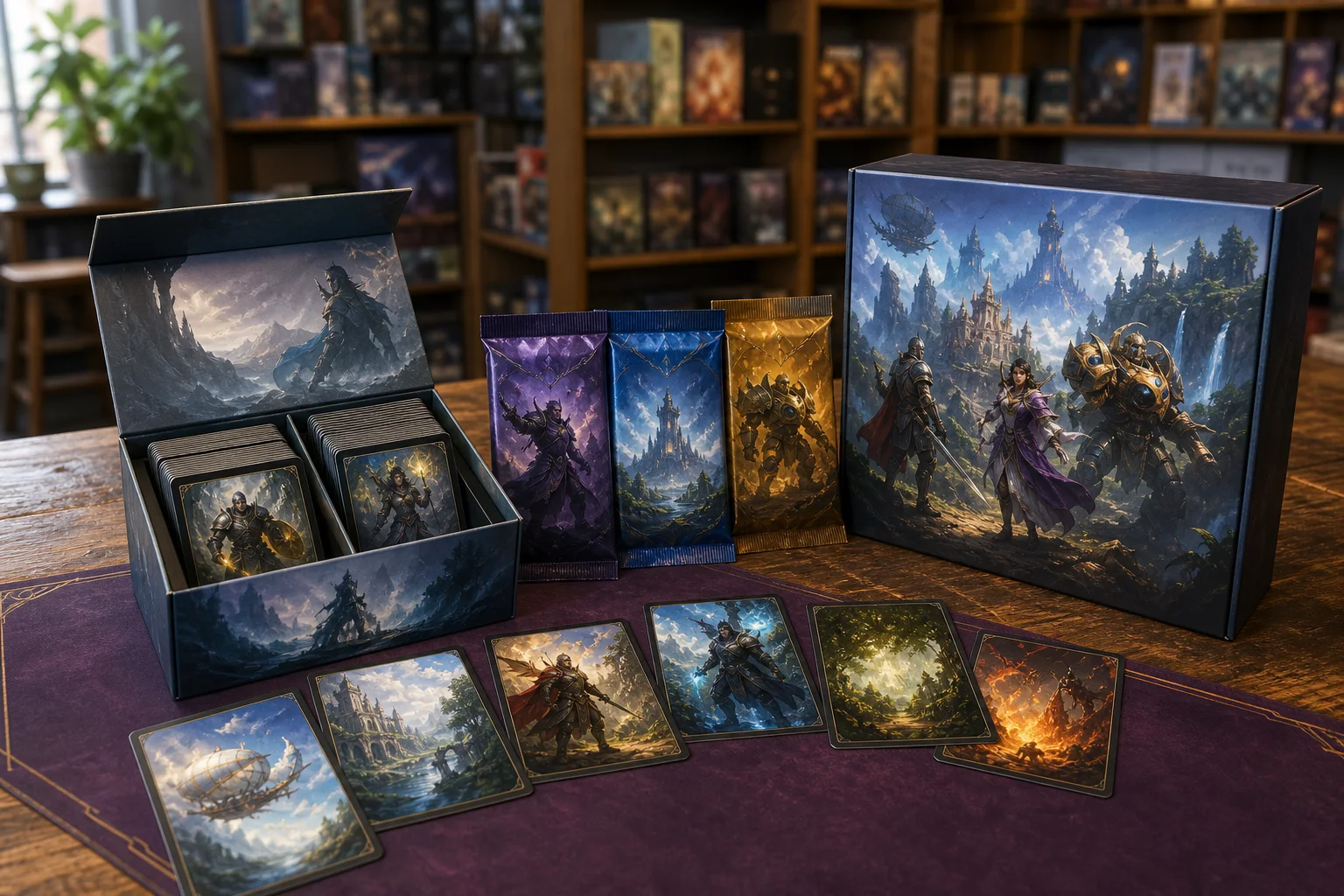
What Are Lorcana Cards? Starter Decks vs Booster Packs
Lorcana cards are game pieces and physical collectibles. Buy a named ready-to-play starter deck if the immediate goal is ordinary play. One loose booster contains randomized cards, not a complete 60-card deck. Pack Rush is the important exception: it is a separate official format that uses two boosters per player under different rules.
Start with seats, not the box front. The featured character does not reveal how many decks are inside, and the word "starter" is not a player count. Write down how many people need to play. Then count the complete decks listed in the exact product description. Tokens, rulebooks, art, and bonus packs can matter after the deck requirement is covered.
The first-purchase error to avoid is counting every card-containing item as a playable setup. A booster supplies cards. A playmat gives one player a surface. Tokens record game state. None covers an ordinary-play seat unless the product description explicitly identifies a complete deck.
What Are Lorcana Cards?
Lorcana cards belong to a deck-building game in which players quest for lore. In ordinary play, the objective is to reach 20 or more lore. Current rules name four top-level card types: characters, actions, items, and locations. A Song is an action governed by additional rules, not a fifth top-level type.
The current Comprehensive Rules, version 2.2.0, effective July 9, 2026, is the controlling source for card types and card fields. It separates four jobs:
| Card type | What the label tells a beginner |
|---|---|
| Character | The card can have strength, willpower, and lore values, and may quest or challenge under the rules. |
| Action | The card resolves its effect when played. Songs are actions and use their own additional rule. |
| Item | The card remains in play and operates through its printed abilities. |
| Location | The card enters play with location characteristics and printed abilities. |
That taxonomy matters at the table, but it does not answer the checkout question. A booster can contain several card types and still fail to provide a legal starting deck. Conversely, a preconstructed deck can be ready for its intended ordinary-play seat even if the buyer does not yet know every card interaction.
Read a character card during a game and its fields answer several separate questions. Cost states what playing the card requires. The inkwell symbol shows whether it can enter the inkwell under the applicable rules. Ink type, name and version, and rules text provide other information. Strength, willpower, and lore values each have their own job on a character card. These fields describe the card, not the product box; none states how many complete decks the buyer receives.
Disney's beginner overview explains the 20-lore objective in plain language and treats playing and collecting as different activities. Keep product terms inside the correct game. The Pokemon card guide covers another game's cards, so it cannot verify what comes in a Lorcana product.
Starter Deck vs Booster Pack: The Fast Buying Rule
A Lorcana product covers one ordinary-play seat only when its own listing identifies a ready-to-play deck. A loose booster covers none. Its randomized cards suit opening, collecting, or possible changes to a deck already in use. The count does not change when a starter box also includes a booster: one documented deck plus one randomized pack is still a one-deck product.
The checkout calculation is documented deck shortfall = max(0, intended player seats - complete decks explicitly included). Use it only for ordinary play. Packs, token sets, rules sheets, and characters pictured on the packaging add zero to the complete-deck column. The source check for the worked rows below was completed on August 10, 2026.
| Exact product or format | Intended use in this audit | Complete decks explicitly documented | Stated deck size | Randomized boosters documented | Seats assessed | Ordinary-play deck shortfall | Source |
|---|---|---|---|---|---|---|---|
| The First Chapter Starter Deck | Ordinary play for one buyer | 1 | 60 cards | 1 | 1 | 0 | Official product page |
| The First Chapter Booster Pack | Randomized expansion or collecting | 0 | Not a deck | 1 | 1 | 1 | Official product page |
| Illumineer's Quest: Deep Trouble from Ursula's Return | Named cooperative product; included here to show configurations vary | 2 prebuilt decks | 60 cards each | Not counted in this audit | 2 for its documented product setup | Not transferred to ordinary constructed play | Official Ursula's Return page |
| Pack Rush | Separate special format | 0 preconstructed decks | Different format; not an ordinary deck | 2 per player | 1 Pack Rush participant | Not applicable to ordinary play | Official Ways to Play page |
The calculation transfers to another product; the component numbers do not. The First Chapter documents what its named starter and booster include. Deep Trouble documents a different configuration with two prebuilt decks. Neither example establishes the contents of every starter, cooperative box, or booster. A new audit row needs its own exact product name, intended format, expressly documented complete decks, and separate randomized-pack count.
Use the same discipline in Pullmarket's pack directory. It presents collecting products whose live pages control their formats and details. A starter-deck assumption borrowed from Lorcana—or from another game—cannot fill in information missing from a current pack page.
How Many Decks Do Two Players Need?
For ordinary play, a two-beginner cart must contain two appropriate complete decks. The named The First Chapter starter documents one 60-card preconstructed deck. Its booster—and any loose booster placed beside it—belongs in the randomized-card count, not the deck count. One starter plus boosters therefore covers one seat. The other beginner needs another appropriate deck unless an exact product listing documents a different setup for the intended use.
Consider the actual receipt: one The First Chapter starter and one loose booster for two beginners. The starter supplies the one documented deck. The loose booster supplies more randomized cards. Run the ordinary-play calculation and the gap is max(0, 2 - 1) = 1.
- Mark the intended format: ordinary play. Pack Rush and a named cooperative product use their own materials and do not enter this calculation.
- Write down the head count: two beginners, each requiring an appropriate complete deck for the ordinary game.
- Credit only documented deck language. Complete, preconstructed, or prebuilt deck counts; the loose booster stays on a separate line.
- Do the subtraction: two seats minus one confirmed deck leaves one seat uncovered.
- Check the listing again before checkout. A component count from an older product does not verify a newer SKU.
The word "starter" helps identify a product's intended role, but it is not a capacity field. One starter box may contain a single deck, learning materials, and a booster. Another named product may expressly support two players. The component list settles the difference. Package size and the number of characters on the box do not.
The same subtraction produces three ordinary-play results. Pack Rush and Deep Trouble remain separate because their named setups answer different questions.
| Buyer or format | Documented contents | Audit result |
|---|---|---|
| One beginner, ordinary play | One exact starter listing that documents one complete deck | max(0, 1 - 1) = 0; the ordinary-play seat is covered. |
| Two beginners, ordinary play | One documented one-deck starter plus any number of loose boosters | max(0, 2 - 1) = 1; one ordinary-play deck is still missing. |
| Two beginners, ordinary play | Two exact starter listings, each documenting one complete deck | max(0, 2 - 2) = 0; both seats are covered, subject to each product's current description. |
| One participant, Pack Rush | Two boosters and the current Pack Rush rules | The ordinary-play formula does not apply. These materials fit the named special format, not ordinary constructed play. |
| Players using Deep Trouble as documented | The named product's two prebuilt 60-card decks | Use the product's intended setup. This example shows that configurations vary; it does not establish a universal two-deck rule for Lorcana boxes. |
The complete-deck column excludes tokens, playmats, counters, a rulebook, foil cards, storage materials, and cover art. Those contents can make a box more useful or enjoyable without covering another ordinary-play seat. A larger package and a longer contents list still leave the same shortfall when only one complete deck is expressly documented.
Condition answers a different question from player coverage. A desirable raw or graded card can still cover zero game seats. Use the graded-versus-raw guide for that collecting choice, not for the deck count.
What Comes in a Lorcana Starter Deck?
There is no safe universal component list for every Lorcana starter product. The official The First Chapter example names one preconstructed 60-card deck, two foil cards, 11 game tokens, one rulebook, and one 12-card booster. Those counts belong to that named product and should not be copied onto later starters.
The official The First Chapter product page is useful because it puts the deck and booster side by side. One is a selected 60-card list. The other is a 12-card randomized product. The booster adds an opening experience to the box, but it does not increase the complete-deck count from one to two.
The Four Fields to Check
Keep the deck and booster on different lines when reading the exact SKU:
- Copy the format claim as written. "Ready to play," "preconstructed," "cooperative," "Pack Rush," "collection," and "gift" do not describe the same use.
- For decks, record only what the listing expressly includes. Keep any stated deck size beside that count.
- Tally randomized boosters separately. They may be extras inside another product or the required materials for a named special format.
- Use the official participant description for seat coverage. Characters pictured on the package are artwork, not evidence of player capacity.
A product-family name cannot supply missing specifications. "Starter Deck," "Collection Starter Set," "Gift Box," "Illumineer's Quest," and "2-Player Starter Set" describe different named products, not interchangeable boxes under one brand. A collection product may help someone organize or begin a collection without being the shortest route to ordinary play. A quest product may include decks for its documented scenario. The contents list—not the familiar word on the front—decides what the buyer receives.
Keep the identity attached to the count. Record the exact product name, its set or edition, the official URL, and the date checked together. A number detached from that record cannot verify the box under consideration.
A copied component count can remain in circulation after the official listing changes. It can also lose the set name that originally limited the claim. Secondary coverage may explain a comparison method; the current official catalog controls the contents of the current SKU.
Save one receipt line in this form: product name | set or edition | intended format | complete-deck count | stated deck size | booster count | player coverage | official URL | date checked. If the delivered box later raises a contents question, that line identifies exactly what was checked before checkout.
When a description promises "cards" but never says "deck," enter zero for the confirmed-deck count until a competent source resolves the omission. If "starter" appears without player coverage, do not borrow a number from another SKU. A conflict between retailer and official descriptions cannot be solved by averaging the two. Resolve it before relying on either count. The audit has done its job when it exposes that missing evidence before purchase.
An unresolved product identity or deck count means stop. The seat-coverage audit is incomplete. Settle the discrepancy or choose a better-documented SKU before buying for a scheduled game.
Are Lorcana Booster Packs Ready to Play?
Not for ordinary constructed play. One loose booster is a randomized group of cards, while an ordinary player needs a complete deck. Pack Rush is the separate official exception: it uses two boosters per player and follows its own rules. Do not transfer that setup to an ordinary game.
Set the ordinary 60-card deck beside The First Chapter's 12 randomized-card booster. They are different purchase units. The documented deck can cover one ordinary-play seat; the booster cannot. Additional boosters increase the loose-card pool, but the supplied evidence gives no pack count at which those randomized cards can be credited as an appropriate ordinary deck.
The Pack Rush Exception
Pack Rush changes the required materials for one named format; it does not change what a booster is. The official Ways to Play page specifies two boosters per player and different rules. A single loose booster therefore remains insufficient for the cited Pack Rush setup and is not converted into a starter deck. Pack Rush also does not rewrite ordinary constructed-play requirements.
"Ready to play" needs a format attached to it. A named preconstructed deck may be ready for ordinary play. Two boosters supply the stated material for Pack Rush. Neither fact supports calling one loose booster ready for either setup.
For current special-format or tournament details, consult the official Lorcana resources page and the latest applicable rules. The research packet found an older limited-format statement that may conflict with a later rules change. For that reason, this page does not publish draft or sealed deck-size claims.
Collation claims need the same product discipline. The Pokemon pull-rate guide cannot supply Lorcana pull rates, and the evidence here does not support one universal rate across Lorcana sets.
When a Booster Pack Is the Better Buy
The opening buyer should check the pack's documented randomized contents and intended reveal. A collector needs the exact set or edition. An established player can treat opened cards as possible changes, then evaluate them against the rules, ink, strategy, and the list already in use.
All three purchases depend on randomness serving the buyer's goal. Boosters can also provide materials for an official booster-based format when every participant deliberately chooses that format and follows its current rules. In each case, the booster has a defined job without functioning as a starter deck.
Three buyers can look at the same shelf and need different products. The person who owns nothing and wants to play tonight needs a documented ready-to-play deck. The player who already has a working deck but wants cards from a named release should verify the exact booster identity. Someone interested in opening physical collectibles rather than assembling a Lorcana setup should make the choice from the live product details.
A mixed cart is fine, but count playable seats before treating its boosters as a collecting choice. A cart full of appealing randomized products can still leave one player without a deck. Closing that shortfall first keeps the play purchase and the opening purchase from being mistaken for each other.
Most booster mismatches begin with one of these four errors:
| Cart error | Check that settles it |
|---|---|
| Borrowing details from another release | Read the exact set or edition. A count or card pool from one release cannot be transferred without proof. |
| Counting a bundled booster as a deck | Determine whether the booster is sold alone or inside another SKU. The containing box may add a deck or accessories, but the booster remains randomized. |
| Leaving the goal undefined | Mark the purchase as collection, deck expansion, or a named format. Each goal requires a different check after opening. |
| Treating a rarity or pull-rate claim as universal | Use competent evidence for the exact product. This research packet does not support universal rates. |
Pullmarket's pack directory shows the collecting products currently listed there. By itself, that category path verifies no particular Lorcana card, set, or product. Open the live product page for the format and purchase details; if that page does not identify the Lorcana item, the directory is not evidence that it is available.
Rarity Does Not Determine Play Readiness
At checkout, rarity identifies an individual card; it does not count player seats. Opening a desirable card from a booster leaves the ordinary-play deck count unchanged. A documented preconstructed deck can cover its intended seat without promising a high-rarity pull. Judge the collectible by its card record and play readiness by the product's component list.
Rarity references also age. Ravensburger's August 4, 2025 announcement introduced Epic and Iconic with Fabled. That makes an older five-rarity quick-start key incomplete as a current reference. Here, the consequence is narrow: an outdated key can cause a product-identification error. It does not support a rarity guide, value guide, or pull-rate estimate.
Keep four records separate when identifying a card:
| Record | Question it answers |
|---|---|
| Rarity | What official rarity label applies to the card in its release? |
| Finish or treatment | Is it a regular version, foil treatment, or another documented variant? |
| Condition | What physical state is the card in? |
| Play readiness | Does the buyer have a suitable complete deck for the intended format? |
A grading holder can record an opinion about authenticity and condition under the grader's process. It cannot turn one card into a deck. When presentation is the actual decision, compare raw and third-party-graded collecting formats separately from the starter-product choice.
This page does not infer a price, price-appreciation forecast, universal card total, counterfeit test, or grading-value claim. Each subject requires its own current evidence. Rarity may make a card interesting to collect while leaving the buyer's playable-seat count unchanged.
Use Pullmarket for Collecting, Not a Starter Setup
Pullmarket is relevant only on the collecting side of this decision. It offers online pack openings tied to real physical collectible outcomes and publishes pack details before opening. Outcomes may be raw or third-party graded. This guide does not establish current Lorcana inventory, and Pullmarket does not replace the ready-to-play deck a new Lorcana player needs.
That limitation is useful rather than incidental. Once the buyer has separated "I want to play" from "I want to open and collect," each path can be evaluated by the correct evidence. Official Lorcana product and rules pages control the game setup. Pullmarket's live mixed-category directory controls what online collecting options are currently shown.
Physical fulfillment uses a hybrid model. Some outcomes may be in Pullmarket custody, while others can be reserved against verified supplier or partner-vault inventory and sourced when redeemed under the Terms. It should not be described as an exclusively pre-stocked vault. The how Pullmarket works page explains published odds, ownership, vaulting, shipment, and the current pack process; the verification and fulfillment overview provides the trust context.
After an opening, the owner may keep the collectible in the Vault, request shipment, trade where enabled, or accept a market-based buyback in Pullmarket Gems. Gems are non-cashable store credit. Those owner options concern a physical collectible outcome, not whether the card belongs to a complete Lorcana deck.
Frequently asked questions
No universal component rule is established here. The official The First Chapter starter example includes one 12-card booster alongside its 60-card preconstructed deck, but that count belongs to the named product. Check the current official listing for the exact starter SKU instead of transferring the example to a later set or differently named product.
A booster can supply cards to consider for deck changes, but opening the pack does not prove every card belongs in the existing list. The player still has to follow current deck-building and card-use rules. Treat the booster as a randomized pool for evaluation, not as an automatic upgrade or a second ready-to-play deck.
For ordinary play, each person needs an appropriate deck. If the exact starter product lists only one complete deck, it covers one ordinary-play seat. Two beginners should add another suitable deck or choose an exact SKU whose official description documents a two-player setup. Accessories and an included booster do not fill the missing seat.
Yes, when the players intentionally use the official Pack Rush format and follow its different rules. The verified setup is two boosters per player. That is a special-format answer, not proof that two boosters make an ordinary constructed deck or that a single loose booster is ready for standard play.
Do not infer that from the shared word "starter." Product-family names can describe collection, gift, quest, or play uses. Read the exact official component list and look for a documented complete deck, deck size, intended format, and player coverage. If those fields are absent, the name alone does not establish ordinary-play readiness.
No. Under the current top-level taxonomy, Songs are actions with additional Song rules. The four top-level types are characters, actions, items, and locations. Older introductory material remains useful for basic concepts, but current Comprehensive Rules version 2.2.0 controls the type system used in this guide.
Collectors can open card packs online. New here? See how Pullmarket works.