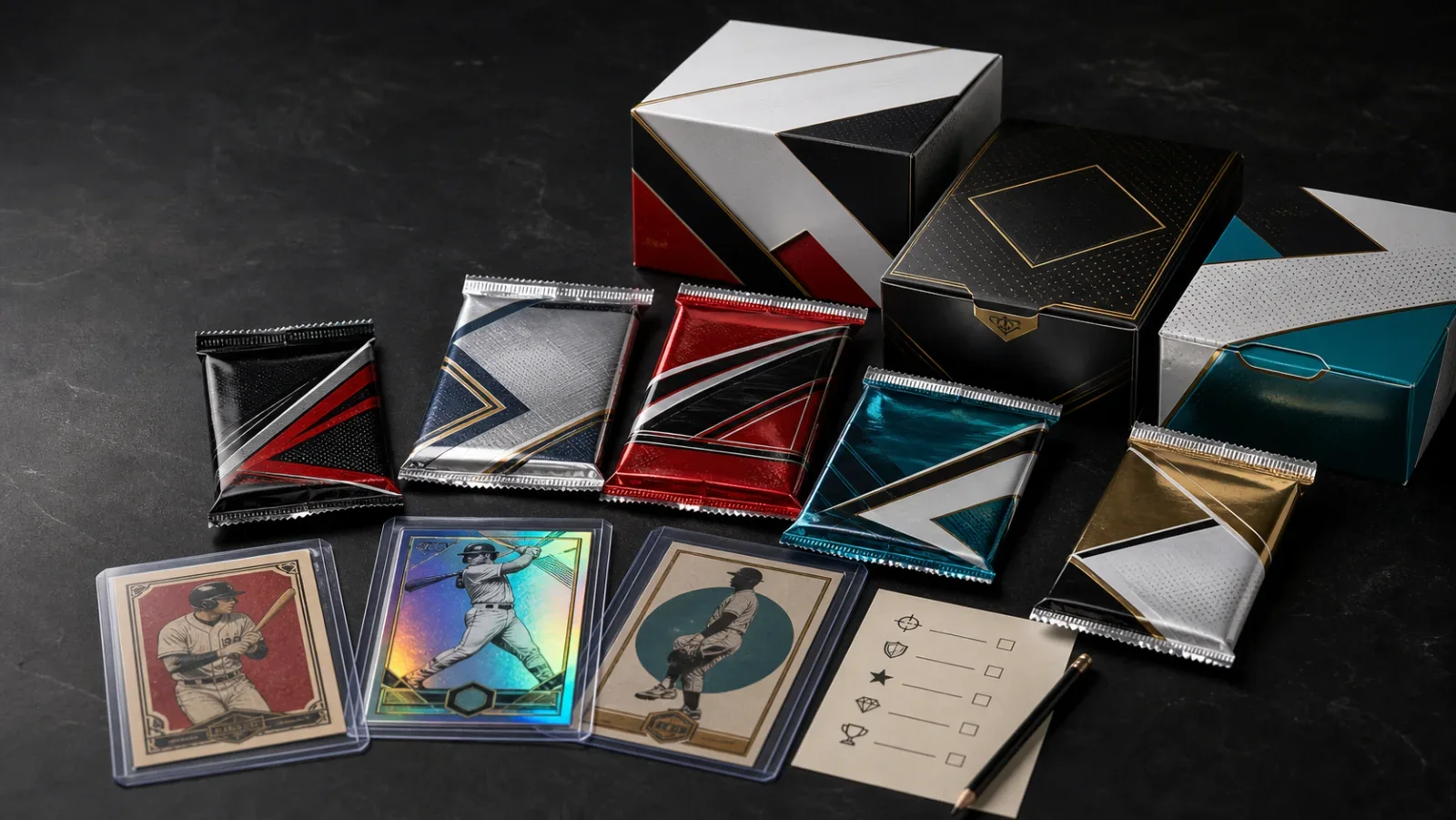
Best Baseball Card Packs To Buy by Collector Goal
The best baseball card packs to buy are different for a set builder and an autograph hunter. Of the five manufacturer-documented products reviewed, 2026 Topps Series 2 fits broad MLB set building; prospect collectors should look to 2026 Bowman. Choose 2025 Stadium Club for photography, the exact 2025 Bowman’s Best Hobby Box for documented autograph quantity, or the 2025 Museum Collection box for concentrated premium content. This article uses “packs” as broad search shorthand. A product family, sealed box, retail SKU, and loose pack are not interchangeable, so each recommendation stays attached to the buying unit its source verifies.
Make two decisions in order. First, decide what belongs in the collection. Then match a listing’s year, full release name, and format to the manufacturer record. Without that second check, a valid box guarantee, checklist, or card count can be misapplied to another SKU.
Best Baseball Card Packs by Collector Goal
Start with what you intend to keep: broad flagship coverage, prospect lineage, baseball images, autographs, or premium hits. Those goals point to different products. The table names the best-supported fit among the five reviewed releases; price, popularity, and a possible future sale are not used to manufacture a universal ranking.
| Collector goal | Best-supported fit among the reviewed products | Evidence level | What the recommendation does not establish |
|---|---|---|---|
| Broad MLB coverage and set building | 2026 Topps Series 2 | Release and base-set structure | That a specific player, autograph, or relic appears in one pack |
| Prospects and early card lineage | 2026 Bowman Baseball | Release and separate prospect-set structure | That prospect cards and current MLB rookie cards are interchangeable targets |
| Full-bleed baseball photography | 2025 Topps Stadium Club | Manufacturer-defined product identity | That an image-led base set provides a particular hit |
| Documented autograph quantity | 2025 Bowman’s Best Hobby Box | Exact year, release, and box configuration | That its box guarantee applies to loose packs or another Bowman product |
| Concentrated premium content | 2025 Topps Museum Collection box | Exact year, release, and box configuration | That a low card count is inherently better than a larger set-building rip |
None of the manufacturer pages cited here calls one product the universal winner. Series 2 earns its row through checklist breadth. Stadium Club answers the photography question. Documented contents put Bowman’s Best Hobby and Museum Collection into two different hit-focused lanes; the words “Hobby” and “premium” do not settle which lane suits a collector.
Read every row literally. A release page may establish a product family’s identity, but a stated count or guarantee stays with the exact year, release, and configuration named by the source. A loose pack bearing the same brand does not inherit the sealed-box statement.
A listing headed simply “Bowman” leaves the exact product unresolved. “Series 2” without a year leaves a similar gap. Those omitted words can control the checklist, card count, and format-specific contents. When comparing baseball card packs online, match the photographed and described item to its full manufacturer name. Apply the same rule across sports-card pack formats: the family nickname is not the item being sold.
A good product match can still be a poor purchase at the price or condition shown in a particular listing. Those variables change and were not captured here. Use the Exact-SKU Listing Audit below after choosing the collection lane.
Are Bowman Packs Better for Prospects or MLB Rookies?
Choose 2026 Bowman for prospect collecting. Choose 2026 Topps Series 2 when the binder needs broad coverage of MLB stars and rookies. If presentation matters more than either checklist path, 2025 Stadium Club is the reviewed photography-led alternative.
Build a broad MLB checklist with 2026 Topps Series 2
The official 2026 Topps Series 2 page identifies a 350-card base set covering MLB stars, rookies, Future Stars, League Leaders, and team cards. That breadth gives a team collector or annual flagship set builder more than one useful route through the checklist. Established players and rookies can occupy the same binder without forcing the collection into a prospect-only lane.
For this collector, the base cards carry the rip. Team pages, missing set numbers, and the annual flagship design still matter when the box produces no autograph. A hit may be welcome, but it is not what makes Series 2 fit the job.
Check the release checklist against the teams and player groups you actually collect. A large share of relevant subjects supports a larger rip; only a handful may point toward singles instead. The checklist can establish membership in the 350-card set. It cannot put a named player into one pack, and collectors with a narrow target should expect much of a broad checklist to fall outside it.
Choose 2026 Bowman when prospects are the point
Topps divides 2026 Bowman into a 150-card Bowman Prospect set and a 100-card base set. It also places 1st Bowman cards at the center of the release. That structure suits a collector tracing the early portion of a player’s card lineage, rather than someone whose main target is an MLB rookie checklist.
A prospect issue can appear before the player reaches an MLB rookie checklist. Bowman addresses that earlier stage; “prospect” and “MLB rookie” are not interchangeable collection goals. Neither label supplies evidence about a later selling price.
Player lookup comes next. Check whether the name appears in the base set, Bowman Prospect set, an insert, or an autograph checklist. Those locations describe different cards. A player’s presence somewhere in the release does not make every card of that player a prospect card, nor does it place that player in every configuration.
Choose 2025 Stadium Club when the image earns the binder slot
2025 Topps Stadium Club uses full-bleed photography across a checklist of stars, rookies, and legends. Its documented identity makes the image—not only a possible autograph or relic—the reason to keep a card.
For a player collector, an action shot, portrait, or memorable baseball image can earn a binder or display slot on its own. The ordinary cards have a clear job in that collection instead of serving only as material around a hit.
Stadium Club does not supply Bowman’s prospect lineage or Series 2’s flagship breadth. When comparing sports card packs, ask what must earn the base card a place: the desired player coverage, a particular point in card chronology, or the photograph. Choose Stadium Club when the photograph decides.
What Baseball Card Product Should I Buy for Autographs?
Among these five products, choose the exact 2025 Bowman’s Best Hobby Box when documented autograph quantity is the deciding criterion. The 2025 Museum Collection box serves another kind of rip: one short premium configuration that combines autograph and relic content instead of supplying the review’s highest stated autograph count.
The exact 2025 Bowman’s Best Baseball Hobby Box guarantees four Chrome autograph cards. Every part of that name matters. The promise belongs to that year, release, and Hobby Box; it does not transfer to a loose Bowman’s Best pack, another Bowman family, a different SKU, or another year.
The manufacturer guarantee fixes one thing: four Chrome autograph cards in the sealed Hobby Box. It does not name the signers. The autograph checklist shows who is represented; the card pulled supplies the player, parallel, and condition. That makes Bowman’s Best Hobby a supported fit for an autograph-centered collection, but never a promise of a particular player.
The documented 2025 Topps Museum Collection box contains one eight-card pack: three base cards, two parallels, an autographed relic, an on-card autograph, and a relic or quad relic. Its three premium hits are concentrated into a much shorter opening than a flagship set-building box.
Choose Bowman’s Best Hobby when the stated autograph count drives the decision. Museum Collection fits a collector who wants autograph and relic content packed into a low-card-count rip. The sources do not establish which configuration is stronger at a price you see in a current listing, and the two boxes are not trying to build the same collection.
An autograph and a grade are also separate card attributes. A sealed box’s autograph guarantee is not a grading promise. Collectors who specifically want encapsulated cards should compare raw and graded card formats separately instead of assuming a signed card will arrive in a slab.
Is a Baseball Hobby Box Always Better Than a Retail Blaster?
No. Hobby is a configuration label, not a universal quality rank. A Hobby box is the better fit only when its documented contents justify the current price for the collection being built. Retail can be more suitable when the buyer wants a smaller rip and does not need a Hobby-only box statement.
Worked example: 2026 Topps Series 2. The documented Hobby Box has 20 twelve-card packs and one autograph or relic per box. The Value Box has six twelve-card packs. That works out to 240 cards in the Hobby Box and 72 in the Value Box, based on the stated pack counts. The release name is the same; the purchasing units, card volume, and verified statements are not.
A set builder who wants more cards from the checklist may prefer the Hobby configuration. Someone seeking a smaller flagship rip may choose the Value Box after checking its current price. Neither decision comes from the word “Hobby” alone, and the autograph-or-relic statement remains attached to the documented Hobby Box.
“Hobby” does not promise a standard number of cards, autographs, or relics across baseball products. Series 2 Hobby and Bowman’s Best Hobby carry different manufacturer statements because each is its own year-release-SKU combination. The label tells you which configuration to investigate; it does not finish the investigation.
That also means Hobby boxes from two years of the same family cannot be assumed to match. A release may change its pack count, checklist, inserts, or guaranteed contents. Use the page for the year printed on the box rather than a description of the product family in general.
The Series 2 autograph-or-relic statement is a per-box statement. Buying one loose pack from that box does not create a pack-level guarantee, and the evidence reviewed here does not move the Hobby promise onto the Value Box. A seller needs separate manufacturer support to make either claim.
Before comparing conventional sports-card packs or online card-pack formats, write down the purchasing unit. “One pack,” “one Value Box,” and “one Hobby Box” cannot share a denominator simply because the wrapper carries the same release name.
What to Check Before Buying Baseball Card Packs at a Retailer
Do not compare retailer prices until the title, package photographs, and manufacturer record describe the same item. Capture the year, full release name, format, stated contents, checklist fit, complete guarantee wording, sealed condition, current seller price, and manufacturer source. A live retailer page proves availability. It does not show that the SKU fits your collection or grant it a box-level statement from another configuration.
Two prices answer the same question only when both sellers offer the same purchasing unit. The Exact-SKU Listing Audit establishes that identity before price enters the decision.
- Write the complete product name. “Bowman” could mean several products. “2025 Bowman’s Best Baseball Hobby Box” resolves to an exact manufacturer record. If the seller’s title names one release but the package image shows another, the identity check has already failed.
- Read what will actually ship. Hobby Box, Value Box, Mega Box, hanger, blaster, and loose pack are separate items. Compare the listing’s pack and card counts with the manufacturer page for that exact format. Shared artwork or family branding does not make their contents identical.
- Ask the checklist one narrow question. The manufacturer’s release-specific checklists can show that a player class, prospect set, autograph group, or card type belongs to the release. Membership is not certainty: the checklist cannot promise that card in one pack.
- Keep the denominator attached. “Four autographs per Hobby Box” is the entire statement. Removing “per Hobby Box” changes it. A seller offering one loose pack cannot use that sealed-box guarantee as a description of the pack.
- Pair the item with records from its own release. Begin with the exact manufacturer page. When rates matter, consult the product-specific odds document for the same item. Topps separates those records by product and release, so a document from another year does not verify the listing in front of you.
- Inspect the physical offer last. The title, photographs, stated contents, seal, and condition should all describe one product. Only then does the current seller price become useful. A cheaper listing may contain a smaller box or an entirely different SKU.
The documents have separate jobs. The product record identifies the applicable item. The checklist records what belongs to the release. The odds sheet supplies rates for the named product or configuration. If one of those sources points to another year, release, or box, the comparison remains unresolved.
Take a listing titled “2026 Topps Series 2 Hobby Box.” If its photograph or pack count instead matches the Value Box, there is no hybrid configuration to evaluate. The seller’s description and the manufacturer record must converge on one item before the Hobby guarantee can enter the comparison.
Here, value means collection fit at the asking price you verify: the desired checklist, useful card volume, exact configuration, documented contents, and sealed-item condition. The research contains no current-price capture, sales comps, or matched pull-rate dataset that could rank these products by likely financial result. If a later sale affects the purchase, treat selling sports cards online as a separate decision.
Use the same audit at Walmart, another retailer, or an online marketplace. Stock answers the availability question only. The listed SKU may still miss a set-building, prospect, photography, or autograph goal. No current Walmart inventory was inspected for this article, so it makes no retailer-specific product recommendation.
A listing is dated evidence. Before buying, recheck the available SKU, seller price, listing condition, checklist, and manufacturer disclosure. Inventory changes, and this article’s goal-based recommendation cannot confirm later stock or listing details.
Write the recheck date beside the listing. That keeps an older comparison from masquerading as a current one.
Keep a screenshot of the configuration and seller terms with that date so the later comparison remains auditable.
This audit covers manufacturer-sealed wax. It does not explain what happens to a card after a pull on an online pack marketplace. Pullmarket’s how-it-works guide covers its pack and ownership flow; Pullmarket legitimacy and verification addresses the separate trust questions.
Keep trading-card rights separate from product quality
MLB reported that Fanatics acquired Topps after securing exclusive long-term MLB trading-card rights. Fanatics’ acquisition announcement says the purchase accelerated its MLB and MLBPA rights to design, manufacture, and distribute trading cards.
Those sources establish acquisition and rights context. They do not test card stock, photography, checklist fit, or the contents of two exact SKUs. They also do not prove that every Topps release offers better collection value than every alternative. Product judgment still returns to the year, release, checklist, configuration, condition, contents, and price.
Where Pullmarket Fits a Card-First Buyer
Pullmarket publishes odds before purchase. Use its baseball category to check inventory; if a pack appears there, inspect that pack’s displayed card examples and odds before opening. The evidence captured for this article is stale. Accordingly, this page does not identify any of the five reviewed releases, or any named card, as available through Pullmarket. The method above identifies the product direction; the category supplies the separate inventory check.
Every Pullmarket pull is a real physical collectible card. Depending on the pack, the outcome may be raw or third-party graded. Once the card is yours, you can hold it in the Vault, request shipment, trade it where enabled, or accept a market-based buyback in Pullmarket Gems; Gems are non-cashable store credit. Fulfillment is hybrid: some cards are held by Pullmarket, while others are reserved against verified supplier or partner-vault inventory and sourced on demand at redemption. If the exact card pulled cannot be fulfilled as originally displayed, Pullmarket may source the same item through another channel, provide a comparable collectible of equal or greater market value, or supply another remedy required by applicable law.
Published odds describe the tier distribution for the individual Pullmarket pack that displays them. A manufacturer-sealed box statement uses different evidence and a different purchasing unit. This article has no matched numerical denominators for those products. Read the details for the pack on screen rather than applying a Topps box statement or another pack’s percentages to it.
Collectors weighing the Gems store-credit option against other ways to move an owned card can use the guide to selling sports cards online. If baseball is no longer the collection goal, browse all pack categories rather than forcing a baseball product to fit.
Browse online sports card packs. New here? See how Pullmarket works.