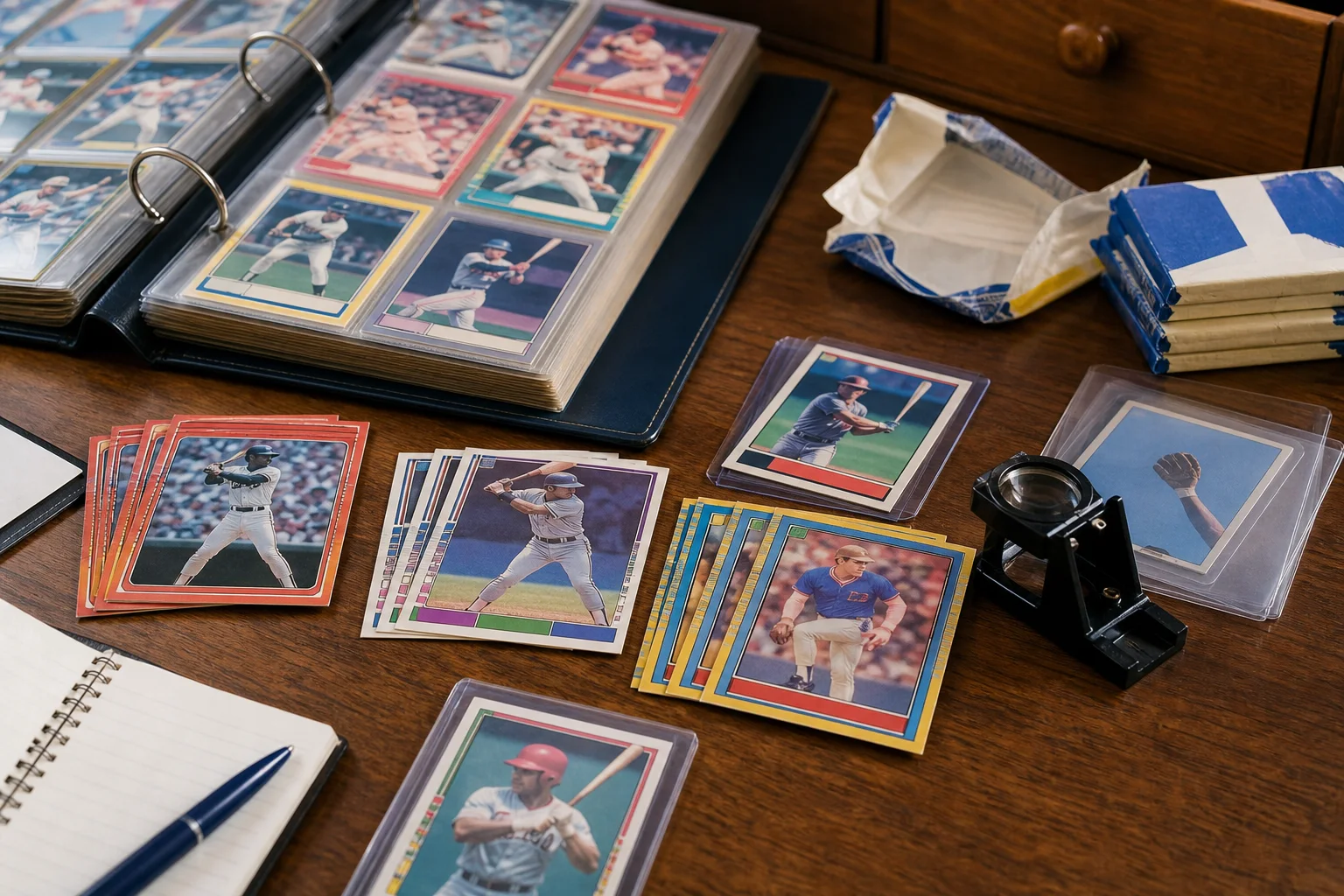
Most Valuable Baseball Cards 1980s Collectors Should Know
Within a reproducible group of 14 exact 1980s cards, the 1986 Topps Traded Tiffany Barry Bonds #11T produced the highest median in our straight-PSA-8 benchmark: $1,180.53. That figure is the median of the three newest qualifying sold-listing rows captured for that exact card, each retaining a direct eBay item URL, as observed on August 10, 2026.
That is a deliberately narrow answer. It is not a claim that Bonds #11T is the universally most valuable baseball card of the 1980s. Change the grade, edition, autograph status, condition, candidate pool, or observation date and the order can change. This guide shows the full denominator so a reader can reproduce the comparison instead of trusting an unexplained countdown.
Fourteen exact identities entered the dataset because each appeared on at least two of five current editorial lists. The benchmark accepted 42 straight-PSA-8 rows and rejected 95 others that mixed grades, graders, editions, autographs, or unsupported receipts. Those exclusions are part of the result, not cleanup hidden behind the ranking.
What Is the Most Valuable Baseball Card from the 1980s?
On August 10, 2026, 1986 Topps Traded Tiffany Barry Bonds #11T ranked first in this page’s 14-card straight-PSA-8 comparison. Its three qualifying rows produced a $1,180.53 median. That answer applies to the declared cohort and method, not every card, edition, grade, condition, or autograph from the decade.
“Most valuable” changes with the object being measured. Record-sale coverage may favor a top-grade copy or an exceptional autograph. Someone sorting an old box needs exact identities, not auction headlines. A buyer comparing graded copies needs every row held to one grader and one grade. Combining those jobs under one ranking produces a number that cannot be applied safely.
This benchmark fixes the denominator at unsigned straight PSA 8 and limits the cohort to 14 cards named by at least two of five inspected editorial lists. Beneath Bonds #11T at $1,180.53, the next three medians observed August 10, 2026, were $899 for 1989 Bowman Tiffany Ken Griffey Jr. #220, $815 for 1986 Topps Traded Tiffany Bo Jackson #50T, and $389.88 for 1985 Topps Tiffany Roger Clemens #181.
An exceptional-sale list can produce a very different answer. High-grade, autographed, scarce-error, and record-setting examples may sell far above an ordinary same-grade benchmark. That does not make either frame wrong. It means a record sale cannot be dropped into a PSA 8 table, and a PSA 8 median cannot be presented as the ceiling for a PSA 10 or autographed example.
The distinction is practical. If you own a raw 1980 Topps Rickey Henderson #482, neither a PSA 10 headline nor the PSA 8 median on this page is automatically its value. The first tells you what a much narrower top-grade object has achieved. The second compares three recent source rows for straight PSA 8 copies. Your card still needs exact identification and condition-specific evidence. The broader baseball card guide is a useful starting point for set, rookie, parallel, and condition vocabulary before any price search.
How We Chose the Most Valuable Baseball Cards from the 1980s
We selected an exact card only when at least two of five independently inspected current editorial lists named it. The rule produced 14 identities before any prices were collected, preventing sale values from determining which cards entered the benchmark.
Candidate selection came before price collection. An exact 1980-1989 card qualified only if it appeared in at least two of five independently inspected current editorial lists: Giant Sports Cards, Old Sports Cards, Rorz Cards, Sports Card Investor, and Beckett.
This rule matters because it prevents us from creating a private shortlist after seeing prices. The five publishers do not agree on one perfect ranking, but their repeated exact identities define a reproducible intersection. Four cards seen in only one list remained on a watchlist rather than being promoted simply because a sale looked interesting.
Selection happened at the exact-identity level. “1985 Mark McGwire #401” is not one object in this research. Standard 1985 Topps #401 and 1985 Topps Tiffany #401 are separate candidates. The same rule separates Topps Traded from a regular Topps set, Topps Traded Tiffany from standard Topps Traded, O-Pee-Chee from Topps, and Bowman Tiffany from standard Bowman.
The rule yielded 14 candidates and every candidate had three qualifying rows. It did not produce an exhaustive census of every valuable baseball card issued from 1980 through 1989. A card omitted from the table may be valuable; it may simply have appeared in only one inspected list, fallen outside the exact date range, or required a different evidence method. Our graded versus raw card guide explains why even an included identity still needs condition-specific treatment.
Why five editorial lists are not five price sources
The editorial lists chose the cohort; they did not set its prices. This separation avoids a circular method in which the same publisher both nominates a card and supplies the number used to prove its rank. Once the 14-card universe was frozen, each identity moved through the same sale-row filter.
That also means editorial popularity is not the benchmark score. Rickey Henderson #482 appeared in all five lists but ranked fifth in this straight-PSA-8 snapshot. Barry Bonds Topps Traded Tiffany #11T appeared in two and ranked first. Repetition across lists answered “which exact cards belong in the comparison?” The same-grade medians answered “how did those selected cards compare under this one current method?”
Most Valuable Baseball Cards 1980s: How the PSA 8 Benchmark Works
The benchmark takes the median of the three newest qualifying unsigned straight-PSA-8 sold-listing rows for each exact identity. All 42 selected rows retain direct eBay item locators, while 95 mixed or unsupported source rows were rejected under one deterministic filter.
For each exact identity, the benchmark uses the median of the three newest captured rows that met all of these conditions:
- The row came from the exact card’s SportsCardsPro Grade 8 sold-listing table.
- The listing title identified a straight PSA 8 or PSA NM-MT 8 copy.
- Year, set, player, card number, edition, and unsigned status matched the candidate.
- The row retained a direct eBay item URL.
- The row did not carry a qualifier such as OC, MC, MK, PD, or ST.
PSA 8 is a comparison denominator, not a recommendation or a claim that PSA is always the best grader. It supplied enough current, like-for-like observations across all 14 cards without guessing the condition of raw copies. Readers comparing grading labels should keep the complete grade designation attached; the PSA vs CGC vs SGC guide explains why the same number cannot be assumed to mean the same thing across companies.
The source tables mix graders and card states, so accepting every row marked “Grade 8” would corrupt the result. The deterministic filter rejected 95 mixed or unsupported rows. Rejections included another grader, another numeric grade, a qualified PSA grade, an autograph, a wrong edition or card number, an insufficient listing title, or the absence of a direct eBay item URL. The final dataset retained 42 rows, exactly three per card.
The source language is important. These are SportsCardsPro sold-listing rows retaining direct eBay item URLs. The direct links make the observations inspectable, but this research did not independently prove that every buyer paid, every transaction reached final delivery, or no sale was later cancelled. The benchmark is an auditable comparison of captured source rows, not a forensic marketplace audit.
With three prices, the median is the middle value after sorting. It prevents one high or low observation from becoming the benchmark by itself. No selected row exceeded five times or fell below one fifth of its card’s three-sale median, the declared flag rule. That is useful quality control, but three observations remain a small snapshot rather than a permanent market model.
Most Valuable 1980s Baseball Cards List: The PSA 8 Benchmark
The bounded list is led by Bonds #11T Tiffany, Griffey #220 Bowman Tiffany, Bo Jackson #50T Tiffany, and Clemens #181 Tiffany. Every rank below uses the same 14-card cohort, unsigned straight PSA 8 grade, three-row median, and August 10, 2026 observation date.
Scope of every rank below: current straight-PSA-8 sale benchmark for 14 exact cards independently named by at least two of five inspected editorial lists, using the median of three qualifying source rows observed August 10, 2026.
| Rank | Exact card identity | Three-sale median | Observed low-high | Editorial lists naming it |
|---|---|---|---|---|
| 1 | 1986 Topps Traded Tiffany Barry Bonds #11T | $1,180.53 | $1,083.88-$1,299.99 | 2 |
| 2 | 1989 Bowman Tiffany Ken Griffey Jr. #220 | $899.00 | $875.00-$1,000.00 | 4 |
| 3 | 1986 Topps Traded Tiffany Bo Jackson #50T | $815.00 | $785.00-$849.95 | 3 |
| 4 | 1985 Topps Tiffany Roger Clemens #181 | $389.88 | $358.00-$399.99 | 4 |
| 5 | 1980 Topps Rickey Henderson #482 | $376.00 | $352.00-$399.00 | 5 |
| 6 | 1985 Topps Tiffany Mark McGwire #401 | $365.00 | $350.00-$409.99 | 2 |
| 7 | 1982 Topps Traded Cal Ripken Jr. #98T | $275.77 | $271.98-$550.00 | 5 |
| 8 | 1983 O-Pee-Chee Tony Gwynn #143 | $175.00 | $161.10-$195.00 | 2 |
| 9 | 1989 Upper Deck Ken Griffey Jr. #1 | $175.00 | $162.50-$199.99 | 3 |
| 10 | 1984 Donruss Don Mattingly #248 | $144.99 | $123.00-$150.00 | 4 |
| 11 | 1980 Topps Nolan Ryan #580 | $125.01 | $125.00-$154.26 | 3 |
| 12 | 1983 Topps Tony Gwynn #482 | $51.67 | $43.25-$54.99 | 4 |
| 13 | 1981 Topps Kirk Gibson #315 | $42.00 | $35.99-$56.50 | 3 |
| 14 | 1985 Topps Mark McGwire #401 | $26.99 | $26.00-$35.00 | 2 |
The table should not be detached from its label. “Barry Bonds is number one” would omit the Tiffany edition, the Traded set, card number, grader, grade, cohort rule, median method, and date. Each of those details changes what the number means.
The order also reveals why a generic player list is inadequate. Griffey appears twice in two different Tiffany and standard identities. Gwynn appears twice across O-Pee-Chee and Topps. McGwire #401 appears twice with the same year and number but different Topps editions. Treating those pairs as duplicates would erase the very distinction driving the comparison.
The complete 42-row receipt ledger
The rows below are the observations used to calculate the medians. Each item ID links to the direct eBay URL retained by the source capture. Prices and dates are transcribed from the selected SportsCardsPro rows; the links are inspection locators, not independent proof of payment or non-cancellation.
| Row | Exact card | Source-row date | Price | Direct item locator |
|---|---|---|---|---|
| 1 | 1986 Topps Traded Tiffany Barry Bonds #11T | 2026-06-22 | $1,083.88 | 267693630633 |
| 2 | 1986 Topps Traded Tiffany Barry Bonds #11T | 2026-06-15 | $1,180.53 | 306986934933 |
| 3 | 1986 Topps Traded Tiffany Barry Bonds #11T | 2026-06-12 | $1,299.99 | 306996773530 |
| 4 | 1989 Bowman Tiffany Ken Griffey Jr. #220 | 2026-07-24 | $875.00 | 127708766701 |
| 5 | 1989 Bowman Tiffany Ken Griffey Jr. #220 | 2026-07-21 | $899.00 | 358468205314 |
| 6 | 1989 Bowman Tiffany Ken Griffey Jr. #220 | 2026-07-21 | $1,000.00 | 117279321277 |
| 7 | 1986 Topps Traded Tiffany Bo Jackson #50T | 2026-08-03 | $815.00 | 366560917481 |
| 8 | 1986 Topps Traded Tiffany Bo Jackson #50T | 2026-08-01 | $785.00 | 257590226880 |
| 9 | 1986 Topps Traded Tiffany Bo Jackson #50T | 2026-07-31 | $849.95 | 298488352321 |
| 10 | 1985 Topps Tiffany Roger Clemens #181 | 2026-07-20 | $389.88 | 800330307341 |
| 11 | 1985 Topps Tiffany Roger Clemens #181 | 2026-07-12 | $358.00 | 377322662801 |
| 12 | 1985 Topps Tiffany Roger Clemens #181 | 2026-06-19 | $399.99 | 327207069964 |
| 13 | 1980 Topps Rickey Henderson #482 | 2026-08-10 | $352.00 | 307103182512 |
| 14 | 1980 Topps Rickey Henderson #482 | 2026-08-10 | $376.00 | 298551730952 |
| 15 | 1980 Topps Rickey Henderson #482 | 2026-08-09 | $399.00 | 147375537579 |
| 16 | 1985 Topps Tiffany Mark McGwire #401 | 2026-07-23 | $350.00 | 178331981327 |
| 17 | 1985 Topps Tiffany Mark McGwire #401 | 2026-07-08 | $409.99 | 158018124712 |
| 18 | 1985 Topps Tiffany Mark McGwire #401 | 2026-05-08 | $365.00 | 406876983619 |
| 19 | 1982 Topps Traded Cal Ripken Jr. #98T | 2026-08-06 | $550.00 | 388716562856 |
| 20 | 1982 Topps Traded Cal Ripken Jr. #98T | 2026-08-05 | $275.77 | 267741698460 |
| 21 | 1982 Topps Traded Cal Ripken Jr. #98T | 2026-08-02 | $271.98 | 206432821229 |
| 22 | 1983 O-Pee-Chee Tony Gwynn #143 | 2026-08-05 | $175.00 | 203282347287 |
| 23 | 1983 O-Pee-Chee Tony Gwynn #143 | 2026-08-01 | $161.10 | 800435509171 |
| 24 | 1983 O-Pee-Chee Tony Gwynn #143 | 2026-07-22 | $195.00 | 158097356030 |
| 25 | 1989 Upper Deck Ken Griffey Jr. #1 | 2026-08-10 | $199.99 | 257555115543 |
| 26 | 1989 Upper Deck Ken Griffey Jr. #1 | 2026-08-03 | $175.00 | 137579292431 |
| 27 | 1989 Upper Deck Ken Griffey Jr. #1 | 2026-07-20 | $162.50 | 198493004139 |
| 28 | 1984 Donruss Don Mattingly #248 | 2026-08-10 | $150.00 | 298550342804 |
| 29 | 1984 Donruss Don Mattingly #248 | 2026-08-09 | $144.99 | 178374192574 |
| 30 | 1984 Donruss Don Mattingly #248 | 2026-08-06 | $123.00 | 227413930422 |
| 31 | 1980 Topps Nolan Ryan #580 | 2026-08-09 | $125.00 | 398266441706 |
| 32 | 1980 Topps Nolan Ryan #580 | 2026-07-31 | $154.26 | 377365075109 |
| 33 | 1980 Topps Nolan Ryan #580 | 2026-07-31 | $125.01 | 398205437238 |
| 34 | 1983 Topps Tony Gwynn #482 | 2026-08-08 | $51.67 | 158144007986 |
| 35 | 1983 Topps Tony Gwynn #482 | 2026-08-08 | $43.25 | 236977162447 |
| 36 | 1983 Topps Tony Gwynn #482 | 2026-08-07 | $54.99 | 158161542736 |
| 37 | 1981 Topps Kirk Gibson #315 | 2026-08-08 | $56.50 | 198506309684 |
| 38 | 1981 Topps Kirk Gibson #315 | 2026-07-28 | $35.99 | 398196054736 |
| 39 | 1981 Topps Kirk Gibson #315 | 2026-07-26 | $42.00 | 397368994432 |
| 40 | 1985 Topps Mark McGwire #401 | 2026-08-09 | $26.00 | 257651850111 |
| 41 | 1985 Topps Mark McGwire #401 | 2026-08-01 | $26.99 | 168580677783 |
| 42 | 1985 Topps Mark McGwire #401 | 2026-07-31 | $35.00 | 377365889285 |
Valuable 80s Baseball Cards: Read the Spread Beside the Median
Sorting each card’s three selected prices makes the middle observation its median. The low and high belong beside that number because they show how far the captured rows spread. Neither measure forecasts another sale or supplies a value for a different grade, edition, or raw copy.
The Bonds #11T rows run from $1,083.88 to $1,299.99, with $1,180.53 in the middle. Bo Jackson #50T occupies a tighter $785 to $849.95 band around its $815 median. The medians provide one consistent sorting rule; the ranges show that the underlying observations did not move in identical patterns.
Cal Ripken Jr. #98T is the clearest warning. Its three source rows are $550, $275.77, and $271.98. The median is $275.77 because the middle two observations cluster together while the $550 row sits well above them. The high row did not cross the declared five-times-median flag, so the method retained it and exposed the range. Deleting it silently would make the table look cleaner while making the method less honest.
Three rows are enough for a transparent current snapshot, not for a confidence interval or a promise of fair value. Market timing, listing presentation, eye appeal within a numeric grade, auction format, and other transaction details may affect results. A reader pricing a purchase should inspect more matched transactions when available, especially when the observed range is wide or the decision is expensive.
The table therefore answers “how did these 14 exact cards compare under one same-grade rule at the cutoff?” It does not answer “what will my card sell for tomorrow?” The card-grading cost calculator is also a separate decision tool: grading fees and outcomes should not be inferred from a PSA 8 sale median.
Valuable 1980s Baseball Cards Depend on the Exact Edition
A player name and year do not identify a usable comp. The full set, card number, edition, autograph status, and grade travel with the price. Standard, Tiffany, O-Pee-Chee, Traded, raw, and graded cards enter separate evidence groups when any of those fields differ.
“Tiffany” can separate one catalog object from another even when the year, brand, player, and card number match. “O-Pee-Chee,” “Traded,” and “Traded Tiffany” perform the same identifying job. The benchmark shows what happens when those labels remain attached:
- 1985 Topps Tiffany Mark McGwire #401 has a $365 straight-PSA-8 median in this snapshot.
- 1985 Topps Mark McGwire #401 has a $26.99 straight-PSA-8 median.
- 1983 O-Pee-Chee Tony Gwynn #143 has a $175 median.
- 1983 Topps Tony Gwynn #482 has a $51.67 median.
Those pairs do not compare “the same card in different listings.” They compare different issues, and even the card numbers differ for Gwynn. Dropping “Tiffany,” “O-Pee-Chee,” “Traded,” or a suffix such as T can move a sale into the wrong comp set.
Grade is equally inseparable from the price. A straight PSA 8 is not interchangeable with a raw card, PSA 9, PSA 10, another grader’s 8, or PSA 8 with a qualifier. Autographs also create a different object. Our graded-versus-raw guide explains why the slab’s grader and full designation are material attributes rather than incidental packaging.
This is why a spectacular high-grade sale can be true and still be irrelevant to the card in your hand. The headline may describe the same player and year while differing on edition, card number, grade, or autograph status. Before using the number, write down every identifying field and compare them one by one.
Valuable Baseball Cards to Look For: Read the Card First
Photograph the full front and reverse before opening a price search. Then transcribe the year, manufacturer, full set, player, card number, edition or variation, autograph status, and raw-or-graded format. For a slab, add the grader, complete grade, and qualifier.
Use one inventory record for the card rather than a loose collection of search terms:
- Catalog identity: record the set’s release year, manufacturer, full set, player, and complete card number. A visible copyright line may not settle the release identity. Write “Topps Traded Tiffany,” not merely “Topps,” and preserve suffixes such as
98Tand11T. - Version and state: keep standard, Tiffany, O-Pee-Chee, Traded, and other variations separate. Mark the card unsigned or autographed, then record whether it is raw or graded.
- Slab details: copy the grader, full numeric designation, and any qualifier rather than reducing the label to a bare number.
The reverse often settles what the front leaves ambiguous. It can supply the card number, set language, or design needed to distinguish related issues. A cropped listing that hides the back has not shown enough evidence when edition is the field separating two comp groups.
Three benchmark pairs that expose common mistakes
McGwire #401: the standard 1985 Topps and 1985 Topps Tiffany versions share the year, player, and number. The edition must remain in the inventory record and every comp query.
Gwynn: 1983 O-Pee-Chee #143 and 1983 Topps #482 share the year and player but not the set or card number. Searching only “1983 Tony Gwynn PSA 8” invites both into the result set.
Bonds #11T: 1986 Topps Traded Tiffany is not standard Topps Traded. The T identifies the Traded numbering branch; “Tiffany” distinguishes the premium edition used by the benchmark’s top row.
Condition review follows identity, not the other way around. Centering, corners, edges, surface, printing, staining, gloss, focus, and possible alteration can all matter under PSA’s published grading standards. Photographs can reveal reasons to reject a premium comparison, but they cannot assign a professional numeric grade. Use the graded versus raw card guide to structure that inspection without pretending a screen view is a slab result.
1980s Most Valuable Baseball Cards: Match the Sale to the Object
A sale belongs in a comp set only when the year, set, card number, edition, autograph status, condition format, and date fit the card being evaluated. Graded comparisons also require the same grader, complete grade, and qualifier status. Asking prices stay outside sold evidence.
Reject a candidate comp at the first material mismatch. Keep the manufacturer, full set, variation, transaction date, and source in the row so another collector can see why it qualified. For slabs, a bare “8” is insufficient; the grader and complete designation determine which evidence set the result belongs to.
Keep asking prices in their own bucket. A seller’s current price records an intention, not a transaction. Dates should remain visible because an old result and a current result do not automatically describe the same market. Direct locators are valuable because another reader can inspect the row rather than taking a rounded summary on faith.
Worked example: standard Topps McGwire #401
Suppose the card in hand is an ungraded standard 1985 Topps Mark McGwire #401. The $365 Tiffany PSA 8 median on this page is not its price. Two fields already fail: edition and condition format. A useful first comp set would contain completed or sold records for raw standard 1985 Topps #401 cards with sufficiently comparable visible condition.
If the card later receives a straight PSA 8 grade, three captured standard Topps observations become relevant: $26, $26.99, and $35, producing a $26.99 median. The Tiffany PSA 8 rows still stay out. Their labels match on 1985, Topps, McGwire, and #401, but the edition does not.
Other identities fail in different places. A Cal Ripken Jr. #98T comp must retain “Topps Traded,” the T suffix, PSA, and 8. An Upper Deck Griffey #1 result cannot price Bowman Tiffany #220. Signed Bonds #11T evidence belongs outside an unsigned comparison. When exact matches are scarce, extend the date window before allowing another identity into the set.
Collectors preparing to sell sports cards online can put the same fields in a short inventory note. That record makes a mismatched headline sale easier to catch before it influences a listing price or grading decision.
Use This Benchmark for One Defined Comparison
Use the table to compare 14 exact identities under the same grade rule on one observation date. Its audit trail contains all 42 selected rows, the 95 mixed or unsupported rejections, each three-sale median, and the observed ranges. The paired McGwire and Gwynn entries also show the market consequence of preserving the edition and card number.
The table stops outside that denominator. It does not price every 1980s baseball card or establish a value for a raw card, PSA 9, PSA 10, another grader’s slab, qualified grade, autograph, error, unopened product, or one-off rarity. Those states need their own matched evidence. Nor can a dated source row guarantee a later sale or prove that a featured card is currently offered in a Pullmarket pack.
Choose the next step from the object actually in front of you:
- Card in hand: settle the exact identity, inspect its condition, and gather matching sales.
- Graded copy: retain the edition, grader, complete grade, qualifier, and certification context.
- Raw card under grading consideration: compare plausible grade outcomes and costs instead of borrowing the best known sale.
- Current pack: read the listed cards, outcome formats, and published odds on the live page.
Current inventory runs on a different clock from this historical benchmark. Pullmarket’s baseball category changes, so the category page—not this dated table—controls what is available now.
The category page answers a separate buying decision: which current baseball packs, card details, outcome formats, and published odds fit the collector’s chase. It does not turn any of the 14 vintage benchmark cards into a promised pull.
Browse online sports card packs. New here? See how Pullmarket works.