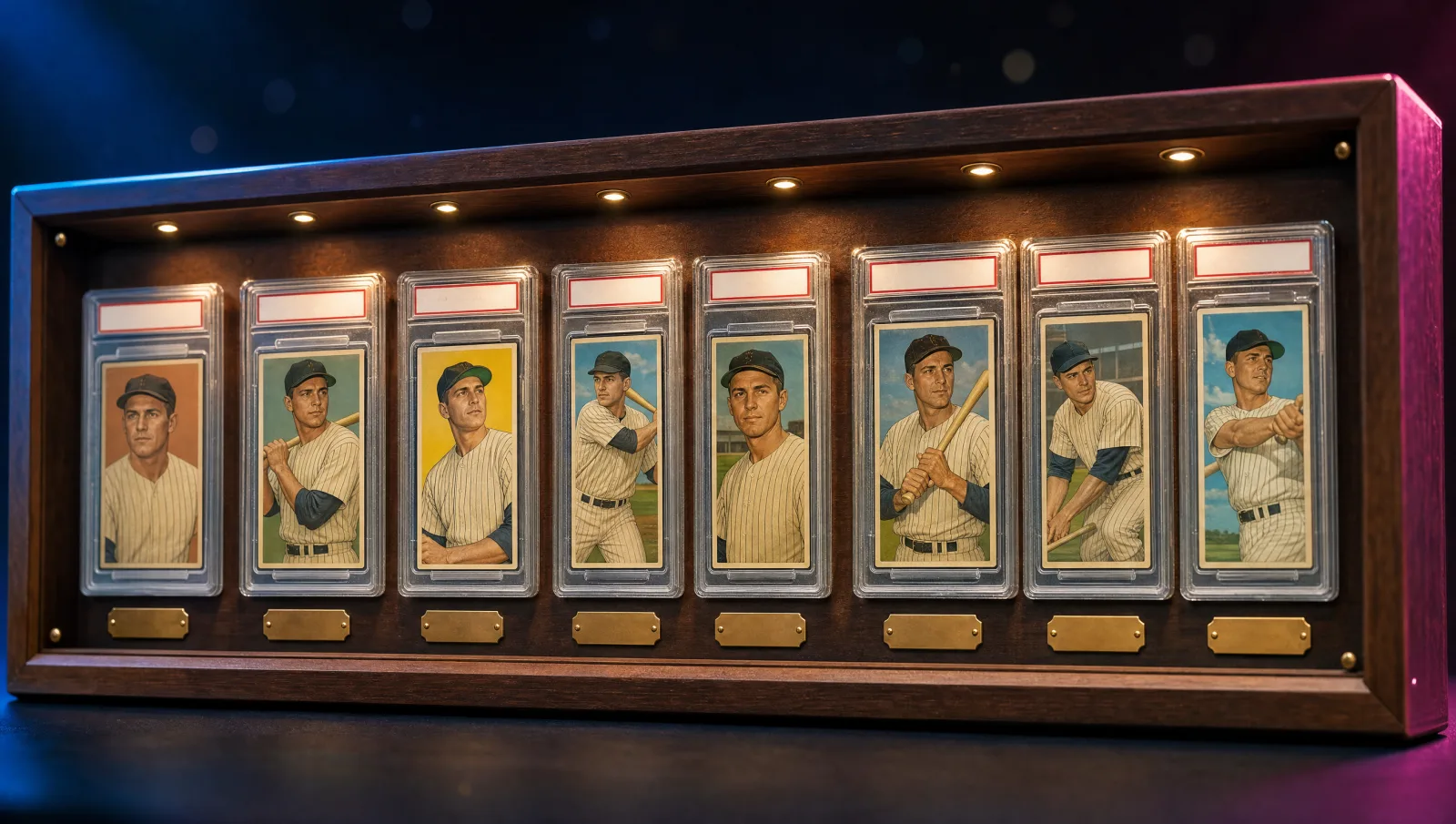
Mickey Mantle Cards: Every Topps Year and What They're Worth
Mickey Mantle appeared on a Topps baseball card every year from 1952 to 1969 except 1954 and 1955, when he was under exclusive contract to Bowman — and his 1952 Topps #311 sold for $12.6 million at Heritage Auctions in August 2022, making it the most expensive sports card ever publicly sold. Across that 18-year Topps window, plus the 1951 Bowman rookie that started the whole lineage, there are roughly 19 mainstream Mantle cards collectors actually chase, plus a thick modern reissue tail that no other lineage guide on the open web covers — 1996 Topps Finest Reprints, 2006 Topps '52 reprints, 2024 Heritage Aaron/Mantle MVPs, 2024 Archives Black Foil, and the 2026 Topps buyback program inserting authenticated original 1952 Mantles into modern Series 1 wax. This is the year-by-year tour with a master lineage table at the top, a counterfeit warning on the 1952 Topps (the most-faked card in the hobby), a PSA-tier pricing framework, and the modern tribute era that the existing authority blogs all stop short of.
Part of: Complete Baseball Cards Guide — the pillar overview of 130 years of baseball cards, from 1880s tobacco issues through the Fanatics-era modern landscape.
Mickey Mantle has roughly 19 mainstream baseball cards: the 1951 Bowman #253 (his true rookie), the 1952 Topps #311 through 1969 Topps #500 Topps run (the iconic 18-year arc), plus Bowman-exclusive 1954 #65 and 1955 #202 (Topps couldn't print Mantle those two years due to his Bowman contract). The 1952 Topps #311 is the headline grail — an SGC 9.5 example sold for $12.6 million in August 2022, the all-time public sports-card record. Values across the lineage range from ~$400 for a PSA 5 1968 Topps to multi-million-dollar sales for high-grade 1952 Topps and 1951 Bowman copies.
Every Mickey Mantle Card, Year by Year (the master lineage table)
The fastest way to make sense of the Mantle lineage is one row per main card from the 1951 Bowman rookie through the 1969 Topps "last card" — across the 18-year Topps run plus the two Bowman-exclusive years. The chronological grid below is the master table; the H2s that follow walk each era with what makes that card matter and what it costs.
| Year | Set | Card # | Significance | PSA 5 range | PSA 8 range |
|---|---|---|---|---|---|
| 1951 | Bowman | #253 | True rookie card (pre-Topps) | $20k–$30k | $250k+ |
| 1952 | Topps | #311 | First Topps appearance; $12.6M SGC 9.5 (Aug 2022) | $100k–$230k | $1.5M+ |
| 1953 | Topps | #82 | Color portrait | $5k–$10k | $80k+ |
| 1953 | Bowman Color | #59 | First true color photo | $5k–$10k | $90k+ |
| 1954 | Bowman | #65 | Bowman-exclusive contract (no Topps) | $2k–$5k | $40k+ |
| 1955 | Bowman | #202 | Bowman-exclusive (last year) | $2k–$5k | $30k+ |
| 1956 | Topps | #135 | Triple Crown year; gray/white back variants | $2k–$5k | $25k–$30k |
| 1957 | Topps | #95 | First "modern-size" card | $1.5k–$3k | $18k+ |
| 1958 | Topps | #150 | All-Star variant exists | $1k–$2.5k | $12k+ |
| 1959 | Topps | #10 | Low-number; centering issues | $1k–$2k | $10k+ |
| 1960 | Topps | #350 | Chronic centering year | $1k–$2k | $9k+ |
| 1961 | Topps | #300 | M&M Boys (Maris HR chase) | $1k–$2k | $8k+ |
| 1962 | Topps | #200 | Last "young Mantle" | $1k–$2k | $7k+ |
| 1963 | Topps | #200 | Manager-style portrait | $800–$1.5k | $6k+ |
| 1964 | Topps | #50 | All-Star subset variants | $700–$1.3k | $5k+ |
| 1965 | Topps | #350 | Mid-career form card | $700–$1.3k | $5k+ |
| 1966 | Topps | #50 | Late-career | $600–$1.2k | $4.5k+ |
| 1967 | Topps | #150 | Late-career | $600–$1.2k | $4.5k+ |
| 1968 | Topps | #280 | Cheapest mainstream Mantle (last playing year) | $400–$800 | $2.5k+ |
| 1969 | Topps | #500 | Last card; yellow/white-letter variants | $500–$1k | $4k+ |
A note on the table: every PSA range above is a starting-point estimate from public hobby press as of June 2026 — cross-verified against PSA Auction Prices Realized and Card Ladder. Vintage Mantle comps move with each major Heritage / Goldin / Memory Lane auction. Treat any cited dollar figure as a starting point and check live comps before transacting. For the full hobby context this lineage sits inside, see the baseball cards pillar; for where Mantle ranks across the cross-player "top of the hobby" curation, see the most expensive baseball cards guide. Rip a baseball pack at Pullmarket — see the published odds → browse the catalog.
The 1951 Bowman #253: Mantle's True Rookie Card
The 1951 Bowman Mickey Mantle #253 is the official rookie card — released a full year before Topps produced its first Mantle issue, when Bowman still dominated the trading-card business. The portrait, the brightly painted color frame, the high-number placement at #253 in a 324-card set, and the rookie-year provenance combine to make it one of the most respected pre-modern cards in the hobby. The card sits at the top of nearly every vintage-rookie ranking — exactly where you'd expect a Mantle rookie to sit.
- Print run / scarcity — the 1951 Bowman high-number series (which #253 sits in) was printed in the smaller second run, making high-grade copies scarce.
- Why it trades for less than the 1952 Topps — collector psychology + the famous Atlantic Ocean dump of unsold 1952 Topps high-numbers, which created a parallel scarcity dynamic. The 1951 Bowman is technically the rookie but historically gets out-traded by the 1952 Topps as the "iconic" Mantle.
- Top public sale — a PSA 9 example sold ~$3.2M at Heritage Auctions in January 2022. PSA pop reports for the 1951 Bowman live on PSA CardFacts.
For the cross-player ranking of Mantle vs Wagner vs other vintage HOF rookies, see the most expensive baseball cards guide. Rip a baseball pack at Pullmarket — see the published odds → open the catalog.
The 1952 Topps Mantle #311: The $12.6M Card
The 1952 Topps Mickey Mantle #311 sold for $12.6 million at Heritage Auctions in August 2022 — the all-time public record for any sports card ever sold. Critical correction the entire SERP gets wrong: the record-setting copy is graded SGC 9.5, not PSA 9.5. The card had previously been a PSA 9 before crossover review at SGC produced the half-point bump. The buyer was Anthony Giordano; the seller was a private collector who had held the card since 1991.
The 1952 Topps Mantle is famous for two reasons working in tandem: it was Mantle's first Topps appearance (Topps's debut full set, in fact), and card #311 falls in the high-number series — the sheet Topps printed last and famously dumped at sea in 1960 when warehouse inventory of unsold high-numbers became a storage problem. That single decision created the scarcity that defines the card's six-decade trajectory. The PSA / SGC pop reports across all grades sit around 2,000+ examples graded, but only a literal handful exist in PSA 9 or SGC 9.5 condition.
The counterfeit problem on this card is enormous — see Counterfeit Warning below before considering any 1952 Mantle purchase. For where this card ranks vs the rest of the all-time hobby grail list, see most expensive baseball cards. Pull a Mantle from a real Pullmarket pack → rip baseball packs with published odds.
The 1953 Topps #82 + 1953 Bowman Color #59: The Beautiful Year
The 1953 Topps Mickey Mantle #82 is the color portrait card collectors regularly call the most aesthetically perfect Mantle issue — Topps moved from the painted realism of '52 to a brighter, sharper portrait style on a smaller card-stock format. The 1953 Bowman Color #59 is Mantle's other 1953 card — Bowman and Topps both had Mantle under contract that year (the last year of the head-to-head era before Bowman's exclusive 1954–55 run). A PSA 9 1953 Topps #82 sold for ~$396k at Heritage in July 2019; entry-tier PSA 5 sits in the $5–10k range. PSA pop reports per year live on PSA CardFacts, with Card Ladder providing the trailing PSA-tier comp data. Open a baseball pack at Pullmarket — see the published odds → browse the catalog.
Why There Is No 1954 or 1955 Topps Mantle (the Bowman Gap)
There is no 1954 Topps Mickey Mantle and no 1955 Topps Mickey Mantle — period. This is the explanation gap two of the three biggest Mantle articles on the open web miss entirely. Mantle signed an exclusive contract with Bowman for 1954 and 1955, which legally barred Topps from issuing a Mantle card those two years. The only 1954 Mantle is the Bowman #65; the only 1955 Mantle is the Bowman #202. Both Bowman issues trade dramatically more affordably than the surrounding Topps cards (PSA 5 ~$2–5k range, PSA 8 in the $30–40k range) because Bowman's distribution by 1955 was meaningfully weaker than Topps's and because the hobby reflexively treats Topps as the "primary" Mantle lineage. Topps acquired Bowman outright in 1956, and every mainstream Mantle from 1956 forward is Topps.
Find a vintage Mantle in a baseball pack at Pullmarket → open packs with published odds.
1956 Topps #135: The Triple Crown Year
The 1956 Topps Mickey Mantle #135 is the "if you can only own one vintage Mantle" pick for most collectors — a beautiful oversized-format card from Mantle's Triple Crown season (.353 batting average, 52 home runs, 130 RBI, AL MVP). It's the last year Topps used the larger pre-modern card size, the artwork pairs a portrait inset with an action sliding photograph, and the on-card aesthetics have aged better than any other vintage Mantle.
Two specific things you need to know:
- Gray-back vs white-back variants — Topps printed the back of the card in two different shades that year. The white-back variant is scarcer in high grades and commands a meaningful premium over the gray-back.
- Top public PSA 10 sale — a PSA 10 1956 Topps Mantle #135 sold for $115k at Memory Lane (per Sports Collectors Daily). PSA 5–6 entry-tier sits around $2–4k; PSA 8 sits around $25–30k.
If $2k for a PSA 5 1956 Mantle is out of budget — and for most collectors it is — you can rip a Pullmarket baseball pack and the odds are published before you buy. Land a graded vintage card: browse Pullmarket baseball packs → open the catalog.
1957–1961 Topps Mantle: The Size Transition and the M&M Boys
The 1957 Topps Mickey Mantle #95 marked the card-size transition — Topps moved from the oversized 1956 format to the modern 2.5"×3.5" template that's been the industry standard ever since. The 1957–1961 run is a five-card stretch covering the prime of Mantle's career, including the 1961 M&M Boys season when Mantle and Roger Maris chased Babe Ruth's 60-HR record together.
- 1957 #95 — first modern-size Mantle. PSA 8 ~$18k, PSA 5 ~$1.5–3k.
- 1958 #150 — All-Star Mantle variant exists (rarer). PSA 8 ~$12k.
- 1959 #10 — low-number card prone to centering issues that constrain PSA 10 supply. PSA 8 ~$10k.
- 1960 #350 — the chronic-centering year; high-grade copies command an outsized premium. PSA 8 ~$9k.
- 1961 #300 — the M&M Boys chase year (Maris 61 HR, Mantle 54 HR). PSA 8 ~$8k.
The 1961 Topps Mantle is the one to watch in this group — it carries the historical narrative weight of the Maris HR chase and the broader "end of an era" feeling as Mantle's knee injuries began curtailing his ceiling. For deep PSA pop reports per year, see PSA CardFacts; for trailing-comp tier data, Card Ladder. Hunting a Mantle? Open a pack and the odds are published → browse baseball packs.
1962 Topps #200: The Last "Young Mantle" Card
The 1962 Topps Mickey Mantle #200 is widely cited by hobby press as the cutoff between "young Mantle" and "veteran Mantle" cards — the last issue before his physical decline (knee injuries, leg taping) starts becoming visible in the photography Topps used. The cardstock that year carried a wood-grain border treatment that's polarizing on aesthetics but instantly recognizable. PSA 8 sits around $7k; PSA 5 around $1–2k. The 1962 Topps set also includes Mantle subset cards (All-Star + Babe Ruth Story multi-player issues shared with Ruth) — for the shared subset coverage and the broader Babe Ruth vintage parallel, see the Babe Ruth baseball cards guide. Pull a vintage card from a real Pullmarket pack → open baseball packs.
1963–1968 Topps: The Veteran-Mantle Era
The 1963–1968 Topps Mantle run is the veteran-era cluster — five-plus years of cards documenting a clearly aging Mantle whose stats had begun their slide but whose icon status had only grown. This is the section where the article deliberately resists the urge to spotlight each year separately, because the year-to-year differentiation is genuinely modest.
- 1963 #200 — manager-style portrait era. PSA 8 ~$6k.
- 1964 #50 — All-Star subset variants exist. PSA 8 ~$5k.
- 1965 #350 — mid-career form card. PSA 8 ~$5k.
- 1966 #50 — late-career. PSA 8 ~$4.5k.
- 1967 #150 — late-career. PSA 8 ~$4.5k.
- 1968 #280 — the cheapest mainstream Topps Mantle. Last playing year. PSA 8 around $2.5k, PSA 5 around $400–800. The honest entry-tier vintage Mantle for collectors who want a real Topps Mantle slab without grail money.
The 1968 #280 is the right answer to "what's the cheapest Mantle Topps card?" and it earns a separate FAQ entry below. For PSA pop and exact sales per year see PSA Auction Prices Realized and Card Ladder. Want vintage Mantle exposure without paying $2.5k for the cheapest PSA 8? Rip a baseball pack at Pullmarket — odds are published before you buy → browse baseball packs.
1969 Topps #500: Mantle's Last Card (and the Yellow/White Variant)
The 1969 Topps Mickey Mantle #500 is the last Mantle card during his playing career — Topps had already printed and distributed the card when Mantle announced his retirement in spring 1969, making the issue a symbolic capstone to the 18-year Topps lineage. Two distinct variants exist: the yellow-letter version (more common) and the white-letter version (genuinely scarcer in high grades and commanding a real premium). The white-letter PSA 8 trades in the $5–8k range; the yellow-letter PSA 8 in the $3–4k range. PSA pop reports separate the two variants, so identification is straightforward — check the lettering of "Mantle" along the bottom of the card. For the broader hobby context, see the baseball cards pillar. Open a baseball pack at Pullmarket — see the published odds → browse the catalog.
Counterfeit Warning: The 1952 Topps Mantle Is the Most-Faked Card in the Hobby
The 1952 Topps Mickey Mantle #311 is the single-most counterfeited trading card in the entire hobby — fake 1952 Mantles outnumber real ones in the open market by a wide margin, and nearly every raw 1952 Mantle being offered publicly today should be assumed to be a counterfeit until proven otherwise. The counterfeit problem is so well-documented that all three major grading services maintain dedicated counterfeit-spotting guides for this single card. Five red flags to know before you spend $500 — much less $5,000 — on a raw 1952 Mantle:
- Perfect centering — 1952 Topps high-numbers were cut on bad sheet stock with notorious centering variance. Near-perfect centering on a raw card is a red flag, not a green one — genuine examples almost always show some centering imperfection.
- Wrong colors — the genuine 1952 Mantle has a distinctive blue background. Counterfeits frequently render the background darker green or grayish, and unnaturally red or pale skin tones on the portrait are an immediate tell.
- Artificially rounded corners — fakes are often sandpapered to mimic age wear, but the resulting corner softness doesn't match the surface-wear pattern a genuine 74-year-old card naturally develops.
- Wrong card stock weight and opacity — genuine 1952 Topps has a specific paper stock that's both heavier and less translucent than most reprint stocks. Hold a suspect card up to a flashlight: real examples show notably less light passing through.
- Mismatched grading cert — counterfeit PSA, SGC, and BGS holders exist on the market. Always scan the cert barcode against the grader's official cert-verification page — PSA cert lookup, SGC cert lookup, CGC cert lookup. The most sophisticated fraud signature is a cert number that resolves to a different card entirely.
Rip a baseball pack at Pullmarket — every pull is a verified slab, every odds disclosure is published before purchase → browse baseball packs.
Modern Topps Mantle Tributes, Reprints, and the 2026 Buyback Program
The modern Topps catalog has continued issuing Mantle content every year since his death in 1995 — a thirty-year tribute lineage that no other Mantle lineage guide on the open web covers in any depth. If you bought your last Mantle card in the 1980s, here's what's happened since:
- 1996 Topps Mantle Finest Reprints — Topps reprinted Mantle's entire Topps run on the then-new Chromium / Finest stock. Popular entry point for collectors who want the full lineage in a single buyable subset.
- 2006 Topps '52 reprints — Topps's 50th-anniversary reproduction of the 1952 set, including Mantle #311 in the original '52 design (clearly marked as reprint).
- 2024 Topps Heritage #190 Aaron / Mantle MVPs insert — dual MVP tribute card honoring the 1957 MVP winners (Hank Aaron NL, Mickey Mantle AL).
- 2024 Topps Archives Mantle Black Foil — Archives parallel using the foil treatment that's become a Topps Archives staple.
- 2025 Topps Heritage High Number — continues the annual Heritage tribute cycle with set-level Mantle parallels.
- 2026 Topps buyback program — Topps is inserting authenticated PSA-graded original 1952 Mantle cards as random hits across 2026 Topps Series 1, Series 2, and Update — a 75th-anniversary chase program where each buyback is a real graded original 1952 card, not a reprint, sourced from Topps's own inventory of authenticated examples.
The 2026 buyback program is the genuinely under-covered modern story — pulling a real 1952 Topps Mantle out of a 2026 modern pack is a hobby outcome that didn't exist 18 months ago. For the modern Topps Chrome Mantle tributes and parallels in detail, see the 2024 Topps Chrome Baseball guide and the 2025 Topps Chrome Baseball guide. Land modern Topps cards: browse Pullmarket baseball packs → open the catalog.
What Mickey Mantle Cards Actually Cost (the PSA Tier Framework)
A clean way to read Mantle pricing across the lineage is by PSA tier, not by year — most collectors care less about whether they own a 1963 or a 1965 and more about whether they own a PSA 5 or a PSA 8. Four tiers carry the entire lineage:
PSA 1–3 (raw / low-grade vintage — the affordability tier). Most non-1952 / non-1951 Mantle cards in PSA 1–3 holders trade in the $400–$3,000 range across the lineage. The 1952 Topps and 1951 Bowman sit higher (low five figures); the 1968 #280 and the 1969 Topps yellow-letter sit lowest. Critical caveat: raw 1952 Mantles are almost all fakes — buy slabbed.
PSA 5–7 (mid-tier vintage — the realistic chase tier). Most mainstream non-1952 / non-1951 Mantles sit $1,500–$10,000 PSA 5–7. The 1956 #135 and 1957 #95 anchor the high end; the 1968 #280 anchors the low end. This is the tier that lets a working collector actually own a vintage Mantle.
PSA 8 (NM-MT — the chase tier). The tier that separates lineage collectors from casuals. 1952 Topps PSA 8 = $1.5M+; 1953 Topps PSA 8 = ~$80k; most other Topps Mantles PSA 8 = $5k–$30k. 1968 #280 PSA 8 is the cheapest mainstream Mantle in slabbed-high-grade form at around $2.5k.
PSA 9–10 (trophy tier — sale by sale). 1952 Topps SGC 9.5 sold $12.6M at Heritage in August 2022 (the all-time public record; only three SGC 10 / PSA 10 / equivalent-grade examples exist publicly). 1956 Topps PSA 10 sold $115k at Memory Lane. 1953 Topps PSA 9 sold ~$396k at Heritage in July 2019. 1951 Bowman PSA 9 sold ~$3.2M at Heritage in January 2022. Cross-player ranking lives in most expensive baseball cards.
All dollar figures above are starting-point estimates from public auction press as of June 2026 — verify any specific comp against PSA Auction Prices Realized or Card Ladder before transacting. Rip a baseball pack at Pullmarket — see the published odds → browse the catalog.
Buy a Graded Mantle, Chase a Raw One, or Rip a Pullmarket Pack?
Three legitimate paths exist for a collector who wants a Mickey Mantle card in-hand — and the right one depends entirely on what experience you're actually buying:
| Path | What you get | What it costs | Who it's for |
|---|---|---|---|
| Buy a graded Mantle single | Exactly the Mantle you wanted, in a current PSA / SGC / BGS slab, today | Full market price ($400 PSA 5 1968 → $1.5M+ PSA 8 1952) | Collectors with a specific year / grade target |
| Chase a raw Mantle | Authentication risk + grading-fee gamble + the hunt | "Cheaper" sticker price but real counterfeit and condition risk — especially on the 1952 Topps | Vintage hunters comfortable with raw-card grading and authentication |
| Rip a Pullmarket baseball pack | Real third-party-graded singles allocated to your account, from a baseball-curated pack with published odds before purchase. Each pull is held in Pullmarket custody or fulfilled through the Pullmarket Vault per Terms §5.5 | Per-pack price (well below high-tier graded singles); the published odds disclose exactly which slabs are in the possible-outcome pool | Collectors who want the rip experience and a real graded slab without buying-and-resealing |
A short, plain note on the third path: Pullmarket runs a Pullmarket Vault fulfillment model — every pulled card is a real third-party-graded slab, managed through the Pullmarket Vault workflow per Terms §5.5. Pullmarket Gems is store credit and is explicitly not cashable. Pullmarket isn't a sweepstakes, lottery, or wagering product — the product is collecting and ripping real graded cards. The full operating model is on the trust and safety page; the rip → decide → vault / ship / sell-back flow lives on how Pullmarket works.
Closing: Where to Start in the Mantle Lineage
There is no single Mickey Mantle baseball card — there's a 19-card mainstream lineage that runs from the 1951 Bowman rookie through the 1969 Topps last card, plus a 30-year modern tribute tail that didn't exist when the existing authority lineage guides were written. Pick the year you want, identify the variant on the card you actually have, and chase the specific slab that fits your budget. The master table at the top of this guide is the map; the year H2s are the field guides; and a Pullmarket baseball pack is one honest path to a real graded vintage or modern card with the odds published before you rip — without the 1952 Topps counterfeit risk and without grail money.
Frequently asked questions
The 1951 Bowman #253 is Mickey Mantle's official rookie card — released in 1951, a full year before Topps produced its first Mantle issue. The 1952 Topps #311 is his first Topps appearance and the more publicly famous of the two cards, but it's technically Mantle's second-year card, not his rookie. The 1951 Bowman trades for less in equivalent grades than the 1952 Topps despite the rookie status — a function of collector psychology, the 1952 high-number Atlantic Ocean dump scarcity story, and the Topps brand association with the modern hobby.
The 1952 Topps Mickey Mantle #311 is iconic as Mantle's first Topps appearance, and card #311 falls in the high-number series — the sheet Topps printed last and famously dumped at sea in 1960 when unsold high-number inventory became a warehouse problem. The resulting scarcity, combined with Mantle's status as the defining 1950s baseball star, set up the card's six-decade trajectory. The headline $12.6 million sale at Heritage Auctions in August 2022 was an SGC 9.5 copy (not PSA 9.5 — PSA doesn't issue half-grades). Only a tiny handful of top-grade examples exist publicly.
Mickey Mantle signed an exclusive contract with Bowman for the 1954 and 1955 seasons, which legally prevented Topps from issuing a Mantle card those two years. The only mainstream 1954 Mantle is the Bowman #65; the only mainstream 1955 Mantle is the Bowman #202. Both Bowman issues trade dramatically more affordably than the surrounding Topps cards because Bowman's distribution by 1955 was meaningfully weaker than Topps's. Topps acquired Bowman in 1956 and every mainstream Mantle from that point forward through 1969 is Topps.
The 1968 Topps Mickey Mantle #280 — Mantle's last playing-career card — is the cheapest mainstream Topps Mantle, trading around $2,000–$2,500 in PSA 8 and $400–$800 in PSA 5. It's the honest entry-tier vintage Mantle for collectors who want a real Topps slab without spending $5,000+ on higher-tier years. Among 1969 Topps copies, the yellow-letter variant of #500 sits in a similar affordability band. For the year-by-year cheapest options across all four PSA tiers, see the PSA-tier framework section above.
The 1956 Topps Mickey Mantle #135 was printed with the card back in two different shades — gray-back and white-back. Both share the same card number (#135) and identical front design; the differentiator is the color of the back-side cardstock. The white-back variant is scarcer in high grades and routinely commands a meaningful premium over equivalent gray-back copies. Identification is straightforward — flip the card over. PSA pop reports separately track gray-back vs white-back grading population, so verify the variant on any cert before purchasing.
Five red flags: (1) too-perfect centering (1952 high-numbers had bad sheet stock — perfect centering on a raw card is suspicious, not desirable), (2) wrong background color (genuine is distinctly blue, counterfeits often render darker green or grayish), (3) artificially sandpapered corners that don't match the surface wear of a 74-year-old card, (4) wrong card stock — too thin, too translucent under a flashlight, and (5) a grading-service cert number that doesn't resolve correctly. For any 1952 Mantle purchase above $500, buy slabbed by a current PSA, SGC, or BGS holder and verify the cert on the grader's site.
Yes, on a tiered basis. The 1996 Topps Finest Reprints (Mantle's entire Topps run reprinted on Chromium / Finest stock) and the 2006 Topps '52 reprints (50th-anniversary reproduction of the 1952 set including Mantle #311) are collectible at modest values. The 2024 Heritage #190 Aaron/Mantle MVPs insert and the 2024 Archives Black Foil parallels trade higher. The 2026 Topps buyback program is genuinely different — Topps is inserting authenticated PSA-graded original 1952 Mantles as random hits in modern 2026 Series 1, 2, and Update wax, so those are real graded originals, not reprints.
Pullmarket publishes the odds on every baseball pack before you buy, and every pull is a real third-party-graded slab held in Pullmarket custody or fulfilled through the Pullmarket Vault per Terms §5.5. The catalog at /baseball-packs is the starting point. Pullmarket isn't a sweepstakes, lottery, or wagering product — the product is collecting and owning real graded physical cards. Pullmarket Gems is store credit and is not cashable. For the full operating model see the trust and safety page and how Pullmarket works.
Pullmarket is an online collectible-card pack marketplace for instant online rips, graded-card chases, secure inventory, and shipping eligible cards to your door. Pullmarket helps collectors compare live packs, or learn about Pullmarket LLC.