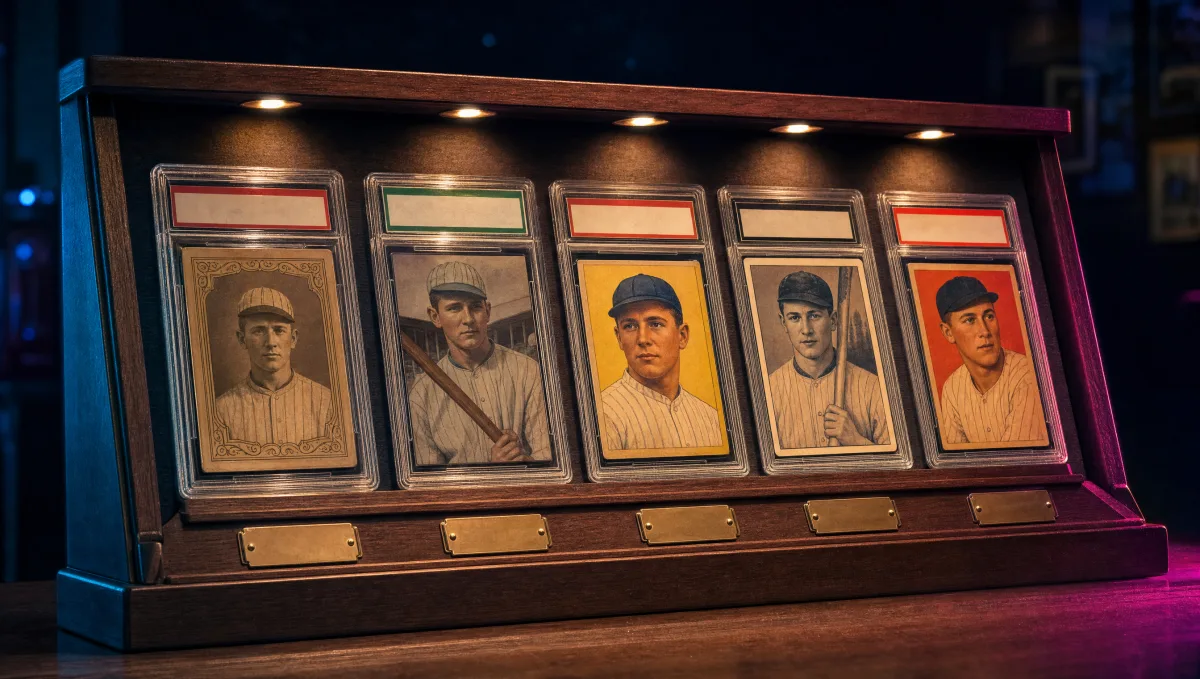
Every Babe Ruth Baseball Card: Pre-War Tobacco to Modern Reprints
Babe Ruth's first baseball card was the 1914 Baltimore News issue printed when he was a 19-year-old minor-league pitcher for the International League Orioles; his last in-life card was the 1939 Play Ball post-retirement appearance, and the 1948 Leaf #3 — released the year he died of cancer on June 13, 1948 — sits as the de facto post-mortem tribute. Between those bookends, roughly 25 primary Ruth cards crossed the pre-war tobacco, caramel, candy, and gum era. Eight decades of modern reprints have kept Ruth on cardboard ever since — Topps Heritage, Allen & Ginter, Sterling, Diamond Kings, Bowman Heritage. The top of the babe ruth baseball card SERP is a wall of retailers, price aggregators, and three excellent authority blogs that each cover only one slice — rookie debate, 1933 Goudey tetralogy, or value lookup — with no forgery section and no modern reprints. This is the full 1914-to-today lineage guide that page wouldn't write. Pullmarket — operated by Pullmarket LLC — walks every era chronologically, hands you a master table at the top, tells you which forgeries cross the counter most often, and is honest about values across the run.
Part of: Complete Baseball Cards Guide — the pillar overview of 130 years of baseball cards, from 1880s tobacco issues through the Fanatics-era modern landscape.
Every Babe Ruth Baseball Card, Era-by-Era (the master table)
The fastest way to make sense of the Ruth catalog is one row per card, because the universe is finite — roughly 25 primary pre-war cards plus the 1939 Play Ball and 1948 Leaf bookends. Modern reprints get their own H2 because the tail is effectively unlimited. Every set name, card number, and PSA-graded comp in this table is cross-verified against PSA CardFacts and a Heritage Auctions, Goldin, or Memory Lane realized sale; any single dollar figure should be treated as a sale-by-sale anchor, not a current market price.
| Year | Set | Card # | Era / format | PSA-graded comp | Notes |
|---|---|---|---|---|---|
| 1914 | Baltimore News | #9 | Pre-rookie (minor league) | PSA 3 ~$7.2M (Dec 2023) | The rookie debate — International League Orioles |
| 1916 | M101-4 Sporting News | #151 | Rookie (major league) | PSA 6 ~$1.45M (mid-2021) | Often called the "true" rookie |
| 1916 | M101-5 Sporting News | #151 | Rookie variant | Comp via PSA APR | Sister issue to M101-4 |
| 1917 | E135 Collins-McCarthy | #147 | Caramel | PSA 6 ~$65K | Early Red Sox era |
| 1921 | E120 American Caramel | — | Caramel | PSA 8 ~$165K | Yankees era opens |
| 1921 | E121 American Caramel | — | Caramel | PSA 4 ~$60K | Sister to E120 |
| 1921 | E220 National Caramel | #89 | Caramel | PSA 5 ~$195K | Scarce |
| 1921 | E253 Oxford Confectionary | — | Confectionery | PSA 6 ~$65K | Scarce |
| 1921 | Frederick Foto Service | #46 | Foto | ~$235K | Ungraded sale comp |
| 1922 | V89 William Patterson | #25 | Candy (Canadian) | PSA 6 ~$70K | Canadian issue |
| 1923–24 | Exhibits | — | Postcard-size | PSA 1 ~$12K | Affordable entry tier |
| 1923 | Lections | #8 | Candy | PSA 2 ~$15K | — |
| 1927 | E210 York Caramel | #6 Type 1 | Caramel | PSA 3 ~$12K | Murderers' Row era |
| 1927 | E126 American Caramel | #38 | Caramel | PSA 3 ~$25K | — |
| 1927 | FC59 Honey Boy Ice Cream | #14 | Ice cream | PSA 5 ~$40K | — |
| 1929 | Star Player Candy | #21 | Candy | PSA 5 ~$65K | — |
| 1932 | U.S. Caramel | #32 | Caramel | PSA 7 ~$75K | Last big caramel era |
| 1933 | Butter Cream | #23 | Confectionery | PSA 4 ~$150K | Short print |
| 1933 | Goudey | #53 | Gum (tetralogy) | PSA 5 ~$41K / PSA 9 $4.2M | Yellow Ruth — single print |
| 1933 | Goudey | #144 | Gum (tetralogy) | PSA 5 ~$38K | Full-body Ruth — double-printed |
| 1933 | Goudey | #149 | Gum (tetralogy) | PSA 5 ~$25K | Red Ruth — same pose as #53 |
| 1933 | Goudey | #181 | Gum (tetralogy) | PSA 5 ~$24K | Green Ruth — seated |
| 1933 | Goudey Sport Kings | #2 | Multi-sport | PSA 7 ~$60K | Crossover set |
| 1933 | Uncle Jacks Candy "King of Swat" | #24 | Candy | PSA 3 ~$65K | — |
| 1935 | Goudey Four-On-One | — | 4-player panel | PSA 7 ~$10K | Affordable entry |
| 1939 | Play Ball | — | Gum | Comp via PSA APR | Post-retirement appearance |
| 1948 | Leaf | #3 | Post-mortem tribute | PSA 3 ~$6K | Year of Ruth's death |
Live cert lookups and population reports run on PSA's CardFacts database; cross-grader cert verification on SGC and CGC. Realized-sale records for high-dollar comps live in the Heritage Auctions archive. For the master record-sale list including the 1914 Baltimore News $7.2M and the Newman Collection Goudey #53 $4.2M, see the most expensive baseball cards sibling.
The Ruth Rookie Card Debate: 1914 Baltimore News vs 1916 Sporting News
The 1914 Baltimore News #9 was Ruth's chronological first card — printed for the minor-league Baltimore Orioles (International League) when he was a 19-year-old pitcher, before the Red Sox bought his contract that July. The 1916 M101-4 and M101-5 Sporting News #151 cards were his first major-league cards, issued during his Boston pitching years. The hobby splits cleanly: PSA, SGC, and Heritage Auctions list the 1914 as the rookie because it's chronologically first; Beckett historically treated the 1916 M101 as the "true" rookie because the Orioles were minor-league. The 1914 Baltimore News set the all-time Ruth public-market price record at approximately $7.2 million in December 2023 per Heritage's archive; the 1916 M101-4 PSA 6 hit $1.45 million in mid-2021. Roughly ten copies of the 1914 Baltimore News are known in any condition across the PSA and SGC population reports combined. The card measures approximately 2-5/8" by 3-5/8" with blue or red tint borders depending on the variant.
The 1933 Goudey Tetralogy: Yellow, Red, Full-Body, Green
Goudey put Ruth on four different cards in their 1933 set — the only player ever given four cards in a single Goudey issue. The tetralogy is the single most-searched Ruth sub-topic and the deep section of this guide. Card-by-card:
- #53 — "Yellow Ruth" (portrait, yellow background). The toughest of the four in high grade and single-printed. PSA 5 comps run roughly $41K; PSA 8 around $120K; the public-market Goudey record is the PSA 9 from the Thomas Newman Collection that sold for $4,212,000 in July 2021 via Memory Lane, per Sports Collectors Daily's coverage of the Newman sale.
- #144 — "Full-Body Ruth" (Ruth at the plate, stadium facade). The iconic and most-coveted of the four. Goudey double-printed #144 on the original sheet because they withheld the Napoleon Lajoie #106 card — the famous Goudey set-completion scandal. The double print means #144 is more plentiful overall but paradoxically harder in true high grade, because most surviving copies are mid-grade averaged. PSA 5 comps around $38K; PSA 8 around $55K.
- #149 — "Red Ruth" (identical pose to #53, red background). Same Ruth art as #53 with the background recolored red. Slightly more affordable than #53 at low grades. PSA 5 around $25K; PSA 8 around $110K.
- #181 — "Green Ruth" (seated, green background). The only seated Ruth in the set, with reverse-text emphasizing hitting prowess rather than standard stats. Cheapest of the four overall but harder than #144 in high grade — fewer surviving copies. PSA 5 around $24K; PSA 8 around $47,500.
Honest framing across the tetralogy: PSA 5–8 grades run low-five-figure to low-six-figure prices; PSA 9 examples are eight-figure auction events; PSA 10 effectively does not exist on any of the four. Live pop counts on each card on PSA CardFacts. For the Goudey #53 record-sale deep coverage, see the most expensive baseball cards sibling.
Pre-War Ruth Cards Beyond Goudey: Caramel, Candy, and Confectionery
The 1914 rookie and the 1933 Goudey tetralogy are the headline stops, but the pre-war Ruth catalog runs deeper. A quick tour of the supporting cast — every entry below is in the master table above with PSA-graded comps:
- 1917 E135 Collins-McCarthy #147 — Ruth's earliest non-rookie card, issued during his Red Sox pitching years before the 1920 Yankees trade.
- 1921 E120 / E121 / E220 / E253 American & National Caramel issues — the Yankees-era debut. E220 is the scarcest and trades into the low six figures at PSA 5+.
- 1921 Frederick Foto Service #46 — small-print foto issue; high-grade copies have sold ungraded into the high five-figures and low six-figures.
- 1922 V89 William Patterson #25 — Canadian candy issue; one of the only Ruth cards printed outside the US during his career.
- 1923–24 Exhibits — postcard-size; the most affordable pre-war Ruth entry tier (low-grade copies into the low five-figures).
- 1927 E210 York Caramel and E126 American Caramel — Murderers' Row era; the year Ruth hit 60.
- 1929 Star Player Candy #21 and 1932 U.S. Caramel #32 — late-career candy issues; U.S. Caramel is one of the cleaner pre-war comps in mid-grade.
- 1933 Butter Cream #23, Goudey Sport Kings #2, Uncle Jacks Candy "King of Swat" #24 — same year as the Goudey tetralogy; each has its own collector following.
- 1935 Goudey Four-On-One — a four-player panel card; the most affordable Ruth slab in mid-grade per Sports Collectors Daily's under-$1,000 affordable Ruth list.
One absence is worth stating plainly: no T206 Ruth exists. The T206 era ran 1909–1911, and Ruth's pro career started in 1914 — three years after T206 ended. If anyone offers you a "T206 Babe Ruth," it is fake. Modern fantasy reprints of imagined T206 Ruth cards exist as collector novelties but are not period cards.
1939 Play Ball and 1948 Leaf: The Post-Career Bookend
Ruth retired in May 1935, which means the 1939 Play Ball Ruth is a post-retirement appearance — not a playing-career card — and it's regularly confused with one in the resale market. The 1948 Leaf #3 was issued the year Ruth died of cancer (June 13, 1948) and the hobby treats it as the de facto post-mortem tribute card, often called Ruth's "last card." PSA 3 comps for the 1948 Leaf run roughly $6K, making it one of the most accessible Ruth cards in graded form for collectors who want a Ruth slab without pre-war money. Old Sports Cards' lineage piece is the canonical secondary coverage on the Leaf; PSA's CardFacts page is the population authority. The Leaf is also one of the most-forged Ruth cards in the modern era because the late-1940s paper is more accessible to fakers than the 1914–1933 vintage stock — see the forgery red-flags section below for the gloss and black-light tests that apply.
Modern Ruth Reprints: Topps Heritage, Allen & Ginter, Sterling, and Beyond
The gap section. The authority blogs covering Ruth stop at 1948 — yet modern Ruth cards exist annually and are actually pullable from current-year baseball pack product. If you want a real Ruth slab without pre-war money, modern is where it lives:
- Topps Heritage Ruth inserts — Topps Heritage's annual nostalgia-design sets re-create historic Topps designs and frequently feature Ruth in their "All-Time Greats" and "Legends" subsets. Real current-year licensed cardboard. Base versions run sub-$20 raw; relic and auto parallels reach higher.
- Topps Allen & Ginter Ruth base cards — A&G includes Ruth in most recent years (e.g. 2022 A&G #42, 2024 A&G with relic-cut signature inserts, 2025 A&G). Base cards run sub-$20 raw; relic and cut-auto 1/1s can hit five figures on the secondary market.
- Topps Sterling Legendary Relics (LR-BR) — 2025 Topps Sterling includes Ruth in the Legendary Relics insert series, serial-numbered to /25 or less with 1/1 parallels. Live product checklists on Beckett's hobby product database.
- Topps Dynasty Dual Relic Cut Signatures — periodic 1/1 cut-signature cards (game-used bat or jersey paired with a cut signature). Five-figure secondary market on most.
- Panini Diamond Kings Materials Masterpiece — 1/1 patch and auto cards. Panini issues Ruth as a non-licensed hobby legend in its retro sets.
- Bowman Heritage Ruth inserts — periodic; usually filed under "Heroes of the Diamond" or similar nostalgia subsets.
Honest framing: modern Ruth cards are cards, not investments. The Topps Heritage base Ruth at $5 raw is for the kid who wants a Ruth in a binder. The Sterling LR-BR 1/1 is a different animal entirely. Either way, modern Ruth product is the realistic path to a Ruth pull from current pack product — and the path where Pullmarket's published-odds packs actually intersect with the Ruth lineage.
How to Spot a Fake Babe Ruth Card (forgery red flags)
Pre-war Ruth cards are the most-faked cards in the hobby — heavily counterfeited across the 1933 Goudey tetralogy, the 1916 M101 Sporting News rookie, and the 1948 Leaf. None of the three top authority blogs covering Ruth combine lineage with a systematic forgery section, which is the single biggest reason raw pre-war Ruth purchases go wrong. Walk through this checklist before any cash changes hands on a raw card:
- Black-light test first. Authentic pre-1948 paper does not fluoresce under UV light. Modern fake paper aged with coffee, tea, or weak bleach glows blue-white under a black-light. SABR's "Using a Black Light in Baseball Card Authentication" piece is the long-form authority on this single test.
- Loupe the print dots. Authentic 1916 M101 Ruth cards show a photoengraving dot pattern across ALL areas — including light backgrounds. Counterfeit M101s have blank stock in light areas with no print dots visible under magnification. CGC's counterfeit alert (article 12082) is the canonical reference for the M101-5 specifically.
- Check the gloss. Authentic 1933 Goudey cards do NOT have a glossy front. Counterfeit Goudeys are glossy — the single fastest visual tell on a fake Goudey Ruth.
- Goudey #144 left-border test. On authentic #144, there is a small visible space between the left border and the "G" in "George" on the nameplate. Common fakes have the "G" hitting the border directly with no space.
- Goudey nameplate registration. Authentic Goudey nameplates show a slight right-side overlap into the border. Counterfeits are edge-aligned, with the nameplate flush against the right border.
- Look for "spider wrinkling." Cards artificially aged with liquid and heat develop a spider-web wrinkling pattern across the surface. Authentic period wear is more random and localized — usually concentrated at corners and edges, not spread across the face.
- Grass and background detail. Authentic Goudeys show fine grass and background detail under magnification — the "field" behind Ruth is rendered with print texture. Fakes are flat. The All Vintage Cards Goudey forgery guide describes this as "grass colors and details non-existent on a fake."
- Cross-verify with PSA APR plus the cert lookup. Every PSA, SGC, and CGC slab carries a printed cert number that resolves on the grader's own website — PSA cert lookup, SGC cert lookup, CGC cert lookup. No working cert resolve, no sale.
What Are Babe Ruth Cards Actually Worth? (price tiers by grade)
Values sit on four honest tiers. Any single dollar figure cited here is a sale-by-sale anchor, not a current market price — comps move with each auction and the right place to check live data is PSA Auction Prices Realized for individual sales and Card Ladder for trailing PSA-graded progression. Heritage Auctions and Goldin archive the high-dollar primary records.
The affordable tier (under $5K) — low-grade 1923–24 Exhibits, low-grade 1935 Goudey Four-On-One, 1948 Leaf #3 in PSA 1–3, low-grade Bowman Heritage and Topps Heritage modern Ruth inserts. The "Ruth slab in your collection" entry tier per Sports Collectors Daily's under-$1,000 affordable Ruth list. A 1948 Leaf PSA 2 around $4–$5K is the standard entry slab.
The mid tier ($5K–$50K) — PSA 4–6 1933 Goudey tetralogy across all four numbers, PSA 3–5 early caramels (1917 E135, 1921 E121, 1923 Lections, 1927 E210), PSA 6+ 1933 Goudey Sport Kings #2, 1929 Star Player Candy PSA 5 range, mid-grade 1923–24 Exhibits.
The high tier ($50K–$500K) — PSA 7+ 1933 Goudey tetralogy across all four numbers, PSA 5+ 1921 American Caramels (E120, E220), PSA 6+ 1933 Uncle Jacks Candy "King of Swat," PSA 4+ 1933 Butter Cream #23, PSA 5+ 1927 E126 American Caramel, PSA 7+ 1932 U.S. Caramel.
The trophy tier ($500K+) — PSA 6+ 1916 M101 Sporting News rookies (the $1.45M PSA 6 M101-4 sale), the 1914 Baltimore News in any grade (the $7.2M public record), PSA 9 1933 Goudey tetralogy (the Newman Collection #53 at $4.2M is the public-market Goudey record), and any Ruth game-used auto-patch 1/1.
Grading economics for the Ruth catalog — PSA Value-tier service runs roughly $15–$25 per card plus shipping at current public tiers; Express and Walk-Through tiers run higher (live pricing on PSA's submission tiers). The PSA 7 → PSA 8 spread on a 1933 Goudey #144 runs roughly 3–5x; the PSA 8 → PSA 9 spread is 20–50x because the population shrinks to single digits. For the vintage HOF parallel — how the 1952 Topps Mantle #311 shows the same trophy-tier dynamic in the post-war era — the Mickey Mantle cards guide is the sibling field guide. Specific dollar figures cited above change weekly; treat any value here as a starting point and check the linked comps.
Where Pullmarket Fits: Pulling a Modern Ruth Insert
Three legitimate paths exist for any collector who wants a Babe Ruth card in hand. The right path depends entirely on what experience you are actually buying:
| Path | What you get | What it costs | Who it's for |
|---|---|---|---|
| Buy a graded pre-war Ruth | A vintage Ruth slab in hand today | $5K (1948 Leaf PSA 2) to $7.2M (1914 Baltimore News) | Vintage collectors with a target |
| Buy a sealed baseball product | A sealed box of raw packs with a chance at a modern Ruth insert | $50–$300 depending on product (Topps Heritage, Allen & Ginter, Sterling) | Sealed collectors and break buyers |
| Rip a Pullmarket baseball pack | Real third-party-graded baseball singles allocated to your account from a Pullmarket pack with published odds before purchase; each pull is held in Pullmarket custody or fulfilled through the Pullmarket Vault per Terms §5.5 | Per-pack price; the published odds disclose exactly which slabs sit in the possible-outcome pool | Collectors who want a real graded pull without buying-and-resealing a sealed box |
Pullmarket runs a Pullmarket Vault fulfillment model — every pulled card is a real third-party-graded slab, managed through the Pullmarket Vault workflow per Terms §5.5. Pullmarket Gems is store credit and explicitly not cashable. Pullmarket isn't a sweepstakes, lottery, casino, or wagering product — the product is collecting and ripping real graded cards. The full operating model is on our trust and safety page; the rip → decide → vault / ship / sell-back flow is on how Pullmarket works.
How to Authenticate Before You Buy
The forgery section above is about identifying a fake card in hand. This checklist is about avoiding fakes at the point of purchase — what to verify before you press "Buy It Now" or wire a deposit:
- Buy graded slabs only. PSA, SGC, or CGC. Raw pre-war Ruth from a non-vetted seller is a coin flip you will lose. The grading risk on raw pre-war Ruth is the single largest authentication exposure in vintage baseball cards.
- Verify the cert number. Every PSA, SGC, and CGC cert resolves to a public page on the grader's site — PSA cert lookup, SGC cert lookup, CGC cert lookup. If a seller can't produce a working cert lookup, walk away.
- Check the auction-house provenance for high-dollar cards. Heritage Auctions, Goldin, Memory Lane, and REA all publish realized-price archives that include the exact card serial number on prior sales. If a PSA 7 1933 Goudey #144 with a specific cert number appears in a private listing at half the auction comp, cross-check the cert against the archive to confirm it isn't a stolen-cert listing.
- Cross-match the PSA pop count to the asking price's reasonableness. A PSA 9 1933 Goudey #144 with single-digit population — sub-$50K asking is a red flag, not a deal.
- For modern Topps Heritage, Allen & Ginter, and Sterling raw cards — buy from a reputable hobby seller or pull from current pack product. Modern fakes are far rarer than pre-war fakes but they exist, particularly on 1/1 parallel cards where a single fake can move five figures.
Closing: The Ruth Lineage, in One Sentence
There is no single Babe Ruth baseball card — there's a 34-year primary lineage from the 1914 Baltimore News rookie to the 1948 Leaf post-mortem tribute, plus eight decades of modern Topps Heritage, Allen & Ginter, Sterling, and Bowman Heritage reprints. Pick the era you actually want, verify the slab against the grader's cert lookup, run the forgery checklist before any raw card crosses the counter, and treat every dollar figure as a starting point — not a current market price. The master table above is the map; the baseball cards pillar is the parent hub for the whole category; and a Pullmarket baseball pack is one honest path to a real graded modern Ruth insert with the odds published before you rip.
Frequently asked questions
The hobby splits. PSA, SGC, and Heritage Auctions list the 1914 Baltimore News #9 (Baltimore Orioles, International League) as the rookie because it's chronologically first. Beckett historically treated the 1916 M101-4 and M101-5 Sporting News #151 cards as the "true" rookie because the 1914 Orioles were minor league. The 1914 is rarer (population in the dozens across PSA and SGC combined); the 1916 M101 is more accessible in low grade and trades into the low five figures at PSA 1–3. Either card is a credible rookie depending on which authority you follow.
Four — and the only player ever given four cards in a single Goudey set. Card #53 is the "Yellow Ruth" portrait (single-printed, toughest in high grade); #144 is the "Full-Body Ruth" at the plate with stadium facade (double-printed because Goudey withheld the Napoleon Lajoie #106 card); #149 is the "Red Ruth" using the same portrait pose as #53 with a red background; and #181 is the "Green Ruth," the only seated Ruth in the set. PSA 5 comps run from roughly $24K (#181) to $41K (#53); PSA 9 examples are eight-figure auction events.
The 1914 Baltimore News holds the public-market price record at approximately $7.2 million (December 2023, per Heritage Auctions' archive). The 1933 Goudey #53 PSA 9 from the Thomas Newman Collection sold for $4,212,000 in July 2021 via Memory Lane, per Sports Collectors Daily's coverage. The 1916 M101-4 Sporting News #151 PSA 6 hit $1.45 million in mid-2021. For the full record-sale list including non-Ruth headliners — the 1952 Topps Mickey Mantle #311 PSA 9.5, the T206 Honus Wagner — see the most expensive baseball cards sibling.
The double-print. Goudey withheld the Napoleon Lajoie #106 card from the 1933 production sheet — the famous set-completion scandal — and used the empty slot to print a second copy of Ruth #144. The double print roughly doubled the surviving population of #144 versus the single-printed #53. More copies means lower per-copy scarcity, which means lower per-grade comp prices despite #144 being the iconic "Ruth at the plate" image of the set.
Yes — they're current-year licensed Topps products with Ruth's image. They're not vintage cards and they're not investments at typical retail prices, but they're real cardboard from the actual Topps production line. The 2025 Topps Sterling Legendary Relics LR-BR Ruth and the periodic Topps Dynasty cut-signature 1/1s are the higher-end modern Ruth cards. The Topps Heritage base Ruth at $5 raw is the realistic "Ruth in your binder" entry tier.
Five fastest tests, in order: black-light the card (authentic 1933 Goudey paper does not fluoresce under UV; modern fake paper glows), check the gloss (authentic Goudeys are not glossy; counterfeits are), the #144 left-border test (authentic #144 shows a small space between the left border and the "G" in "George"; fakes hit the border), the nameplate registration (authentic Goudey nameplates show slight right-side overlap; fakes are edge-aligned), and grass detail under magnification (authentic shows print texture; fakes are flat). Single best policy: buy graded slabs only.
Modern Ruth inserts from Topps Heritage, Allen & Ginter, Topps Sterling, and Bowman Heritage appear in current-year baseball pack product. Pullmarket baseball packs publish their odds before purchase, deliver real third-party-graded slabs, and let you ship the physical card to your door, vault it, trade it, or sell it back for Pullmarket Gems store credit per Terms §5.5. Pre-war Ruth cards (1914 Baltimore News through 1948 Leaf) live on the secondary market only — Pullmarket doesn't source pre-war Ruth.
Pullmarket is an online collectible-card pack marketplace for instant online rips, graded-card chases, secure inventory, and shipping eligible cards to your door. Pullmarket helps collectors compare live packs, or learn about Pullmarket LLC.