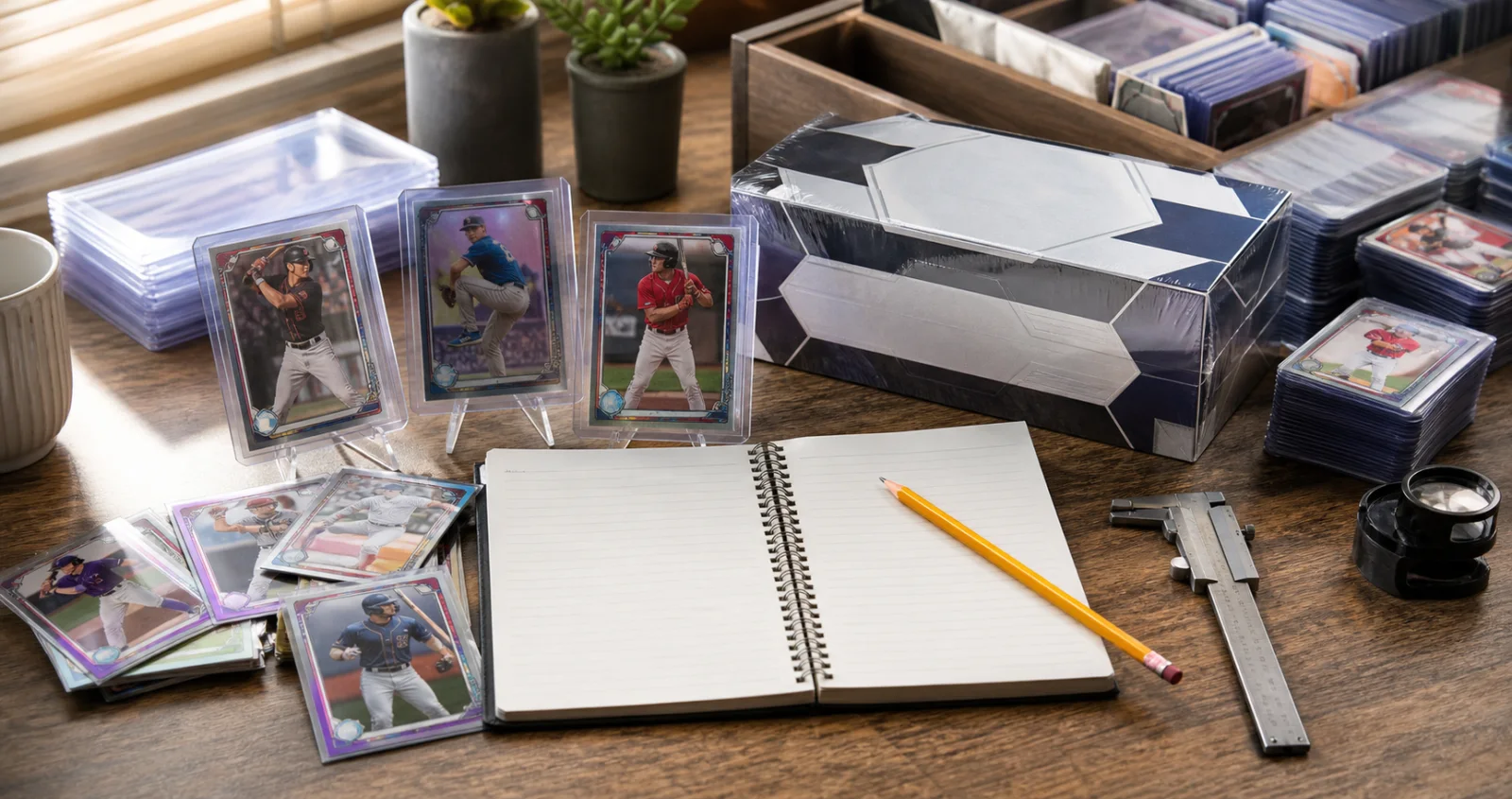
2026 Bowman Baseball Guide: Checklist, Prospects and Formats
The observed public street date for 2026 Bowman Baseball was May 13, 2026. The release has a 100-card MLB base checklist, a separate 150-card Paper Prospect checklist and a matching 150-card Chrome Prospect checklist. Plain numbers, BP codes and BCP codes distinguish those families. Topps also publishes format-specific per-pack odds, so the card code, treatment and exact Hobby, Jumbo, Breaker Delight, Mega or Value configuration all matter when choosing what to open.
“Ethan Holliday #1” is not enough to identify a 2026 Bowman card. Holliday appears as BP-1 in Paper Prospects and BCP-1 in Chrome Prospects, so dropping the prefix collapses two physical card families into one listing. “Chrome Prospect Refractor” has the opposite problem: it names a family and treatment but omits the player, code and format evidence. Keep those details attached. Then choose among a documented sealed rip, the exact single or a graded copy.
What Is in 2026 Bowman Baseball?
The official checklist contains 100 numbered MLB base cards, 150 Paper Prospects numbered BP-1 through BP-150 and 150 Chrome Prospects numbered BCP-1 through BCP-150. Inserts, variations and autograph subsets sit outside those lists. They require their own family names, card codes and, when relevant, treatment or autograph evidence.
Topps’ current pages conflict on the date. An April 14 checklist page says May 6, while an April 30 prospect page says May 13. The 2026 Bowman Hobby product page, established public release coverage and retailer availability support May 13, 2026, as the observed public street date. No inspected source explains what May 6 represented, so it should not be labeled a preorder or early-access milestone. The Trading Card Database set record provides independent navigation for the release.
This guide covers the main Bowman product. Bowman Chrome, Bowman Draft and Bowman Sapphire are separate products with their own checklists, formats, release dates and odds.
The official Topps checklist PDF divides the primary cards this way:
| Checklist family | Numbering | What the list contains | What the identifier establishes |
|---|---|---|---|
| MLB base | 1–100 | MLB veterans and designated rookie subjects | Membership in the numbered base checklist |
| Paper Prospects | BP-1–BP-150 | Prospect cards printed as the Paper family | Paper Prospect identity |
| Chrome Prospects | BCP-1–BCP-150 | Prospect cards printed as the Chrome family | Chrome Prospect identity |
Calling the release a 400-card base set blurs the structure Topps published. The numbered MLB base checklist has 100 cards. Paper Prospects and Chrome Prospects are two additional 150-card families. Matching suffixes connect corresponding prospect identities, but the cards remain physically distinct.
Take Ethan Holliday. His Paper Prospect is BP-1; his Chrome Prospect is BCP-1. The same pattern applies to Konnor Griffin at BP-92 and BCP-92, Eli Willits at BP-95 and BCP-95, and Jesús Made at BP-96 and BCP-96. A listing that drops the prefix cannot distinguish Paper from Chrome.
BCP-92 still is not a complete description of every Konnor Griffin card carrying that code. The physical copy might be the standard Chrome Prospect, a named Refractor or another documented treatment. Autograph and variation branches have their own checklist evidence. The baseball card guide covers the broader differences among base cards, prospects, rookies, inserts, parallels and autographs; for this set, preserving the full printed code is the quickest first check.
2026 Bowman Card Identity Field Reference
Start with the prefix. A plain number belongs to the MLB base checklist, BP identifies Paper Prospects and BCP identifies Chrome Prospects. That code answers which card family is in hand. It does not prove rookie status, a 1st Bowman mark, a parallel, a variation or an autograph. Settle those claims from the printed card and the exact official subset.
“Kade Anderson #19” leaves two possibilities open: BP-19 and BCP-19. “JJ Wetherholt #115” has the same defect. A complete record needs the year, product, family, full code, player, treatment, autograph status and grade status. The source that proves one field may have nothing useful to say about the next.
| Card class or claim | Record this evidence | Safe conclusion | What remains unresolved | Best next source |
|---|---|---|---|---|
| MLB base card | Year, product and plain numeric card number | The card belongs to the 100-card base list | Rookie designation, parallel or variation status | Printed card and its base-checklist row |
| MLB rookie card | Numeric card number plus a visible Rookie designation | The card is presented as a rookie in the MLB base family | Prospect-card or 1st Bowman status | Card image and official base checklist |
| Paper Prospect | Complete BP code | Paper Prospect checklist identity | Chrome identity, a 1st Bowman mark or autograph inclusion | Paper Prospect checklist and card image |
| Chrome Prospect | Complete BCP code | Chrome Prospect checklist identity | Paper identity, a named Refractor or autograph inclusion | Chrome Prospect checklist and card image |
| 1st Bowman | Visible “1st” or “1st Bowman” mark, or exact official support | That specific card carries the designation | Whether every BP or BCP card for the player carries it | Physical card or exact official record |
| Parallel | Parent family and official color, pattern or finish name | A treated version of the parent card | Print run, unless the card is numbered or Topps documents one | Card, checklist and odds sheet |
| Variation | Manufacturer’s exact variation name and a confirmed subject | Membership in the named variation group | Whether any other alternate image is an official variation | Named variation checklist |
| Insert | Insert family, code and player | Membership in a distinct insert set | Base, Paper Prospect or Chrome Prospect identity | The checklist’s named insert section |
| Autograph | Autograph family, code, player and treatment | Membership in that autograph subset | Autograph availability for every subject in the parent checklist | Named autograph checklist |
| Graded copy | Grader, numeric grade and certification details | Third-party assessment of that physical copy | The identity of any different raw, parallel or autograph version | Slab label, certification record and card |
At checklist number 19, the official Paper and Chrome rows both name Kade Anderson. At 115, both name JJ Wetherholt. The 2026 Bowman BP/BCP Identity Ledger performs that comparison for all 150 prospect numbers. Each row keeps the checklist number, subject, team, Paper code, Chrome code, primary-source locator and verification date together.
The source check was completed on August 10, 2026. Both downloads—the CSV and the JSON—contain 150 rows built from the same eight fields. The validated JSON has SHA-256 checksum 9d191f1126855c6825ab77047909dc0e6bc43ab706ca143ad33f5e1b41db5bad. If a later copy returns a different checksum, it is not the validated artifact.
The ledger handles a deliberately narrow lookup. Choose a prospect number and compare the official BP and BCP rows: it reports whether both rows name the same subject and team. It is not a visual audit of 150 physical cards for a printed 1st Bowman logo. A matching row also does not establish autograph membership, parallel eligibility, value or pull probability. Each of those claims needs a separate record.
Rookie-designated subjects appear in the numbered MLB base section. BP and BCP are prospect-list prefixes. Search titles often place “rookie,” “prospect” and “1st Bowman” beside one another, but repetition does not merge the terms. The checklist establishes the family; a printed designation or exact official support establishes the status claimed for that card.
Jesús Made shows where the ledger stops. BP-96 identifies his Paper Prospect card, while BCP-96 identifies the Chrome Prospect. Neither code names a color, autograph or variation. If a listing claims one of those treatments, the corresponding subset and the physical copy have to support it. Otherwise, the identity may be right while the description attached to it is not.
Topps warns that checklist inclusion does not place every subject into every parallel, variation or autograph treatment. A title such as “2026 Bowman Chrome Prospect auto” therefore remains incomplete without an autograph-family name. First confirm the player’s BCP entry. Then find that player in the stated autograph subset and compare the code with the card.
Extra title words cannot replace those checks. “Bowman rookie parallel” still lacks the year, complete card number and treatment. Record what the card and source establish; leave the rest unresolved. The baseball card guide can settle unfamiliar terminology, while the checklist and printed card settle this card’s identity.
How Hobby, Jumbo, Breaker Delight, Mega and Value Differ
Topps publishes nine odds columns: Hobby, Jumbo, Breaker Delight, Mega CEE, Mega EA, Mega SE, Value CEE, Value EA and Value SE. Treatments and per-pack rates can differ by column. Match the physical SKU to its exact column before using a rate; an unlabeled retail package cannot safely be assigned to one of the three Mega or Value codes.
The official Topps odds PDF controls the format comparison. CEE, EA and SE are left unexpanded because the inspected evidence does not define those abbreviations. The packet also does not establish that “Value,” “blaster” and “hanger” are interchangeable names. Use the package details, then select the exact official column that matches them.
| Configuration | Documented signal in the Topps odds sheet | Collector decision |
|---|---|---|
| Hobby | Chrome Prospect Mini Diamond and X-Fractor treatments are listed in the Hobby column | Check Hobby documentation when either named finish is the chase |
| Jumbo | Shared treatments can carry rates different from Hobby | Read the Jumbo entry on its own terms rather than importing a Hobby rate |
| Breaker Delight | Purple Geometric Chrome Prospects are listed at 1:1 in the Breaker Delight column and absent from the other displayed columns | Use the Breaker Delight column when researching that exact Geometric treatment |
| Mega | Lazer Refractors appear in the Mega columns | Match the exact Lazer treatment to the correct Mega configuration |
| Value | Green treatments appear in the Value columns | Identify which Value column applies before recording availability or rate |
This table is a treatment locator, not a format ranking. A collector hunting an X-Fractor has a reason to inspect Hobby documentation. Someone researching a Lazer treatment needs the applicable Mega column. Neither observation says which sealed box offers better financial value.
The rate rows show why format names cannot be treated as decorative labels. Topps lists base Sky Blue cards at 1:268 per Hobby pack and 1:77 per Jumbo pack. Chrome Prospect Refractors appear at 1:178 per Hobby pack and 1:60 per Jumbo pack.
Those are per-pack rates for card families. They are not named-player probabilities, case frequencies or box-value calculations. Cards per pack and packs per box also differ, so comparing 268 with 77 does not by itself identify the stronger purchase.
| Box format | Documented box contents | Advertised autograph or treatment signal | What the numbers actually help decide |
|---|---|---|---|
| Hobby | 20 packs of 8 cards, or 160 cards | 1 autograph per box | Broad box-level exposure with one advertised autograph |
| Jumbo | 12 packs of 28 cards, or 336 cards | 3 autographs per box | More total cards and more advertised autographs than Hobby, before considering price |
| Breaker's Delight | 10 cards | 2 autographs and at least 3 numbered Geometric parallels | A concentrated configuration for collectors specifically seeking the documented Delight mix |
| Mega | 6 packs of 7 cards, or 42 cards | 2 Chrome Prospect Lazer parallels and 1 Bowman Sterling card; no autograph promise was verified | A treatment-led retail route rather than an autograph-guarantee route |
| Value | 6 packs of 10 cards, or 60 cards | Retail-exclusive Green parallels; no autograph promise was verified | A larger card count than Mega with a different documented treatment family |
The official Topps Hobby page documents 20 packs of eight cards and one advertised autograph. The official Topps Jumbo page gives a different shape: 12 packs of 28 cards and three advertised autographs. The inspected Breaker’s Delight listing, Mega listing and Value listing supply the box contents for those remaining sealed formats. Those retail pages document their configurations; Topps remains the source for official checklist membership and stated odds.
The box-level contrast is sharp. Jumbo distributes three advertised autographs across 336 cards. Breaker’s Delight puts two advertised autographs and at least three numbered Geometric parallels into ten cards. One offers broad checklist exposure; the other compresses a tightly specified mix into a much smaller box.
Mega and Value make another useful contrast. Mega documents two Chrome Prospect Lazer parallels and one Bowman Sterling card in a 42-card box. Value documents 60 cards and retail-exclusive Green parallels. Neither inspected listing supplied an autograph promise. A possible autograph family in retail odds is not the same claim as an advertised autograph per box.
The matrix cannot name a best value because no synchronized delivered-price dataset was inspected. It can eliminate a poor fit. A collector seeking the documented Delight mix does not need a generic retail comparison; a collector who wants more cards before price enters the discussion can see that Jumbo contains 336, Hobby 160, Value 60 and Mega 42.
The 1:178 Chrome Prospect Refractor entry belongs to one card family in the applicable format column. Read it as one stated insertion per 178 packs for that family. Konnor Griffin and Jesús Made are not named in the rate, and the number does not describe any other individual subject.
Player eligibility has to be checked separately. Even then, Topps cautions that a checklist subject may not appear in every parallel or variation. Dividing 178 by the size of a checklist would add an analyst’s assumption to the manufacturer’s figure; the result would not be a Topps-published named-player probability.
This guide therefore leaves named-player odds, inferred unnumbered print runs, case-hit frequencies and expected value uncalculated. The official rows also do not support a claim that one configuration provides better chances than another.
For a Chrome Prospects X-Fractor chase, four checks are enough:
- Name the family and treatment in full; “Chrome hit” is too broad.
- Find the player in the relevant official checklist or subset.
- Identify the physical SKU and use its exact odds column.
- Copy the 1:X figure from that column without converting it into a player-specific rate.
A blank cell offers no official support for that treatment in the chosen configuration. A populated cell documents intended availability and a per-pack family rate. Topps states that its checklist and odds describe intended production configuration and that actual contents and odds may vary.
Digital ripping follows a different product record, which the online card packs guide explains. The sports-card pack guide compares the broader collecting routes; it is not a substitute for Bowman’s SKU-specific checklist and odds evidence.
What Is the Difference Between a 1st Bowman and a Rookie Card?
A 1st Bowman belongs to a player’s prospect years and generally predates the official MLB rookie card. Verify the specific card through a visible “1st” or “1st Bowman” mark, or exact official documentation. BP and BCP do one narrower job: they identify Paper and Chrome Prospect families. Neither prefix alone proves the printed designation.
BCP-92 answers the family question: it identifies Konnor Griffin’s Chrome Prospect card. It does not finish a “1st Bowman” claim when glare hides the relevant part of the card. Topps’ 1st Bowman collector glossary points collectors to the printed mark. Without a visible mark or exact Topps support, the defensible record is “1st Bowman status unverified.”
A player-name search can mix prospect cards, MLB rookies, inserts and minor-league cards on one screen. That is a search result, not a chronology. The baseball card guide explains the general terms. For the card in front of you, use the checklist row to establish its family and the printed mark to establish its designation.
BCP-92 is a useful inspection case because its claims can be checked independently:
- Match BCP-92 to Konnor Griffin and his team in the official checklist.
- Copy the entire code. “92” without the BCP prefix does not settle the card family.
- Inspect the card itself for “1st” or “1st Bowman.” A listing title is not a substitute for the visible mark.
- Name the treatment only when the applicable evidence supports Paper, Chrome, parallel, variation or autograph status.
A record can pass one check and fail another. BCP-92 may establish Griffin’s Chrome Prospect identity while an obscured mark leaves 1st Bowman status unresolved. A visible 1st Bowman mark does not prove the card is a Refractor, and BCP-92 alone does not put Griffin in an autograph subset. A serial stamp describes the numbered copy carrying it; without the full code, it cannot establish the parent family.
The 150-row identity ledger observes the same limit. It pairs official BP and BCP identities but does not claim that the logo on every physical card was inspected.
Which 2026 Bowman Prospects Deserve More Research?
Start with Konnor Griffin, Kevin McGonigle and Jesús Made. All three appear in the official prospect checklist, and MLB Pipeline ranked them first, second and third in its January 2026 preseason Top 100. That ranking is a dated scouting reference. It does not predict card value, demand, grading results or future performance.
The official checklist answers “does this player have a card in the set?” MLB Pipeline’s preseason 2026 ranking addresses baseball evaluation. Putting the sources side by side creates a sensible research queue without asking either source to do the other’s job.
| Player | Official Bowman evidence | January 2026 MLB Pipeline context | Appropriate next question |
|---|---|---|---|
| Konnor Griffin | BP-92 and BCP-92 | No. 1 | Which Paper, Chrome or documented subset card is actually being considered? |
| Kevin McGonigle | Confirmed prospect-checklist member | No. 2 | What is the complete card code and treatment? |
| Jesús Made | BP-96 and BCP-96 | No. 3 | Does the desired format list the treatment being targeted? |
| Ethan Holliday | BP-1 and BCP-1 | Checklist identity is confirmed here | What does current scouting evidence say, separate from hobby attention? |
| Eli Willits | BP-95 and BCP-95 | Checklist identity is confirmed here | Which exact card family, logo and treatment does the listing show? |
MLB Pipeline’s order was a preseason snapshot. Development, promotions, injuries and new performance evidence can change a prospect evaluation, so the January 2026 date belongs beside the ranking whenever it is used. The list is not a permanent ordering of the players or their collectibles.
The split between card evidence and baseball evidence is useful in practice. Pipeline cannot confirm an autograph subset or parallel. Topps can confirm card inclusion, but its checklist is not an independent scouting report.
Prospects Live’s 2026 Bowman analysis adds team-by-team scouting opinions and distinguishes prospects appearing in base cards, autographs or both. Use that work to research less familiar players. Use Topps to confirm the official card identity.
No current prices, completed-sale dataset, population reports or verified print runs were inspected here. The table is therefore a research queue, not a most-valuable list or investment ranking.
A Griffin collector still has a card decision after reading the scouting report: BP-92 or BCP-92, standard card or documented treatment, unsigned or autograph, raw or graded. The sports-card pack guide is useful only after that identity work, when the remaining question is whether to chase several acceptable cards through a rip or target one exact copy.
How to Identify Inserts, Parallels, Variations and Autographs
“2026 Bowman insert” does not identify one checklist section. The release names Bowman Scouts Top 100, Bowman Sterling, Electric Sluggers, Under the Radar, Power Chords, Anime, Final Draft, Patchwork, Crystallized and Bowman Spotlights. Keep the actual family name beside the player, code and treatment. Without it, there is no reliable way to test the card against the correct checklist branch.
Beckett’s set guide helps locate the base, prospect, parallel, variation, autograph and insert sections. Official inclusion and stated rates still come from the Topps checklist and odds documents.
The evidence changes with the claim:
- Insert: Find the named insert section and retain the family, player and code. The card does not become another base, BP or BCP entry.
- Parallel: Identify the parent set first. Add a color, pattern or finish only when the card or official source supports that name; shine by itself does not prove “Refractor.”
- Variation: Use the manufacturer’s full variation name and confirm the subject in that section. Alternate artwork alone is insufficient.
- Autograph: Keep the autograph family attached to the player and code. When a signed card also has a parallel treatment, record both instead of reducing the description to “auto.”
- Serial-numbered copy: Transcribe the stamped numerator and denominator from the physical card. That stamp belongs to the treatment and copy carrying it.
Anime and Anime Kanji share part of a name, not a checklist identity. Anime is an insert family. Anime Kanji is a short-print variation limited to Japanese players, with anime-style artwork and a direct phonetic Kanji rendering of the player’s name. Topps assigns them separate checklist identities and separate odds rows.
Red RC cannot be shortened to “red parallel” either. Its full identity is a performance-linked redemption program, not an ordinary numbered red parallel. The generic label would erase the program mechanics and mix it with conventional color treatments.
Jesús Made’s BCP-96 establishes his standard Chrome Prospect identity and stops there. A listing titled “2026 Bowman Jesús Made Chrome auto” still needs an exact autograph subset, a visible signature, the card code and any treatment. If Jesús Made is absent from the claimed subset, his place on the parent Chrome Prospect checklist cannot make the autograph description valid.
Topps lists Chrome Prospect Autographs, Chrome Rookie Autographs, Draft Pick Pairings Autographs and insert autograph parallels separately. “Bowman auto” may work as a search phrase, but it is not a complete identity for the collectible.
“Case hit” is also too loose to replace the published family name and 1:X rate. A long denominator records a difficult stated insertion rate. It does not create an official rarity nickname, and it cannot establish the print run of an unnumbered card.
A serial stamp applies to the copy carrying it. It does not supply a print run for an unnumbered neighboring treatment. Likewise, a family-level odds row does not reveal the exact probability for one player.
Read grading as a condition layer on the identified card. The slab’s grader and numeric grade apply to that physical copy; they cannot change Paper into Chrome or convert an unsigned card into an autograph. The graded-versus-raw card comparison explains when the assessed condition of a copy affects the collecting decision.
Are the Paper Prospect and Chrome Prospect Checklists the Same?
The lists align by subject and trailing number, but the physical cards are different. BP-92 identifies Konnor Griffin’s Paper Prospect; BCP-92 identifies his Chrome Prospect. Both checklists run from 1 through 150. Keep the BP or BCP prefix before recording a treatment, autograph, serial number or grade.
A search for “Konnor Griffin Bowman 92” can surface both families because the name and suffix agree. The C resolves the ambiguity: BP-92 is Paper Prospects, while BCP-92 is Chrome Prospects. Once the prefix disappears, a later grade or treatment can be attached to the wrong checklist family without looking obviously incorrect.
Write the card identity on one line before adding condition or price evidence:
2026 Bowman Baseball / Chrome Prospects / Konnor Griffin / BCP-92 / exact treatment / autograph status / serial notation / grade if applicable
For the Paper card, use Paper Prospects and BP-92 instead. When no source settles the treatment, leave that field blank or mark it unverified. A seller’s description should not fill an evidence gap.
The line separates several different jobs. Year and product keep the main 2026 Bowman release apart from neighboring Bowman products. Family and full code settle Paper versus Chrome. Treatment distinguishes a standard card from a parallel or variation; autograph and serial information narrow the identity further. Grader information belongs to the assessed copy.
Those distinctions have to be settled before comparable-sale research. A sale may match Konnor Griffin and the trailing number while involving BP instead of BCP, a standard card rather than a Refractor or an unsigned copy rather than an autograph.
Use the physical card or slab label as the starting point:
- Copy the complete card code, including BP or BCP.
- Match that code and player to the official checklist.
- Resolve the treatment from the card and the applicable official documents.
- Add autograph, serial and grade details only when the copy supports them.
- Compare records after every field material to the decision agrees.
The order matters. A grade can be transcribed perfectly and still describe the wrong collectible if the underlying BP or BCP identity is wrong.
Paper, Chrome, autograph, unsigned, raw and graded copies belong in separate groups until the comparison controls for those differences. A graded BCP-92 Refractor and a raw BP-92 standard card share a player, but they answer different buying questions.
For a card already owned, the selling sports cards online guide covers condition review and comp selection. Complete the Bowman identity first; price evidence cannot correct a mismatched code or treatment.
Is 2026 Bowman Baseball Worth Opening?
Open sealed product when the rip and exposure to several acceptable card families matter more than receiving one exact card. Buy a single when the chase is fixed by player, code and treatment. Choose a graded copy when third-party authentication and a stated grade are priorities. Skip a format whose official column does not document the desired treatment.
“Worth” can mean an enjoyable rip or a financial return. This guide can support the first decision. It cannot calculate the second because no synchronized box prices, completed card sales, grading populations or verified print-run dataset was inspected.
| Collector priority | Route that fits the job | What the collector gives up |
|---|---|---|
| Enjoy the rip and encounter multiple card families | Open sealed Bowman product | Control over the exact player, code and treatment |
| Acquire one known player or parallel | Buy the exact single | The sealed opening experience and broad checklist exposure |
| Own a card already authenticated and graded | Choose a graded-card route | The normal raw-card mix of sealed Bowman product |
| Chase a documented format treatment | Select a configuration whose Topps column lists it | Access to treatments listed only under other configurations |
| Avoid an unwanted product mix | Skip the unsupported configuration | The chase may require another format or a direct single |
A sealed box makes sense when the acceptable result is broad. A collector happy to pull MLB base cards, Paper Prospects, Chrome Prospects and several insert families can use the format table to choose a product mix. The tradeoff is control: the checklist and odds sheet do not turn a pack into an order for one player.
The single-card route fits a narrower want. If the target is already “Konnor Griffin BCP-92, exact treatment,” unrelated checklist exposure has little use. The collector gives up the rip but can inspect the actual card, seller record and, when applicable, slab details.
A grade answers a condition question about one authenticated copy. It does not identify a missing prefix, turn Paper into Chrome or merge a standard card with its parallels, variations and autographs. Confirm the underlying card first. Then use the grader, numeric grade and certification details to describe that copy.
A format earns consideration only if its exact Topps column contains an entry for the desired treatment. A blank cell supplies no official basis for chasing that treatment through the SKU in hand. The practical alternatives are another documented format or the exact single.
Even a populated cell has a limited job. It records intended availability for a card family and gives the manufacturer’s per-pack rate. It does not promise Konnor Griffin, Jesús Made or a particular serial-numbered card. No player-level calculation is needed to decide that a fixed card target is narrower than the published family rate.
The how online card packs work comparison applies when the alternative is a digital rip rather than another manufacturer-sealed SKU. Define an acceptable pull before choosing the surface. Several acceptable prospect families can justify a sealed configuration. One required treatment sharply narrows the fit. Requiring an existing third-party grade makes the target narrower again.
Choose sealed Bowman when the rip and exposure to several documented families are part of the goal. Choose the single when the requirement has become BCP-92 in one named treatment. If authentication and a specified grade are mandatory, look for a graded copy instead of relying on a sealed raw-card mix to supply that condition.
A current online pack is a separate route. It fits only when the pool displayed on its live page and that pack’s published odds match the collector’s goal. Bowman’s checklist, box contents and rates do not transfer to it.
Compare 2026 Bowman With Current Online Baseball Packs
Use Topps’ checklist to identify a 2026 Bowman card and the matching SKU column to read its stated per-pack rate. A live online baseball category documents something else: the packs and physical-card outcomes displayed there at that time. Neither record can answer for the other.
No exact inventory receipt confirms 2026 Bowman Baseball or a named 2026 prospect in the current category. That does not prevent a collector from considering a current baseball-card rip as a separate choice after the Bowman research is complete; it does prevent the category from being presented as evidence that this set or player is available.
For sealed Bowman, the package, checklist and exact odds column must agree. For an online pack, inspect that pack’s live pool, construction and published odds. When neither route verifies the required card or treatment, buying the exact single keeps the decision attached to evidence.
How Pullmarket Fits the Graded-Card Route
Inspect the current baseball category, then open the page for any pack under consideration. Its live details show that pack’s possible physical-card outcomes and published odds; they do not establish that 2026 Bowman, a named player, a particular grade or an exact card is available.
A displayed outcome may be raw or third-party graded. After a pull, the owner can keep the real physical collectible in the Vault, ship it, trade where enabled or accept a market-based sellback for Pullmarket Gems, which are non-cashable store credit. Fulfillment is hybrid: some cards are held by Pullmarket, while others are reserved against verified supplier or partner-vault inventory and sourced on demand. How Pullmarket works explains the pack process, the Pullmarket trust guide covers the operating disclosures, and the selling sports cards online guide distinguishes Gems sellback from listing a card elsewhere. One visible example does not establish an exact-card probability unless the pack expressly publishes one.
Frequently asked questions
Treat the label as unresolved. The inspected sources do not make “blaster” or “hanger” equivalent to Value, and they do not map either term to Mega CEE, Mega EA, Mega SE, Value CEE, Value EA or Value SE. Compare the physical package, pack count and card count with the official 2026 Bowman odds PDF. If no exact column can be established, do not borrow that column’s treatments or rates.
The grade still describes the assessed copy, but the incomplete label does not settle Paper versus Chrome. Read the code visible on the card and match the player to the official checklist. If the card image and slab description conflict, retain the discrepancy until the identity is confirmed. Do not combine BP and BCP sales merely because the player and trailing number are the same.
No. A stamp such as a numerator over a denominator documents the particular numbered treatment carrying it. It does not establish the print run of an unnumbered parallel, an insert with a similar finish or another color in the same family. Record the parent set, exact treatment and serial notation together. Without a physical stamp or manufacturer statement, leave the print run unverified.
No. Those are separate products, not formats of the main release covered by this guide. A player missing from one Bowman product cannot be added from another product’s checklist, and a treatment or odds row cannot be transferred across them. Keep the full year and product name in every record so neighboring Bowman releases remain separate during searches, collection audits and sale comparisons.
Browse online sports card packs. New here? See how Pullmarket works.