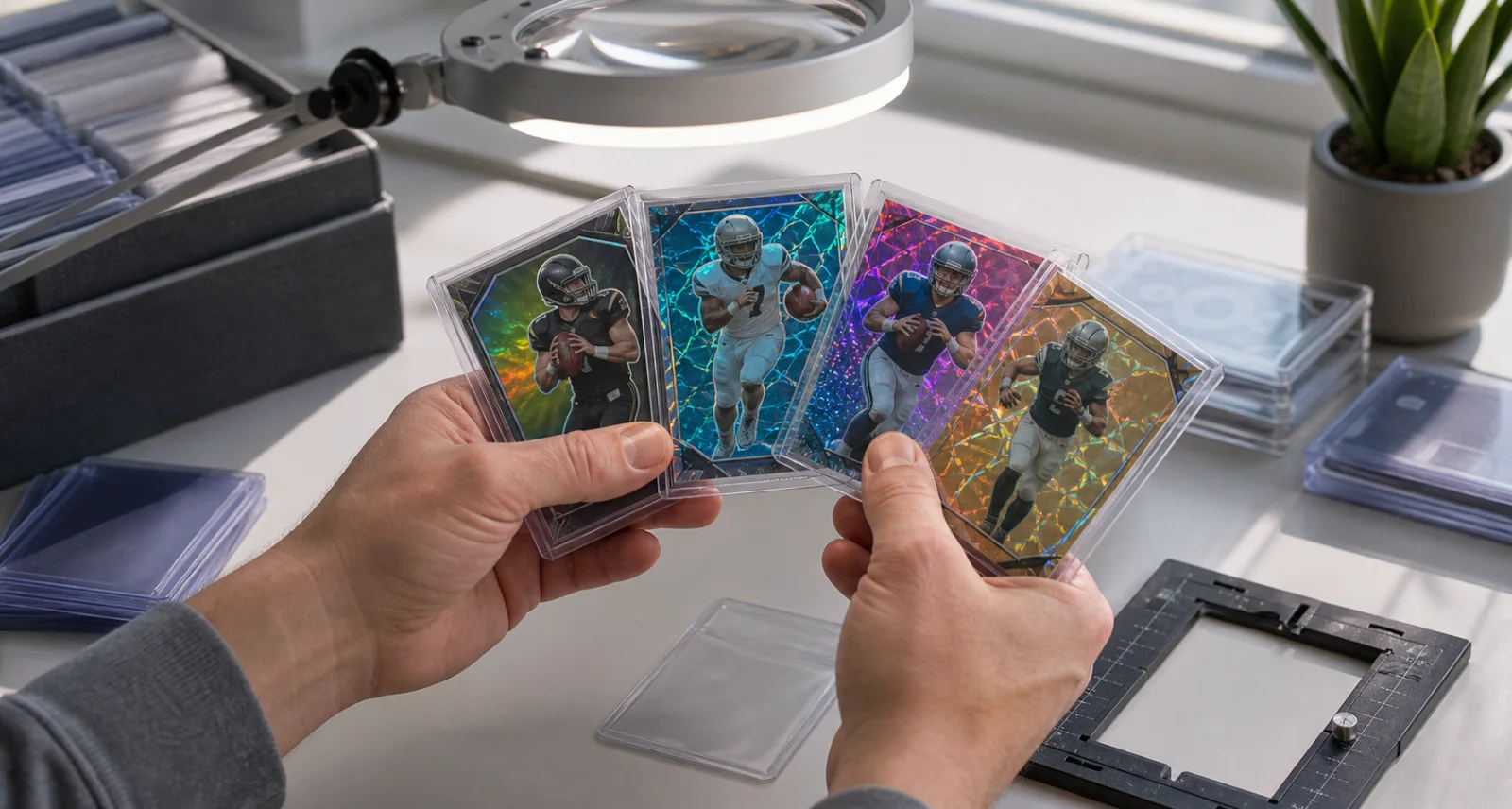
2025 Topps Chrome Football: Set, Formats and Chases
The name says 2025 Topps Chrome Football. The calendar says April 15, 2026. Both belong in the record. This was the first Topps football release under the official NFL and NFLPA trading-card license, built around a 400-card base set. The decisive buying fact is that Topps documents Hobby, Jumbo, Delight, Sapphire, Value, Mega, Hanger, and Fanatics configurations in separate odds columns. Inserts, autographs, patches, and parallels do not run identically through all of them.
For any card under consideration, the useful answer is specific: what is it, where does Topps document it, and does the other sale actually match?
There is also a buying decision hiding in that description. “Any of these three rookie inserts” leaves room for a box. “This player, this insert, this finish” does not.
Catalog: Set name: 2025 Topps Chrome Football. Release date: April 15, 2026.
Release Date and NFL License for Topps Chrome Football 2025
April 15, 2026 is the documented release date; 2025 remains the product year printed in the set name. The NFL announcement confirms the date and Topps’ official NFL and NFLPA trading-card license. None of the inspected sources explains the naming choice, so a catalog should store the product year and release date separately.
The NFL’s licensing announcement identifies Topps as the official exclusive NFL and NFLPA trading-card licensee. That status gives the set its official league, team, uniform, and mark context. Another product may feature the same professional player without carrying the same presentation or belonging to this checklist.
The 2025 name paired with an April 15, 2026 release is not a catalog error. Record both. The date is documented; a reason for the naming is not.
On a spreadsheet, put 2025 in the product-name cell and April 15, 2026 in the release-date cell.
Two marketplace listings may both say “2025” and still represent different cards. Before treating them as comparable, match the complete set name, player, team, printed card number, and release date. Agreement on the product year cannot repair a mismatch in any of those identity fields.
The NFL license settles rights and product identity. It does not supply a print run, measure scarcity, predict a grade, estimate demand or resale value, or prove that every checklist subject received every parallel. A sale title still needs the parallel name, card number, and correct checklist branch; “licensed” cannot stand in for them.
The broader football card guide places this release inside the base-card, rookie, insert, parallel, and autograph vocabulary used across the hobby.
Topps Chrome Football 2025 Checklist: What It Can Prove
The checklist settles a card’s identity inside the release: subject, card number, branch, variation, and treatment. It does not establish current value or place that card in every package. To check format access, move from the card’s checklist family to the matching row and exact SKU column in Topps’ odds sheet.
The numbered core contains 400 cards. That figure does not include the full release inventory of inserts, variations, autographs, and relics. The Beckett checklist coverage provides practical navigation alongside the Topps product pages, checklist, and odds documents.
“Checklist” can describe two different objects. Sometimes it means the 400-card base run. Elsewhere it includes every branch attached to the release: rookies, image variations, named inserts, autographs, relics, autograph relics, and their treatments. Before accepting a sale title, locate the card in the relevant branch rather than searching only the base list.
#327 / rookie / Team Camo image variation / Prism contains four identity layers. The number and rookie designation place the card in the numbered base core. Team Camo is the variation; Prism is the parallel finish. The card is not an insert because an insert begins with its own named design.
Rookie Patch Autograph needs the same precision. Memorabilia without a signature is a relic. Memorabilia plus a signature is an autograph relic. A signature without memorabilia remains an autograph.
A Sale Note With Enough Identity
One ledger line can hold the decision-grade identity:
full product | player | team | printed number | branch | treatment | Topps SKU column
The branch may be base, rookie, variation, insert, autograph, relic, or autograph relic. The treatment may be Prism, Neon Pulse, Geometric, X-Fractor, RayWave, Red White and Blue, or Football Leather. Neither a color nickname nor a treatment replaces the product and printed card number. Two records that differ on a material field are not clean comps.
Save the product year and complete set name beside the card number, player, team, rookie designation where applicable, checklist branch, finish, and documented format. If the family or finish cannot be resolved, keep the sale as background context. It is not matched price evidence.
The checklist stops at identity
A checklist hit means the subject or family belongs to the release. It does not place that card in every format. Package access requires the exact odds row and SKU column; price requires a dated sale for the same card identity. Neither source shows that a target will appear in a particular pack or that one SKU offers better value.
If condition is the unresolved field, the graded versus raw guide separates those comparison records. The checklist has already done its job; it cannot decide whether two condition states match.
Topps Chrome Football Rookies, Inserts, and Card Families
Topps numbers veterans 1–300. The rookie run begins at 301 and ends at 400, for 100 rookies. Variations, named inserts, autographs, relics, and autograph relics sit in separate checklist branches. A player’s base entry therefore does not establish that player in another family, treatment, or package.
The official Topps checklist PDF shows the handoff in the numbered run: card 300 closes the veteran group, and cards 301–400 make up the rookie group. The sections that follow introduce different families rather than extending that base numbering.
Power Players and Legends of the Gridiron contain 40 subjects apiece. Urban Legends, Helix, Shadow Etch, and Fanatical each list 30. Fortune 15 also contains 30, while Future Stars and All Chrome Team have 25 each.
The other named groups vary sharply in size. Game Genies has 25 cards. Chrome Radiating Rookies, Ultra Violet, and Lightning Leaders have 20 each; Kaiju has 10, and Let’s Go has 5.
Those figures count subjects in each design. Ten Kaiju entries identify 10 checklist subjects. They do not promise 10 Kaiju cards or establish an equal share of the family’s pack ratio for every player. Package evidence still comes from the applicable odds row.
A Complete Card Record Before You Search Prices
Start with the complete product name and printed card number or code. Then locate the exact checklist branch: base, rookie, variation, named insert, autograph, relic, or autograph relic. Keep Topps’ wording for the refractor or variation instead of reducing it to a color. Record serial numbering, a signature, and memorabilia as separate fields.
That record exposes three bad matches immediately: a base rookie paired with a rookie insert, a named insert paired with a similarly colored parallel, or a patch autograph paired with an unsigned relic. Only after those distinctions match should the record be joined to a Topps package column or a completed sale.
Topps Chrome Football 2025 Autograph Checklist
“Autograph” is not one universal pool in this release. Chrome Autographs, Rookie PREM1ERE Patch Autographs, and NFL Honors Gold Shield Autographs are separate families with separate identity and format questions. Find the player in the named family first, then inspect its applicable SKU column. A general autograph statement cannot prove access to a narrower patch family.
The official Topps Hobby launch page names three distinct families:
| Family | Saved checklist note |
|---|---|
| Chrome Autographs | Chrome signature lane; verify subject and treatment |
| Rookie PREM1ERE Patch Autographs | Rookie-premiere signature plus patch; verify subject and SKU |
| NFL Honors Gold Shield Autographs | NFL Honors Gold Shield signature family; verify subject and format |
These are not alternate labels for one signed-card pool. A package that advertises an autograph does not, by that statement alone, promise either of the narrower patch families.
A title that says only “rookie auto” leaves the decisive fields unstated. Match the subject, card code, named autograph family, treatment, and exact format. If one of those fields is absent, leave it unresolved; the shorthand cannot prove a Rookie PREM1ERE Patch Autograph, an NFL Honors Gold Shield Autograph, or the Topps package column assigned to that family.
Patch note from Topps: Rookie PREM1ERE patches were worn when players first suited up for an official regular-season NFL game. That manufacturer statement describes provenance. It supplies no value estimate, subject-level frequency, or promise that the wanted player appears in a given box.
For a one-player autograph hunt, begin with the subject and named family. The wanted treatment and exact SKU come next. A broad autograph promise cannot repair a missing subject or family entry.
An autograph name on a checklist is an identity lead. When the task becomes documenting and comparing a card already owned, continue with the selling cards online guide.
Topps Chrome Football Inserts for the 2025 Set
Helix, Ultra Violet, Radiating Rookies, Kaiju, and Game Genies are named insert designs in the inspected Topps material. Prism and X-Fractor are parallel treatments, not substitute names for those inserts. The checklist identifies the design and subject; the matching Topps odds row and SKU column identify documented package access.
The inspected Topps material confirms five insert families relevant to this shorter field map. Their names are identity data. The supplied evidence does not support ranking them by price, scarcity, demand, or long-term importance.
| Insert family | Record it as | Do not merge it with |
|---|---|---|
| Helix | Helix insert, plus subject and any documented treatment | Prism or another base-card parallel |
| Ultra Violet | Ultra Violet insert | A generic “Chrome insert” record |
| Radiating Rookies | Radiating Rookies insert | A standard rookie base card |
| Kaiju | Kaiju insert | X-Fractor or another parallel finish |
| Game Genies | Game Genies insert | An unnamed non-base card |
Helix and Kaiju start as named designs. Prism and X-Fractor describe treatments within the parallel structure. That distinction changes the checklist branch, the search terms, and the odds row needed for a package lookup.
Use the family name before the finish.
A reflective surface or color accent cannot settle the question. The printed card code and official family name establish the card first; the finish follows. Seller shorthand may help with marketplace searches, but it should not replace the manufacturer’s identity in a collection ledger or comp set.
A player-specific insert hunt begins in that insert’s subject list, not in the odds PDF. The PDF may give a ratio for the family, but that number does not become a player-level ratio without a supported denominator allocating the family among its subjects.
Topps Chrome Football Hobby vs Retail in 2025
“Retail” is not a usable Topps odds-column name. Value, Mega, Hanger, and Fanatics have separate configurations, just as Hobby, two Jumbo columns, Delight, and Sapphire do. Identify the wanted family or finish first, then retain only the exact package columns in which Topps documents that row.
The official pack-odds sheet separates Hobby, two Jumbo configurations, Delight, Sapphire, three Value configurations, three Mega configurations, two Hanger configurations, and a Fanatics Box. Two products sold through retail channels may therefore lead to different columns. “Retail odds” is too imprecise to support either a finish claim or a ratio.
Four package configurations have enough support here for a complete card-count comparison:
| Format | Verified package contents | Advertised format note |
|---|---|---|
| Hobby | 20 packs, 4 cards per pack, 80 cards per box | One autograph per box is advertised on the Topps Hobby launch page. |
| Mega | 7 packs, 6 cards per pack, 42 cards per box | The inspected Target Mega listing advertises Hot Pink and Lime Green X-Fractor parallels. |
| Value | 7 packs, 4 cards per pack, 28 cards per box | The Topps Value page advertises red, white, and blue refractors; it does not advertise an autograph guarantee in the inspected overview. |
| Hanger | 1 pack, 20 cards per pack, 20 cards per box | The inspected Topps product extract advertises Pulsar parallels, with the package count corroborated by Beckett’s format summary. |
That is a volume comparison: Hobby contains 80 cards, Mega 42, Value 28, and Hanger 20. It is not an expected-value table or a calculation of cost per wanted finish. A subject-level chance would also need information that these package totals and format-row odds do not supply.
The inspected Hobby and Jumbo columns both document Prism and Neon Pulse, but their cells are not interchangeable. On the base Refractor row, Hobby reads 1:4 packs and Jumbo reads 1:2 packs. Each ratio stays with its own source column.
Geometric belongs in the Delight lookup. Topps gives that parallel family a Delight lane; it should not be treated as evidence for a smaller version of Hobby.
An X-Fractor target points to Mega, but the odds sheet contains more than one Mega configuration. “Mega” identifies the product family, not the complete citation.
RayWave, Red White and Blue, and Football Leather Refractor families appear in the inspected Value columns. The exact Value configuration remains part of each odds fact.
Sapphire uses its own base treatment and color ladder. A Sapphire chase therefore poses a different product question from ordinary Chrome Hobby, Mega, Value, or Hanger packaging.
The finish on the card record determines where to look. Prism or Neon Pulse sends the search to Hobby and Jumbo; the corresponding base Refractor cells are 1:4 packs for Hobby and 1:2 packs for Jumbo. Geometric points to Delight, whose base Refractor cell is 1:1. X-Fractor points to the applicable Mega column, where base Refractor is 1:3.
RayWave, Red White and Blue, and Football Leather targets require the complete Value configuration. The documented Hanger columns show base Refractor at 1:1. Sapphire remains separate, with its own base treatment and color ladder.
These are routing clues for the odds sheet. They do not allow a ratio to move into a neighboring Jumbo, Mega, Value, or Hanger column simply because the package names look related.
Match the Package to Topps’ Column Code
Topps labels the inspected columns with codes 6390 through 6403. Save the code with the full format name; a retailer’s shortened name may omit part of the official header.
Codes 6390–6394 cover the inspected Hobby, Jumbo, Delight, and Sapphire lanes. 6390, Hobby Distributor, reports base Refractor at 1:4, Prism at 1:9, and Neon Pulse at 1:30. The two Jumbo columns are 6391, HTA Jumbo First Day Issue Online Exclusive, and 6392, HTA Jumbo Hobby Distributor. Both show base Refractor at 1:2, Prism at 1:3, and Neon Pulse at 1:9. Under 6393, Breaker Delight Hobby Distributor, base Refractor is 1:1 and Geometric is 1:2. Under 6394, Sapphire Hobby Distributor, base Sapphire is 1:1 and Gold Sapphire is 1:6.
| Topps code and column | Transcribed rows |
|---|---|
6395 Value Box SE | Base Refractor 1:4; RayWave 1:5; Red White and Blue 1:10; Football Leather 1:10 |
6396 Value Box EA | Base Refractor 1:4; RayWave 1:5; Red White and Blue 1:10; Football Leather 1:10 |
6397 Value Box CEE | Base Refractor 1:4; RayWave 1:5; Red White and Blue 1:10; Football Leather 1:10 |
6398 Mega Box SE | Base Refractor 1:3; X-Fractor 1:2 |
6399 Mega Box EA | Base Refractor 1:3; X-Fractor 1:2 |
6400 Mega Box CEE | Base Refractor 1:3; X-Fractor 1:2 |
6401 Hanger Box SE HH | Base Refractor 1:1; Pulsar 1:1 |
6402 Hanger Box EA HH | Base Refractor 1:1; Pulsar 1:1 |
6403 Fanatics Box | Base Refractor 1:3; Topps Refractor 1:1; Pulsar 1:10 |
Every number in that table comes from one named row and one named column. It is not a box guarantee. Topps describes the odds sheet as the intended production configuration and warns that actual contents and odds may vary. The SKU code prevents a ratio from sliding from one Mega, Value, Jumbo, or Hanger configuration to another.
No universal format winner is supported. The odds sheet shows where Topps documents a family and its per-pack ratio. It does not establish one box as the right purchase for every collector.
Cross Off Formats the Source Does Not Support
Read the wanted finish row horizontally. A populated cell supports keeping that exact column on the shortlist. A blank or dash supplies no numerical ratio for the comparison and cannot be filled with a neighboring package’s number.
For X-Fractor, the populated Mega cells support Mega configurations as documented places to continue the lookup. The same test applies to Geometric, Football Leather, Prism, Neon Pulse, Sapphire color, autograph, and insert rows.
A missing numerical cell is an evidence limit, not proof that a card is impossible to pull. Set that configuration aside for this source-based shortlist unless another competent source establishes the needed fact.
After recording the exact Topps format and odds cell, the sports card pack guide can help compare other opening models without collapsing their disclosures into this manufacturer sheet.
Topps Chrome Football 2025 Odds: Preserve the Source Cell
A usable odds citation names the Topps SKU code, complete format column, card-family row, and published per-pack ratio. Preserve a source dash as a null numerical value because Topps does not define the mark as zero or impossible. One cell describes that format-row event only—not a named player, box, case, print run, or value estimate.
Audited SKU-to-Finish Matrix
Two records in the downloadable topps-chrome-sku-finish-matrix.csv contain no numerical ratio. Topps prints a dash for Base X-Fractor Refractor under 6390 Hobby and for Base Prism Refractor under 6395 Value SE. The CSV saves both cells as dash_in_source with null numerical odds. It does not recast either mark as zero, unavailable, exclusive, or impossible because Topps does not define it that way.
Those controls sit among 46 audited records transcribed from selected finish rows on pages 1–2 of Topps’ 22-page odds PDF. Each record carries the SKU code, exact format and regional label, source-row label, source-column label, PDF page, odds numerator, odds denominator, odds unit, source-cell type, source URL, revision token v=1776193199, retrieval date, and copied-versus-derived status. The file performs no numerical odds calculation.
Box configuration requires a separate evidence record. The official Topps Value Box page confirms four cards per pack and seven packs per box for Value, while Beckett supplies independent format summaries and checklist navigation. The odds-PDF column alone cannot supply unsupported cards-per-pack or packs-per-box figures for every other SKU.
| Collector target | Exact Topps columns that survive | Published per-pack cell |
|---|---|---|
| Base Prism Refractor | 6390 Hobby; 6391 and 6392 Jumbo | 1:9 Hobby; 1:3 in each inspected Jumbo column |
| Base Neon Pulse Refractor | 6390 Hobby; 6391 and 6392 Jumbo | 1:30 Hobby; 1:9 in each inspected Jumbo column |
| Base Geometric Refractor | 6393 Breaker Delight | 1:2 |
| Base Sapphire | 6394 Sapphire | 1:1 |
| Base RayWave Refractor | 6395–6397 Value | 1:5 in SE, EA, and CEE |
| Base Red, White, and Blue Refractor | 6395–6397 Value | 1:10 in SE, EA, and CEE |
| Base Football Leather Refractor | 6395–6397 Value | 1:10 in SE, EA, and CEE |
| Base X-Fractor Refractor | 6398–6400 Mega | 1:2 in SE, EA, and CEE |
| Base Pulsar Refractor | 6395–6400 Value/Mega; 6401–6402 Hanger; 6403 Fanatics | 1:10 Value/Mega/Fanatics; 1:1 Hanger |
| Base Topps Refractor | 6403 Fanatics | 1:1 |
The matrix answers one question: which published ratio belongs to the selected finish and exact Topps column? It does not rank boxes. Equal denominators on different card-family rows still describe different events.
A per-dollar comparison would need three inputs absent from this research: a stable box-price series, a card-value distribution, and a subject-allocation denominator. Without them, the ratios cannot support a value ranking.
Topps also warns that its PDF reflects intended production configuration and that actual contents and odds may vary. Read the unit literally. 1:2 pack states the frequency of that format-row event; it is not a box ratio, a case frequency, or a 50% chance of pulling a named player.
The online pack odds guide explains why the event and denominator must stay together. The trading-card pack odds database applies the same source-control principle to other products.
A reproducible citation needs the product name, SKU code, full format label, source row, ratio and unit, source URL, PDF revision, and retrieval date. “Mega X-Fractor 1:2” omits which Mega column supplied the number. SE, EA, and CEE happen to share that selected ratio here, but another row may differ. The configuration label therefore remains necessary even when the current values match.
Refractor 1:1 is not a checkable source note.
6398 | Mega Box SE | X-Fractor | 1:2 is.
The first line omits both the finish and package column. Delight and the documented Hanger configurations list base Refractor at 1:1; Hobby lists 1:4, Jumbo 1:2, and Mega 1:3. Topps published separate format cells rather than one release-wide Refractor rate.
The shortest complete audit record is: SKU code, full source column, card-family row, and ratio with unit. Add the source URL, revision, retrieval date, and cell type when the record must be independently reproduced. A blank remains blank; a dash remains dash_in_source with null numerical odds.
The ratio is a stated pack frequency for that precise intersection. It does not guarantee one card in each consecutive group of packs. Checklist membership likewise does not guarantee a subject in every variation or parallel.
Topps’ PDF describes Topps manufacturer-pack odds. A Pullmarket pack page publishes odds for that displayed Pullmarket pack. The products and denominators are separate, and neither source can fill an empty cell in the other.
Mega, 1:2 leaves out the X-Fractor row and the exact Mega configuration. Keep both with the documented ratio.
Accurate transcription does not prevent a card mismatch. Build the identity record separately: set name, checklist family, card number, player, subset or insert, parallel wording, autograph status, and format. Only then attach the odds cell. That sequence keeps a similarly named product, family, or finish from inheriting the ratio.
Empty evidence should stay visible. If the odds grid lacks a numerical value for a row and column, a neighboring number cannot repair it. If one insert table omits a player, that omission addresses that table only; it does not establish the player’s absence from every branch of the release.
Photographs become useful after the text record is coherent. The front, back, printed card number, copyright line, and serial stamp can confirm or challenge a proposed identity. A reflective marketplace image cannot assign a parallel on its own. The checklist row and manufacturer wording remain the controlling labels.
The buying note comes last. A collector targeting one player and one finish has a different decision from someone who would welcome several families within the same SKU. Saving that goal beside the source record prevents a format lookup from quietly turning into an unsupported recommendation.
How to Check 2025 Topps Chrome Football Card Values
Two sales belong in the same comp set only when the set, card number, player, insert or subset, parallel or variation, and autograph status agree. Then separate raw cards from slabs; for a slab, retain the grader and full grade label. Save the completed-sale date and transaction context. A base card is not a substitute for its image variation or numbered parallel, and a raw copy is not the same price record as a PSA 10.
Three checks separate a usable comp from a nearby sale:
| Gate | What must match |
|---|---|
| Card identity | Product, player, card number, family or subset, parallel or variation, and autograph status |
| Condition state | Raw versus graded; for slabs, the grader and complete grade label |
| Transaction evidence | Completed sale, sale date, access date, and enough context to verify the exact variant |
Use the official checklist for the first check. A player-name search can return base cards, inserts, variations, autographs, and parallels in one result set. Condition needs its own pass: raw sales stay apart from graded sales, and equal numerical grades from different services should not be pooled automatically.
An asking price records a seller’s request, not a matched transaction. The inspected SportsCardsPro set page says its estimates draw on cards sold through eBay and other marketplaces. Treat that estimate as a dated research lead, then inspect the underlying matched sales where available.
Put the access date beside the evidence because values change. If no recent completed sale matches the exact card, variant, and grade state, record that gap. A nearby parallel or different grade can provide context, but it cannot silently replace the missing comp.
Do not keep box and single-card pricing in the same record. A sealed price needs a dated listing for the exact box configuration. A card price needs completed sales matching that card’s complete identity. Use the graded versus raw cards guide when condition is the unresolved field; the guide to checking and selling sports cards carries the completed-sale check forward.
Is Topps Chrome Football Worth It in 2025? Box or Specific Card
No universal “worth it” verdict is supported. A sealed format fits when several documented outcomes from the same exact SKU would satisfy the collector. A single-card search fits when the target is one player, card number, insert family, autograph family, or finish and substitutes would be disappointing. Price, condition, and current market evidence remain separate checks.
| Written target | What the evidence supports |
|---|---|
| Three named base rookies, either of two insert designs, and an autograph family documented in one SKU | Sealed product leaves several acceptable outcomes. The PDF confirms families in the column, not the card that will appear. |
| One player in one family and one finish | This is a specific-card search. |
The first row leaves several different pulls that would satisfy the same written goal. That keeps the documented SKU in the sealed-product comparison. The odds sheet can verify that each family belongs in the column; it cannot select the player or card that appears.
Reduce the target to one player, one family, and one finish. If every substitute would disappoint, the format search is over and the task is to find that card. A box restores uncertainty about subject, family, condition, centering, grade potential, and SKU. Buying the card directly removes pack uncertainty, but identity, condition, authentication where relevant, grade, and current market evidence still need inspection.
This is a fit test, not a blanket verdict for singles or sealed boxes. Use the sports-card pack guide while several outcomes remain acceptable. Once one card is the target, the graded cards versus raw cards guide helps separate its condition records.
Cross out every substitute you would not want to own. If several documented outcomes remain within the same SKU, keep that sealed format in the comparison. If the list ends with one player, number, finish, insert, or autograph, compare the specific single instead of expecting a broad format to deliver an exact identity.
Topps Chrome Football 2025 and Online Graded Packs
A manufacturer Topps pack starts with raw cards. A live Pullmarket pack may display raw cards, third-party-graded cards, or a mixture of both, together with its own published tier odds. Those disclosures apply only to that Pullmarket pack. The live page, not this set guide, determines current inventory and holder details.
When a displayed outcome is slabbed, inspect the grader and full holder label just as you would for a single-card comp. Recognized third-party graders represented in card collecting include PSA, CGC, and SGC. A grader name does not establish that every outcome in a pack is graded.
The online card-pack process explains the Pullmarket opening route. Its published odds remain separate from the Topps manufacturer PDF.
| Post-reveal choice | What it does |
|---|---|
| Vault | Keeps ownership with the user while physical delivery waits. |
| Ship | Requests the physical card. |
| Trade | Exchanges the collectible where trading is enabled. |
| Sell back for Gems | Accepts a market-based buyback in Pullmarket store credit. |
Fulfillment uses a hybrid model. Some cards are already in Pullmarket custody. Others are reserved against verified supplier or partner-vault inventory and sourced when the owner redeems them. If the displayed item cannot be fulfilled as shown, the available remedy is the same item through another channel, a comparable collectible of equal or greater market value, or another remedy required by applicable law.
Gems are noncash Pullmarket store credit. A market-based Gems buyback cannot be withdrawn as cash.
Ownership, Vault use, shipping, and fulfillment appear in how Pullmarket works. Further operating disclosures are available in Is Pullmarket Legit?.
Frequently asked questions
Yes. Use the NFL license to answer a rights-and-identity question: Topps is the official exclusive NFL and NFLPA trading-card licensee, so the set carries official league, team, uniform, and mark context. Stop there. The license does not establish an individual card’s scarcity, print run, condition, likely grade, market value, or package availability.
If a catalog offers separate fields, enter 2025 as the product year and April 15, 2026 as the release date. The inspected sources document both but do not explain Topps’ naming choice. Do not correct either value to match the other; their coexistence is not evidence that the listing or release record is wrong.
For the base-set count, follow only the numbered core: 400 cards. Veterans occupy 1–300; rookies occupy 301–400, a 100-card run. Image variations, named inserts, autographs, relics, autograph relics, and parallel treatments belong to other checklist branches. Adding them to 400 would mix the release inventory with its base numbering.
A seller’s word “retail” is not a complete package identity. Topps separates Hobby, Jumbo, Delight, Sapphire, Value, Mega, Hanger, and Fanatics products, including regional labels where applicable. Two boxes sold through retail channels may differ in contents, finish access, and odds. Save the SKU and complete column name before attaching a ratio.
Start the lookup in Mega for X-Fractor, Delight for Geometric, and the documented Value columns for Football Leather Refractor. That routes the search to a format family; it does not finish the citation. Before saving any ratio, copy the exact SKU, regional label, family row, and per-pack cell. “Mega” or “Value” alone may hide a configuration mismatch.
For autographs, the confirmed names used here are Chrome Autographs, Rookie PREM1ERE Patch Autographs, and NFL Honors Gold Shield Autographs. For inserts, they are Helix, Ultra Violet, Radiating Rookies, Kaiju, and Game Genies. A player still must appear in the exact checklist family before the related odds row and SKU column can document package-level access.
Write down the outcomes that would actually satisfy the chase. Sealed product can fit if several wanted cards or families appear in the same documented SKU. If the acceptable result is one player, card number, insert, autograph family, or finish, the decision has become a specific-card search. Compare exact-condition completed sales for that identity instead of expecting a broad box format to function like a direct purchase.
Beckett’s detailed coverage is useful for navigating subjects and card families. Topps’ official odds PDF supplies the SKU-specific per-pack ratios. Keep the source row, complete column, SKU code, and unit together when saving a number. The manufacturer also states that its table describes intended production configuration and that actual contents and odds may vary.
Browse online sports card packs. New here? See how Pullmarket works.