Football Cards: Your Complete Guide to Sets, Values & Collecting
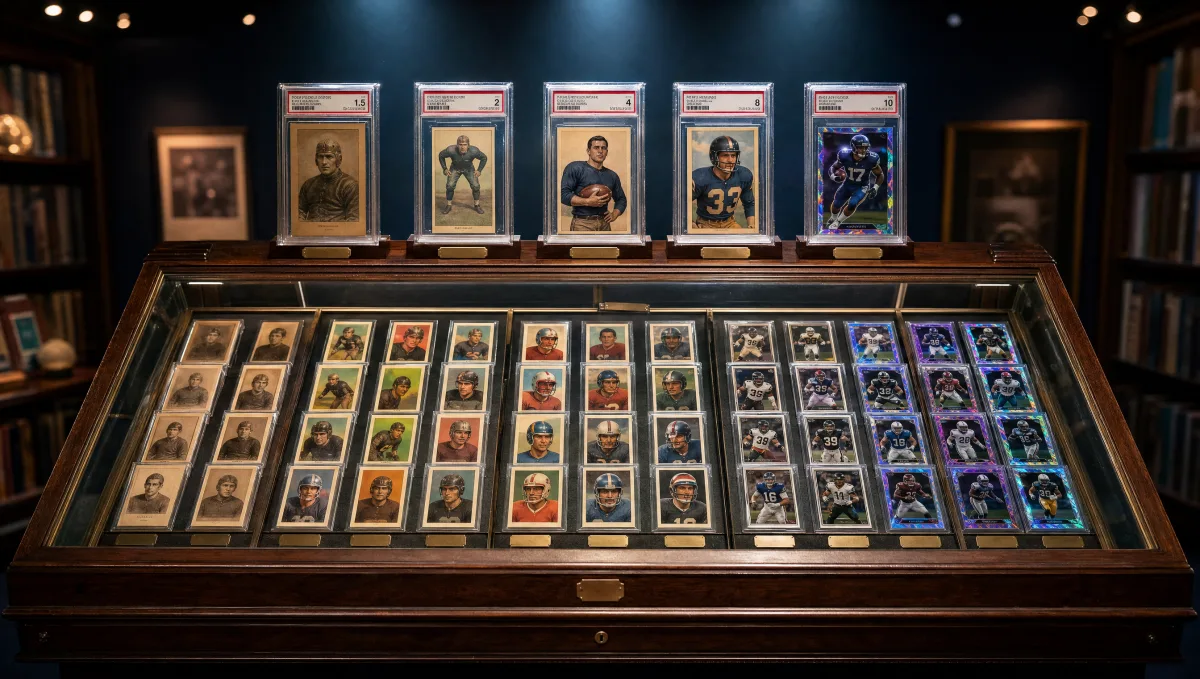
Football cards have been printed continuously since 1894 — when Mayo Cut Plug's N302 set released the first dedicated football issue with 35 cards featuring Harvard, Princeton, and Yale players, including the unnamed "John Dunlop" card that collectors call football's T206 Wagner — making American football the second sport to get its own card category and one of the deepest 130-year collectible disciplines in the world. The bigger 2026 story, though, is that the publisher map just flipped: Panini's NFL/NFLPA exclusive ended March 31, 2026, Topps (under Fanatics Collectibles) took over April 1, 2026, and 2025 Topps Chrome Football dropped April 15 as the first Topps NFL product since 2015 — and most of the SERP is still treating that transition as a one-line news footnote. This pillar is the orientation page that retailer SERP doesn't write: every era at a glance from the 1888 Goodwin tobacco issues through the 2026 Topps-Fanatics return, the Tom Brady $3.107M Playoff Contenders story and the Patrick Mahomes $4.3M National Treasures RPA story, how modern Panini and Topps products work, what rarity actually means inside the Prizm rainbow, how value is set, the junk-wax warning every new collector needs, vintage authentication, grading basics, and a closing how-to-start for 2026. Each section is the high-level synthesis; for the deep dive on any specific topic, this page hands you off to the seven football satellite articles now live in Pullmarket's /learn/ hub. Pullmarket — operated by Pullmarket LLC — covers football cards as part of an online pack-opening platform where every pull is a real, third-party-graded physical card. The pillar is here for orientation, not the upsell.
What Football Cards Actually Are (and Why People Collect)
Football cards are the trading-card category that began with the 1888 Goodwin Old Judge and the 1894 Mayo Cut Plug N302 tobacco issues, expanded through the 1935 National Chicle (the first NFL-focused set), ran through the 1948 Bowman post-war launch, the 1958 Topps Jim Brown rookie golden age, the 1986–1993 junk-wax overproduction era, the 1993 Topps Finest refractor invention, the 2000 Playoff Contenders Tom Brady Rookie Ticket Auto, the 2012 Panini Prizm flagship launch, the 2017 National Treasures Patrick Mahomes 1/1 RPA ($4.3M record), and into the April 2026 Topps-Fanatics return to the NFL license after a decade of Panini exclusive. Collectors chase three things: set completion, specific players (Brady, Mahomes, Montana, Rice, Payton), and trophy graded copies of pre-war vintage and modern 1-of-1 RPAs.
Football cards are small printed cards featuring an NFL or college football player, issued originally as tobacco-pack inserts in the 1880s (1888 Goodwin Old Judge featuring Henry W. Beecher) and 1890s (1894 Mayo Cut Plug N302), evolved into candy-pack inserts in the 1930s (1933 Goudey Sport Kings, 1935 National Chicle), then standardized as standalone trading-card products from 1948 onward (Bowman, Leaf Candy, then Topps from 1955). Today the modern landscape is dominated by Topps under Fanatics Collectibles, which has held the only exclusive NFL and NFLPA license since April 1, 2026 after a 20-year exclusive grant per Beckett News reporting. Unlicensed alternatives still ship from Panini under brand names like Score and Donruss base (no team marks, no NFL logos) — but only Topps-branded cards now carry full NFL team names and logos.
Four collector motivations drive every football-card buyer in 2026. Player chasers collect every card of one player — Brady, Mahomes, Montana, Rice, Payton, Sanders, Marino, Manning, Elway, and modern stars like CeeDee Lamb, Caleb Williams, and Travis Hunter — and chase rookie-card variants across every set, year, and parallel. Team chasers collect every Bears, 49ers, Cowboys, Chiefs, or Bills card. Set-completion collectors chase the classic hobby goal: every card in a single release like 2026 Topps Chrome Football or a vintage run like 1958 Topps. Grail chasers focus on the trophy slabs — graded 1894 Mayo Cuts, 1935 National Chicle Bronko Nagurski, 1958 Topps Jim Brown on the vintage side; 1-of-1 National Treasures RPAs, Brady Rookie Ticket Autos, and Color Blast inserts on the modern side. This pillar serves all four, plus the fifth path Pullmarket exists to enable: collecting via curated sports-card packs with published odds and real third-party-graded fulfillment.
The 2026 context matters. The Panini-to-Topps transition is the largest single shift in football cards since the 2016 Topps-to-Panini handoff a decade ago. Vintage is steady — the 1935 National Chicle Bronko Nagurski has cleared roughly $750,000 in graded high grade per Beckett and public listicles, and SGC has consolidated as the de-facto vintage specialist. The Dec 2025 Collectors Holdings agreement to acquire Beckett (still subject to antitrust review as of mid-2026) is reshaping the grading map under one corporate roof — putting PSA and BGS under the same parent. Each one of those shifts gets its own section below.
Football Card Eras at a Glance (1888 → 2026)
Football cards are best understood as six eras rather than 100+ individual sets — the Tobacco / pre-war origin (1888–1935), the Bowman / Leaf / early Topps era (1948–1955), the Topps near-monopoly era (1956–1980), the Competition + early Junk Wax era (1981–1993), the Refractor revolution + Premium era (1993–2011), and the Panini era + Topps / Fanatics return (2012–present).
Football cards are best understood as six eras rather than 100+ individual sets. Each era is defined either by a publisher transition or by a manufacturing-mechanic shift — tobacco inserts through the 1930s, the 1933 Goudey Sport Kings multi-sport invention, the 1948 Bowman post-war launch, the 1956 Bowman-by-Topps acquisition, the 1960 Fleer AFL alternative, the 1981 court-driven competitive era, the 1993 Topps Finest refractor invention, the 2012 Panini Prizm launch, the 2016 Topps-to-Panini NFL handoff, and the 2026 Panini-to-Topps return under Fanatics. The table below is the synthesis Wikipedia's American football card entry and Sports Collectors Daily's 1894 Mayo Cuts deep dive don't publish in one block; for the per-product encyclopedic depth, Beckett's news archive maintains the modern checklist references.
| Era | Years | Representative sets | Best-known chase cards | Signature mechanic / context |
|---|---|---|---|---|
| Tobacco / pre-war origin | 1888–1935 | 1888 Goodwin Old Judge (Henry W. Beecher), 1894 Mayo Cut Plug N302 (35 cards, Harvard/Princeton/Yale), 1933 Goudey Sport Kings, 1935 National Chicle (first NFL-focused set, 36 cards) | 1894 Mayo "John Dunlop" (no-name card — football's T206 Wagner per Sports Collectors Daily), 1935 National Chicle Bronko Nagurski (~$750K) | Cigarette / candy promo inserts; first football cards; first NFL-focused set 1935 |
| Bowman / Leaf / early Topps | 1948–1955 | 1948 Bowman (108 cards — first full pro set), 1948 Leaf Candy, 1955 Topps All-American (mixed active/retired) | 1948 Bowman Sammy Baugh, 1955 Topps All-American checklist | Bowman as the first post-war major; Topps re-enters in 1955 |
| Topps near-monopoly era | 1956–1980 | Topps annual flagship 1956–1980, Fleer AFL 1960–1963, Philadelphia Gum 1964–1967 | 1958 Topps Jim Brown #62 (PSA 9 only 5 graded, $300K+ per All Vintage Cards), 1957 Topps Bart Starr RC #119, 1965 Topps Joe Namath RC, 1971 Topps Terry Bradshaw RC, 1976 Topps Walter Payton RC | Topps acquires Bowman 1956; Fleer enters AFL 1960; Topps dominates NFL after the 1968 AFL/NFL merger |
| Competition + early Junk Wax | 1981–1993 | Topps, Score (1989), Pro Set (1989), Action Packed (1990), Stadium Club (1991), Upper Deck NFL (1991) | 1981 Topps Joe Montana RC #216, 1984 Topps Dan Marino RC #123, 1984 Topps John Elway RC #63, 1986 Topps Jerry Rice RC #161, 1989 Score Barry Sanders RC #257, 1991 Upper Deck Brett Favre RC | Topps monopoly cracked by 1981 baseball-court ruling spillover; production volumes exploded then crashed |
| Refractor revolution + Premium | 1993–2011 | 1993 Topps Finest (refractor invention), 1996 Topps Chrome Football (refractors arrive in football), 2000 Playoff Contenders, 2003 Topps Chrome | 2000 Playoff Contenders Tom Brady Championship Rookie Ticket Auto #144 ($3.107M record per ESPN, June 2021), 1996 Topps Chrome Eddie George RC, 1998 SP Authentic Peyton Manning RC | Refractors invented in 1993 Topps Finest; insert-driven scarcity replaces base-set volume; the Rookie Ticket Auto becomes the modern football grail |
| Panini era + ultra-modern | 2012–2025 | Panini Prizm (2012 launch), Donruss Optic, Panini Select, Panini Mosaic, National Treasures, Contenders, Immaculate, Score, Donruss base | 2017 Panini Prizm Patrick Mahomes Silver Prizm RC #269 (~$5,200 PSA 10 per public auction records), 2017 National Treasures Mahomes NFL Shield RPA 1/1 #161 ($4.3M record per Beckett News, July 2021), 2020 Prizm Black Finite Justin Herbert 1/1 ($1.8M, Sept 2022) | Panini takes NFL exclusive 2016 (Topps pushed out); Prizm parallel rainbow + RPAs + Color Blast define modern football chase |
| Topps / Fanatics return | 2026–present | 2025 Topps Chrome Football (released April 15, 2026 — first Topps NFL product since 2015), Topps Chrome Refractor variants, upcoming Bowman Chrome Football | 2025 Topps Chrome PREM1ERE Patch Auto 1/1 (new top-tier chase format), NFL Honors Gold Shield Auto 1/1, NFL Debut Patch cards (game-worn jersey patches from a player's first NFL appearance, 1-per-player) | April 1, 2026: Panini NFL/NFLPA exclusive ends; Topps under Fanatics takes over. 20-year NFLPA exclusive per Beckett News scoop |
Two patterns are worth naming. First, trophy cards cluster at era boundaries: the 1894 Mayo "John Dunlop" anchors tobacco, the 1935 National Chicle Bronko Nagurski anchors pre-war NFL, the 1958 Topps Jim Brown anchors post-war Topps, the 2000 Playoff Contenders Brady Rookie Ticket Auto anchors the refractor era, and the 2017 National Treasures Mahomes RPA anchors the Panini era. Second, the Fanatics-Topps return is the boundary that defines 2026 collecting — every buying decision for the next decade routes off this transition. The vocabulary is steep; the table above is the orientation map.
For the year-specific deep dives on the modern era, see the 2025 Panini Prizm Football guide (the last licensed Panini Prizm) and the 2025 Donruss Optic Football guide (the last licensed Optic) in Pullmarket's football satellite map.
How Modern Sets Work — Hobby Boxes, Blasters, Megas, Hangers, Fat Packs
The modern football-card market ships in roughly nine retail SKU shapes — booster pack (~$4–$12), hobby box (12–24 packs with guaranteed hits, ~$200–$2,500), blaster box (4–8 packs, ~$20–$40), mega box, hanger pack, Fat Pack (~30 cards), cello pack, Jumbo/HTA box, and sealed cases (typically 12 hobby boxes). Knowing the SKU is the first step in any buying decision.
The modern football-card market ships in roughly nine retail SKU shapes, each at a different price point and pack-count configuration. Knowing which SKU you're holding is the first step in any buying decision — a $30 blaster and a $2,249 National Treasures hobby box are very different products, and retailer listings frequently blur the line on what's guaranteed in each.
- Pack (booster pack) — typically 6–12 cards depending on product, with one or more hits possible by configuration; roughly $4–$12 MSRP at retail. The atomic unit; every other SKU is a bundle of these plus accessories.
- Hobby box — 12–24 packs of a single product, often with guaranteed hits (autos, relics, refractor counts); roughly $200–$2,500 MSRP depending on the line. The 2025 Panini National Treasures hobby box sits at the premium end around $2,249.95 with 8 autos and relics per box. The set-completion vehicle for serious collectors and the standard breakers' unit.
- Blaster box — 4–8 packs, lower hit rate but accessible price point; roughly $20–$40 MSRP. The Target / Walmart staple and the most common entry point for new collectors.
- Mega box — retail-exclusive box with bonus content, often retail-exclusive parallels not found in hobby; roughly $25–$50 MSRP.
- Hanger pack / hanger box — clip-strip retail pack, 15–35 cards, sometimes with hanger-exclusive parallels; roughly $6–$20 MSRP. The convenience-store entry point.
- Fat Pack (Value Pack) — oversized retail pack, ~30 cards, often with exclusive parallels not in standard packs; roughly $10–$15 MSRP.
- Cello pack — clear-wrap retail pack format, ~18 cards.
- Jumbo / HTA box — Hobby Type A, larger packs with exclusive parallels; collector-targeted and breakers-favored.
- Case — typically 12 hobby boxes; sealed unit for breakers and serious set-builders; $2,500–$30,000+ for premium products.
For the current-year buyer's deep dives on the headline modern products, see the 2025 Panini Prizm Football guide, the 2025 Donruss Optic Football guide, and the Panini Select Football guide.
The Rarity Hierarchy — Base, Silver Prizm, Parallels, RPAs, 1-of-1s
A football card's rarity sits on a tier ladder that runs from common base cards through unnumbered and numbered parallels, Color Blast inserts, Rookie Patch Autos, and finally to the Black /1 or NFL Shield 1-of-1 at the top. In ordinary post-2017 Prizm Football sets, the standard rookie is the base-set card and Silver Prizm is a distinct unnumbered parallel. The 2016 and 2017 rookie subsets are the exception.
A football card's rarity sits on a tier ladder that runs from common base cards through color parallels, numbered refractors, Color Blast inserts, Rookie Patch Autos, and finally to the Black /1 or NFL Shield 1-of-1 at the top. The format that defines almost every modern parallel — the refractor — was invented by Topps for the 1993 Topps Finest set (Wikipedia: Refractor card), and Panini Prizm imported the concept into its 2012 flagship launch. One critical year-specific clarification: 2016 and 2017 Prizm Football rookie base cards use a Silver-style finish and have no separate Silver rookie parallel, as Beckett explains for Patrick Mahomes. Starting in 2018, Prizm returned to a standard base rookie with a distinct Silver parallel.
| Tier | What it is | Example (Panini Prizm) | Typical print run |
|---|---|---|---|
| Base | The standard card | 2018 Panini Prizm #205 Josh Allen (base, non-silver) | Mass print |
| Silver Prizm | An unnumbered parallel in ordinary post-2017 sets | 2018 Panini Prizm Silver #205 Josh Allen | Print run undisclosed; distinct from base |
| 2016-17 rookie exception | Rookie base card has a Silver-style finish; no separate Silver rookie parallel | 2017 Panini Prizm #269 Patrick Mahomes | Year-specific configuration |
| Color Prizm (unnumbered) | Color parallels without serial numbers | 2025 Prizm Hyper, Kangaroo, Pigskin, Lotus Flower, Plum Blossom | Mass print to medium |
| Numbered Prizm (lower color tier) | Color parallel with serial /199 to /399 | 2025 Prizm Neon Blue /399, Aqua /349, Wave /300 | 199–399 |
| Mid-tier numbered | Serial /99 to /199 | 2025 Prizm Pink Velocity /99, Flex /199 | 99–199 |
| High-tier numbered | Serial /10 to /50 | 2025 Prizm Gold /10, Blue Mojo /55, Lime Green /50 | 10–55 |
| Insert + Color Blast | Themed inserts + Color Blast (case-hit scarcity) | 2025 Prizm Color Blast, Manga, Prizmania | Varies — Color Blast is case-hit |
| White Knight Prizm | Ultra-rare base parallel | 2025 Prizm White Knight | Extremely low |
| Black /1 | True 1-of-1 single-copy parallel | 2025 Prizm Black /1 | 1 |
| Rookie Patch Auto (RPA) | Auto + jersey patch insert, typically rookies | 2017 National Treasures Mahomes NFL Shield RPA 1/1 #161 ($4.3M) | 1–199 |
A few notes the table can't convey. Refractor color conventions vary by product year and brand — Panini Prizm's Neon Blue /399 is not the same as Topps Chrome's Black Refractor /299 or National Treasures' Holo Gold /10. Don't memorize a fixed ladder; learn to read the back of the card and the year-specific checklist. The 2025 Topps Chrome Football debut for the new Fanatics era introduces the Topps Chrome PREM1ERE Patch Auto 1/1 and the NFL Honors Gold Shield Auto 1/1 as top-tier chases. When collectors call 2017 Mahomes #269 a "Silver," they are referring to the Silver-style rookie base finish; Beckett notes that no separate Silver rookie parallel exists in that set.
For the rarest cards in football hobby history — the Mahomes National Treasures, the Brady Playoff Contenders, the 1958 Topps Jim Brown, the Bronko Nagurski — see the most expensive football cards guide.
How Football Card Values Actually Work
A football card's secondary-market price is the product of four drivers working in combination: (1) the player and cultural moment (Brady, Mahomes, Rice, Montana), (2) print run and true scarcity, (3) grade and condition (PSA 10 vs PSA 9 can be a 5–20× gap on chase cards), and (4) era and nostalgia cycle (vintage commands a structural premium; junk-wax does not). No single driver explains a card's price.
A football card's secondary-market price is the product of four drivers working in combination — not any one of them alone. A 2017 Panini Prizm Silver Mahomes #269 in PSA 9 trades around $933–$1,135 per public auction records; the same card in PSA 10 sells in the $4,150–$5,800 range. A common 1991 Upper Deck Brett Favre RC in raw condition trades for single digits despite being one of the most recognized junk-wax-era rookies, because the print run was in the millions. The framework is consistent across the hobby:
- Player + cultural moment. Brady (the GOAT premium), Mahomes (the active-icon premium), Rice, Montana, Payton, Sanders, Marino, Manning, Elway, and modern stars (CeeDee Lamb, Caleb Williams, Travis Hunter, Shedeur Sanders) — the Hall-of-Fame, first-ballot, and culturally-iconic premium is enormous. A rookie card of a HOF lock will always carry a different floor than the same-set common.
- Print run / true scarcity. Vintage tobacco-era cards (1894 Mayo Cuts, 1888 Goodwin) are structurally scarce by attrition; modern 1/1 RPAs (Mahomes National Treasures) are scarce by design at the print line; junk-wax era (1986–1993) cards are structurally common. Scarcity is the second axis after the player.
- Grade + condition. PSA 10 vs PSA 9 can be a 5–20× value gap on chase cards. The 2017 Mahomes Silver Prizm PSA 10 at ~$5,200 vs PSA 9 at ~$1,000 is the canonical modern-era example; the 1958 Topps Jim Brown PSA 9 (only 5 graded, $300K+ per All Vintage Cards) vs PSA 8 (~$4,000) is the vintage example. Cert numbers resolve at psacard.com, cgccards.com, and gosgc.com.
- Era + nostalgia cycle. Vintage (pre-1980) commands a structural premium across players. Junk-wax (1986–1993) is structurally cheap regardless of grade for almost every card. Ultra-modern Prizm and Optic parallels are character-driven (Mahomes / Brady / Burrow / Allen carry different premiums than backup-RB chrome refractors).
For a sense of the top of the market — the trophy-class sales that anchor every "most expensive" conversation — the publicly cited top five run roughly: 2017 National Treasures Patrick Mahomes NFL Shield RPA 1/1 #161 at $4.3M in July 2021 (Beckett News), 2000 Playoff Contenders Tom Brady Championship Rookie Ticket Auto #144 at $3.107M in June 2021 (ESPN), Brady "Holy Grail" Playoff Contenders Championship Ticket at $2.252M in April 2021 (Antiques and the Arts and CBS Sports reporting), a separate Brady Probstein eBay sale near $2.3M, and Justin Herbert 2020 Panini Prizm Black Finite 1/1 at $1.8M in September 2022 (SI Collectibles reporting). For real-time comp tracking, the hobby's primary pricing-data sources are Card Ladder (rolling sale-by-sale data) and Beckett's pricing database. Neither is a perfect oracle, but both beat a single eBay sold-listing for any serious buy-or-sell decision.
For the full top-trophy list and the deeper sale-by-sale breakdown, see the most expensive football cards guide plus the dedicated player guides the Tom Brady football cards guide, the Patrick Mahomes rookie card guide, and the 49ers + Bears vintage football cards guide.
The Brady + Mahomes Story — Why Modern RCs Dominate Vintage in Football
The Tom Brady 2000 Playoff Contenders Rookie Ticket Auto #144 is the modern football grail — highest public sale $3.107M (June 2021). The Patrick Mahomes 2017 National Treasures NFL Shield RPA 1/1 #161 surpassed it at $4.3M (July 2021). Combined, the modern football trophy ceiling sits roughly 8–10× higher than the vintage trophy ceiling — the 1958 Topps Jim Brown peaks around $358,500. Modern dominates vintage in football because the auto-numbered modern RC stack produced two icons in adjacent eras.
The Tom Brady 2000 Playoff Contenders Rookie Ticket Auto is the modern football grail, and the closest thing the entire football-card hobby has to a single icon. Issued 2000 in Playoff Contenders Championship Edition as card #144, on the Championship Ticket variant numbered to /100, with an on-card autograph, the card's highest publicly confirmed sale is $3.107 million at the Lelands Mid-Spring Classic Auction in June 2021 per ESPN's record-sale coverage — a BGS 9 with a 10 auto subgrade. A "Holy Grail" Contenders Rookie Ticket #144 with a BGS 8.5 / auto-9 closed at $2.252M in April 2021 per Antiques and the Arts and CBS Sports reporting; a separate Probstein-managed eBay sale of a high-grade Brady Contenders hit roughly $2.3M in February per ESPN. Brady's 2000 SP Authentic RC #118 — a separate, much more-printed Brady rookie — cleared $312,000 in April 2021. The Brady Contenders story matters because it shows the modern-era pattern in football: a single-product, on-card auto, low-numbered Rookie Ticket Auto can outrank entire vintage years. The 1958 Topps Jim Brown — football's vintage trophy — peaks around $358,500 at a November 2016 PSA 8 sale per CGC's most-expensive roundup. Modern football's trophy ceiling is roughly 8–10× higher than the vintage trophy ceiling.
The Patrick Mahomes 2017 Panini Prizm and National Treasures RPA are modern grails. Two cards anchor the Mahomes lineage. (1) 2017 Panini Prizm #269 — the rookie base card has the Silver-style finish used throughout the 2017 rookie subset, and Beckett notes that no separate Silver rookie parallel exists. The card commonly called the Mahomes Silver sells for $4,150–$5,800 in PSA 10 and $933–$1,135 in PSA 9. (2) 2017 National Treasures NFL Shield Patrick Mahomes Autographed Rookie Card #161, serial 1/1, BGS 8.5 / auto-10 — sold for $4.3 million in July 2021 per Beckett News. Mahomes is structurally distinct from Brady because his major chase cards span both Prizm and National Treasures while Brady's defining modern rookie is Contenders-specific.
For the year-by-year deep dives, see the Tom Brady football cards guide (every Brady rookie variant plus the real-vs-fake authentication guide) and the Patrick Mahomes rookie card guide (Silver Prizm, National Treasures, every parallel in between).
The Modern Panini → Topps Landscape in 2026 (the Fanatics Transition)
Panini's exclusive NFL/NFLPA license ended March 31, 2026; Topps (under Fanatics Collectibles) took over April 1, 2026 under a 20-year NFLPA exclusive per Beckett News. The first product was 2025 Topps Chrome Football, released April 15, 2026 — the first Topps NFL cards since 2015. New chase formats include the Topps Chrome PREM1ERE Patch Auto 1/1, the NFL Honors Gold Shield Auto 1/1, and NFL Debut Patch cards. Panini retains unlicensed brands like Score and Donruss base.
The Panini-to-Topps NFL license transition is the single biggest 2026 context shift in football cards, and it changes how every collector should think about modern products. The transition is also the largest gap in the SERP — every authority blog covers it as a news headline, but almost none have synthesized what it means for new collectors yet. Three things every 2026 football-card collector needs to know:
- Topps holds the new exclusive NFL/NFLPA license effective April 1, 2026. Fanatics Collectibles (which acquired Topps in early 2022) secured a 20-year NFLPA exclusive starting 2026 per Beckett News's scoop on the deal. Panini's exclusive ended March 31, 2026. The first product under the new license is 2025 Topps Chrome Football, released April 15, 2026 with a Topps.com pre-order on April 3. New chase formats: the Topps Chrome PREM1ERE Patch Auto 1/1, the NFL Honors Gold Shield Auto 1/1, and the NFL Debut Patch insert (game-worn jersey patches from a player's first NFL appearance, one per player). Topps and the NFL ran a Collector Celebration Day at Acrisure Stadium on April 25, 2026 around the NFL Draft.
- The legacy Panini portfolio defines the 2012–2025 era. Panini Prizm (launched 2012, the chromium-finish flagship — 72 parallels in 2025 including the Silver Prizm RC, White Knight, Gold /10, Kangaroo, Pigskin, Lotus Flower, Plum Blossom, plus Color Blast and Manga inserts); Donruss Optic (the chrome version of Donruss base — 35 veteran/legend parallels and 47 rookie parallels in 2025, with Fire, Freedom, Holo, and Jazz unnumbered through Neon Blue /399, Pink Velocity /99, Lime Green /50, and Gold Vinyl /1); Panini Select (tiered Concourse, Premier, and Field Level format); Panini Mosaic (mosaic-foil flagship); Panini National Treasures (ultra-premium — 2025 hobby boxes around $2,249.95 with 8 autos and relics, home of the Mahomes 1/1 RPA); Panini Contenders (auto-chase home of the Brady Rookie Ticket); Panini Immaculate (high-end patch and auto); Score Football (entry-level); Donruss Football (paper base); Panini Flawless (ultra-premium with embedded gems). Most 2025 Panini products are the last licensed of their kind under the expired Panini deal. Per Athlon Sports reporting on the secondary market, sealed 2025 Panini product has climbed roughly 20–40% since the transition announcement.
- The practical buyer question: 2025 Panini or wait for 2026 Topps? Mixed answer, depending on collector goal. 2025 Panini Prizm, Optic, Select, National Treasures, Contenders, and Mosaic are all the final-licensed Panini editions for the foreseeable future — for collectors who chase Panini-brand rainbows (every color of a player's Prizm card), 2025 may carry a scarcity-by-finality premium that compounds over time. For collectors of MODERN STARS with full NFL team marks and current photography, 2025 Topps Chrome Football (April 15, 2026 release) is the new fully-licensed home and the first Topps NFL cards since 2015. Neither side is wrong; it depends on whether the player chase or the brand rainbow is the priority.
A note on Panini's post-license business: Panini's Score and Donruss base products had unlicensed status for years even during the exclusive period and remained in production with player likenesses but no team logos or marks. Post-2026, what Panini continues to produce without the NFL license is uncertain — likely Score and Donruss base continue without team logos, but the structure may shift. Beckett News, Yahoo Sports, and NFL.com's official Fanatics-NFLPA announcement are the primary sources to track.
For the current-year deep dives across this product map, see the 2025 Panini Prizm Football guide (flagship modern Panini, last licensed), the 2025 Donruss Optic Football guide (chrome Donruss, last licensed), and the Panini Select Football guide (the tiered Concourse / Premier / Field Level format).
Vintage Collecting (1894 Mayo → 1980 Topps) and the Junk-Wax Warning
Vintage football cards (pre-1980) sit at the top of the hobby through structural scarcity — the 1888–1935 tobacco era, the 1948 Bowman post-war launch, and the 1956–1980 Topps near-monopoly age all produce trophy cards. The junk-wax era (1986–1993) is the opposite: Topps, Score, Pro Set, Action Packed, Stadium Club, and Upper Deck NFL flooded the market with massive print runs, leaving most cards from that window worth pennies regardless of player. If you inherited "old cards from grandpa's attic" from 1986–1993, they are almost certainly cheap.
Vintage football cards — defined loosely as everything printed before 1980 — sit at the top of the football-card hobby for a structural reason: scarcity through attrition. The tobacco era (1888 Goodwin, 1894 Mayo Cut Plug N302) is scarce by century-long destruction; the pre-war gum / candy era (1933 Goudey Sport Kings, 1935 National Chicle) is scarce by limited print runs and Depression-era survival rates; the post-war Bowman / early Topps era (1948 Bowman onward) is scarce by smaller publisher footprints and the Bowman acquisition into Topps in 1956; and the Topps near-monopoly age (1956–1980) sits in a sweet spot of strong distribution but no real preservation culture. The trophy cards from these eras — 1894 Mayo "John Dunlop" (football's T206 Wagner per Sports Collectors Daily), 1935 National Chicle Bronko Nagurski (~$750K), 1958 Topps Jim Brown #62 (PSA 9 only 5 graded, $300K+ per All Vintage Cards), 1957 Topps Bart Starr RC, 1965 Topps Joe Namath RC, 1971 Topps Terry Bradshaw RC, 1976 Topps Walter Payton RC, and the era-bridge 1981 Topps Joe Montana RC #216 — are the top of the football hobby.
A few framings every vintage football buyer needs:
- Authentication is non-trivial in the vintage market. Trimmed cards (where a previous owner cut the borders to improve apparent centering), re-backed cards (where damaged backs have been replaced), color-restored cards, and outright counterfeits are real and common in the high-value vintage tier. Buy slabbed (PSA or SGC) or buy from established dealers (Dean's Cards, PWCC, Heritage Auctions, Goldin, Lelands) with provenance and returns. The 1958 Topps Jim Brown and 1971 Topps Terry Bradshaw are two of the most commonly trimmed cards in the hobby.
- Condition is everything on vintage. A PSA 5 and a PSA 7 of the same 1958 Topps Jim Brown can have a 5–10× price gap. One PSA 7 in your budget often beats five PSA 4s for any long-horizon collector.
- SGC owns vintage labeling. SGC has consolidated as the de-facto vintage specialist with cleaner, period-appropriate labels and a strong track record on pre-1980 grading. For modern football (Prizm, Optic, Chrome), lean PSA; for vintage pre-1980 Topps and Bowman, SGC is increasingly the preferred label.
For the vintage Bears and 49ers deep dive — Joe Montana, Jerry Rice, Walter Payton, Steve Young — see the 49ers + Bears vintage football cards guide. For the full top-trophy list, see the most expensive football cards guide.
Grading Basics — PSA, SGC, BGS, CGC (and What Works for Football)
Grading is the process of submitting a raw card to a third-party authentication and grading service, which encapsulates ("slabs") the card in a sealed acrylic holder and assigns it a 1–10 condition grade. PSA holds roughly 67% market share and leads modern; SGC holds roughly 22–23% and is the vintage specialist. BGS is the historical subgrade authority (canonical for the Brady $3.107M and Mahomes $4.3M slabs); CGC holds smaller share. Roughly $15–$25 per card at standard tiers.
Grading is the process of submitting a raw card to a third-party authentication and grading service, which encapsulates ("slabs") the card in a sealed acrylic holder and assigns it a 1–10 condition grade. Grading does two things: it authenticates the card as genuine (counterfeit-proof) and locks in a verified condition, which lets buyers price the card off a single number rather than negotiating subjective "near-mint" claims.
- Why grade? Authentication, condition lock-in, and resale premium on high grades. A raw "near-mint" 2017 Mahomes Silver Prizm trades around comp-of-PSA-9 levels; the same card in PSA 10 sells in the $4,150–$5,800 range. A raw "near-mint" 1958 Topps Jim Brown sells one number; PSA 9 sells $300K+ per All Vintage Cards.
- The major graders today. PSA (psacard.com) is the industry leader at roughly 67% market share with the deepest acceptance for modern Panini Prizm, Optic, and Topps Chrome submissions. SGC (gosgc.com) holds roughly 22–23% market share and is the vintage specialist — increasingly the preferred label for pre-1980 football. BGS (Beckett Grading Services) is the historical authority on subgrade detail and was the canonical grader for the Brady $3.107M Playoff Contenders Rookie Ticket Auto (BGS 9 / auto-10) and the Mahomes $4.3M National Treasures RPA (BGS 8.5 / auto-10); BGS was acquired by Collectors Holdings in Dec 2025 alongside PSA — same corporate roof, antitrust review status still pending mid-2026. CGC (cgccards.com) holds smaller share and is strong on cross-grader work.
- The 1–10 scale. PSA 10 (Gem Mint) is a flawless example; PSA 9 (Mint) is near-flawless with minor imperfections; PSA 8 (NM-Mint) is solid but visible flaws. A single-point gap between PSA 9 and PSA 10 can swing 5–20× on chase cards. The 2017 Mahomes Silver Prizm PSA 10 at $5,200 vs PSA 9 at ~$1,000 is the canonical modern-era example; the 1958 Topps Jim Brown PSA 9 (~$300K+, only 5 graded) vs PSA 8 (~$4,000) is the vintage example.
- Cost framing. Roughly $15–$25 per card grading fee at PSA's Value and Regular service tiers, plus inbound and outbound shipping. Only worth grading if expected post-grade resale exceeds the all-in cost. Junk-wax era football cards almost never clear; chase rookies (Mahomes Silver Prizm, Brady Contenders) and modern parallels usually do.
- Cert verification. Every legitimate slab carries a cert number that resolves on the grader's own website — PSA at psacard.com, CGC at cgccards.com, SGC at gosgc.com. If a seller can't produce a working cert lookup for a graded copy, do not buy.
A note on the Collectors Holdings / Beckett 2025 deal: at writing, the agreement to bring Beckett under the same corporate umbrella as PSA is still subject to antitrust review. If it closes, the modern grading map narrows further with PSA + BGS under one parent; if it unwinds, the status quo holds. This is a section worth re-checking before any large grading-spend decision in 2026.
Pullmarket's model is built around graded ownership — every pull is a real third-party-graded slab held in Pullmarket's own insured custody or fulfilled through the Pullmarket Vault per Terms §5.5. The full Vault workflow disclosure lives at Is Pullmarket Legit?.
How to Start Collecting Football Cards in 2026
The fastest way to lose money in football-card collecting is to spend $500 in the first month with no plan — and 2026 makes that easier than ever because the Fanatics-Topps transition has created two parallel product universes to chase. Make seven small decisions first — pick a goal, pick a side of the Panini → Topps transition, set a budget, protect everything from day one, buy singles for known wants and rip packs for the experience, grade only when the math works, and track everything.
The fastest way to lose money in football-card collecting is to spend $500 in the first month with no plan — and 2026 makes that easier than ever because the Fanatics-Topps transition has created two parallel product universes to chase. The fastest way to build a collection you actually love is to make seven small, deliberate decisions before spending anything. The closing how-to:
- Pick a goal. Set completion vs player chase vs team chase vs vintage vs modern. Different goals route to different budgets and very different paths. Brady? Mahomes? Bears? 49ers? Vintage Jim Brown grail-chase? 2025 Panini rainbow-build before licenses expire? 2026 Topps Chrome on the new-era ground floor? Don't pretend you'll do all of them.
- Pick a side of the Panini → Topps transition. This is the single most consequential decision in 2026 football collecting. Options: (a) collect 2025 Panini Prizm, Optic, Select, National Treasures, Contenders, and Mosaic as final-licensed Panini-finality plays; (b) collect 2026 Topps Chrome Football as the new era (2025 Topps Chrome dropped April 15, 2026 with the PREM1ERE Patch Auto 1/1 as the new chase format); (c) collect across both. Neither side is wrong; it depends on whether the player chase or the brand rainbow is the priority.
- Set a budget. Hobby norm for casual collectors is $50–$200 per month; grail-chasers go higher. Whatever the number, write it down — collection-level spend discipline beats impulse-rip discipline every time. National Treasures hobby boxes alone start near $2,250, so premium-product chasing requires a real budget conversation.
- Protect everything from day one. Penny sleeves on any card worth $1+. Toploaders on any card worth $10+. One-touch magnetic holders or Card Saver sleeves for grading-bound cards. Binders for set-completion runs. A $50 Optic Holo refractor in a binder is worth $50; the same card loose in a deck box for two months is worth $30.
- Buy singles for known wants; rip packs for the experience. Don't try to chase a $5,200 Mahomes Silver Prizm with $5,200 of 2017 Prizm boosters — buy the comp single on eBay or Card Ladder. Rip packs because you want the rip, the surprise, and the chance at a hit you weren't shopping for.
- Grade only when the math works. A $40 card at PSA 9 might net $50 after grading fees and shipping — barely worth it. A $200 modern PSA 10 frequently doubles. Be surgical: grade the chase, not the bulk. For modern Panini Prizm, Optic, Select, National Treasures, and 2026 Topps Chrome, lean PSA. For vintage pre-1980 Topps and Bowman, SGC is often the better label. For ultra-high-end auto and patch cards (Brady Contenders, Mahomes RPAs), BGS still carries weight for auto subgrades.
- Track everything. Card Ladder, Beckett, SportsCardsPro, or a simple spreadsheet — collection-level visibility prevents impulse spend and surfaces sell decisions you'd otherwise miss. A collector who knows what they own at PSA-10 comp values makes better buy / hold / sell calls than one who just remembers buying things.
Pullmarket is built around step 5 — rip packs because you want the rip, then hold the pull in the Vault, ship the physical slab home, trade it, or sell it back to Pullmarket for store-credit Gems. Every pack publishes its odds before purchase, and every pull is a real third-party-graded slab held in Pullmarket's own insured custody or fulfilled through the Pullmarket Vault per Terms §5.5. Pullmarket Gems is store credit, not cash (Terms §9.1). The full walkthrough lives at how Pullmarket works.
Where to Go Next — The Planned Football Satellite Map
Seven in-depth football satellite articles are live in Pullmarket's /learn/ hub. They split into two sub-groupings: current-year product deep dives (2025 Panini Prizm, 2025 Donruss Optic, Panini Select) and player + values deep dives (Tom Brady, Patrick Mahomes, 49ers + Bears vintage, Most Expensive Football Cards).
Seven in-depth football satellite articles are live in Pullmarket's /learn/ hub — this pillar is the door, those satellites are the rooms. Two sub-groupings:
Current-year product deep dives:
- 2025 Donruss Optic Football — full guide — the last licensed Panini Optic, parallels rainbow (Fire / Freedom / Holo / Jazz unnumbered through Gold Vinyl /1), hobby vs mega box comparison, headline rookie hits
- 2025 Panini Prizm Football — the last licensed Panini Prizm, every color and variant including the Silver Prizm RC distinction, White Knight, Gold /10, Kangaroo, Pigskin, Lotus Flower, and Plum Blossom
- Panini Select Football Guide — the tiered Concourse / Premier / Field Level format and how to navigate the three-tier Select rainbow
Player + values deep dives:
- Tom Brady Football Cards — every Brady rookie variant including Playoff Contenders, SP Authentic, and Bowman Chrome, plus the canonical real-vs-fake authentication guide
- Patrick Mahomes Rookie Card — the modern football grail; the 2017 Panini Prizm #269 base rookie with its Silver-style finish, the National Treasures NFL Shield RPA, and the full parallel ladder
- 49ers + Bears Vintage Football Cards — the Joe Montana, Jerry Rice, Walter Payton, and Steve Young vintage quartet anchoring 1980s San Francisco and Chicago
- Most Expensive Football Cards — the trophy-class value list from $4.3M Mahomes National Treasures through the Brady Playoff Contenders sales, the $1.8M Herbert Prizm Black, the 1935 Bronko Nagurski, and the 1958 Jim Brown
If you're curious about other trading-card categories beyond football, the Complete Baseball Cards Guide and the Complete Pokémon Cards Guide are sister pillars covering 130+ years of baseball and 27 years of Pokémon TCG history with the same era-table-plus-satellite-map structure.
Ready to Rip a Real Football Pack?
Seven in-depth football articles are live in Pullmarket's /learn/ hub — this pillar is the door, those satellites are the rooms. If you came here to understand the eras, the table in section 2 is the synthesis no SERP competitor publishes in one block. If you came here to understand the Brady + Mahomes story, section 6 has the citations. If you came here to understand the Fanatics-Topps transition, section 7 is the orientation no authority blog has cleanly written yet. If you came here to start collecting, step 5 of section 10 is where the rip experience lives — at Pullmarket, with published odds and real third-party-graded slabs.
Open a Football Pack — See the Published Odds
Browse the live catalog with the published odds in front of you, see exactly which graded slabs sit in each pack's possible-outcome pool, and decide per pack whether to rip, hold, or pass. Real cards. Real grades. Your decision per pull.
Frequently asked questions
The 2017 National Treasures NFL Shield Patrick Mahomes Autographed Rookie Card #161, serial 1/1, sold for $4.3 million in July 2021 per Beckett News reporting and corroborated by CGC's most-expensive-football roundup. It surpassed the prior record held by the 2000 Playoff Contenders Tom Brady Championship Rookie Ticket Auto #144, which sold for $3.107 million in June 2021 at the Lelands Mid-Spring Classic Auction per ESPN's coverage. Below those, a Brady "Holy Grail" Contenders Rookie Ticket sold for $2.252M (April 2021), a Probstein-managed Brady eBay sale hit $2.3M, and the 2020 Panini Prizm Black Finite 1/1 Justin Herbert RC sold for $1.8M (September 2022) per SI Collectibles. The vintage record sits with the 1935 National Chicle Bronko Nagurski near $750,000. For the full top-trophy list, see the most expensive football cards guide.
Yes. Panini's exclusive NFL/NFLPA license ended March 31, 2026. Topps, owned by Fanatics Collectibles, took over April 1, 2026 under a 20-year NFLPA exclusive per Beckett News's scoop on the deal. The first product was 2025 Topps Chrome Football, released April 15, 2026 — the first Topps NFL cards since 2015. Panini retains unlicensed brands like Score and Donruss base (no team logos, no NFL marks) for the foreseeable future. New 2026 Topps chase formats include the Topps Chrome PREM1ERE Patch Auto 1/1, the NFL Honors Gold Shield Auto 1/1, and NFL Debut Patch cards (game-worn jersey patches from a player's first NFL appearance, one per player). For the full landscape context, see section 7 above.
Some are; most aren't. Pre-war (before 1945) cards in any decent condition are usually valuable because the print runs were small and survival rates are low — the 1894 Mayo Cut Plug "John Dunlop" card is football's T206 Wagner per Sports Collectors Daily, and the 1935 National Chicle Bronko Nagurski has cleared roughly $750,000. Post-war (1948–1979) Topps and Bowman cards of Hall-of-Fame players in high grades hold real value (1958 Topps Jim Brown PSA 9 at $300K+, only 5 graded per All Vintage Cards). Junk-wax era (1986–1993) football cards — the era of Topps, Score, Pro Set, Action Packed, Stadium Club, and Upper Deck NFL flooding the market — are almost always worth pennies regardless of player. Grade and edition matter more than age alone.
Panini Prizm is Panini's chromium-finish flagship football product, launched in 2012 and licensed through 2025. Ordinary post-2017 sets distinguish standard base rookies from Silver Prizm parallels. The 2016 and 2017 rookie subsets are the narrow exception: their base cards use a Silver-style finish and have no separate Silver rookie parallel. The product also carries a deep color and short-print checklist. See the 2025 Panini Prizm Football guide.
Both are Panini-published chromium products from the 2012–2025 modern football era, but they target different collector segments. Prizm is the marquee flagship with a deep parallel rainbow. Optic is the chrome version of Donruss base, usually more accessible, and is anchored by the Rated Rookie design. Both reached their final licensed NFL editions in 2025.
A "rookie card" (RC) is a player's first officially licensed card in a major release. In Prizm Football, exact configuration depends on the year: 2016 and 2017 rookie base cards use a Silver-style finish with no separate Silver rookie parallel, while ordinary post-2017 sets have a standard base rookie plus a distinct Silver parallel. Always match the exact year and version when comparing value.
Only if the expected PSA 9 or PSA 10 (or SGC equivalent) resale clears the all-in grading cost — roughly $15–$25 per card at PSA's Value and Regular service tiers, plus inbound and outbound shipping. For modern Panini Prizm, Optic, Select, National Treasures, Contenders, and 2026 Topps Chrome, lean PSA. For vintage pre-1980 Topps and Bowman, SGC is increasingly the preferred vintage label. For ultra-high-end auto and patch cards like Brady Contenders Rookie Ticket Autos and Mahomes National Treasures RPAs, BGS still carries weight for auto subgrades. Verify any existing slab's cert number at psacard.com, cgccards.com, or gosgc.com before buying graded.
As pure expected value, no — buying singles on eBay or Card Ladder usually beats pack-opening on dollar-efficiency for set completion. As an experience, yes — the rip is the point. 2026 Topps Chrome Football packs (the new licensed flagship under Fanatics) and 2025 Panini Prizm, Optic, and Select packs (the final-licensed Panini) both have published odds and the chance at top-tier hits — Topps Chrome PREM1ERE Patch Auto 1/1, Prizm Gold /10, Optic Gold Vinyl 1/1. Pullmarket's football pack catalog at football packs publishes per-pack odds before purchase, and every pull is a real third-party-graded slab held in Pullmarket's own insured custody or fulfilled through the Pullmarket Vault per Terms §5.5 — a structurally different value proposition from a $5 retail booster.
Pullmarket is an online collectible-card pack marketplace for instant online rips, graded-card chases, secure inventory, and shipping eligible cards to your door. Browse graded card packs online, or learn about Pullmarket LLC.