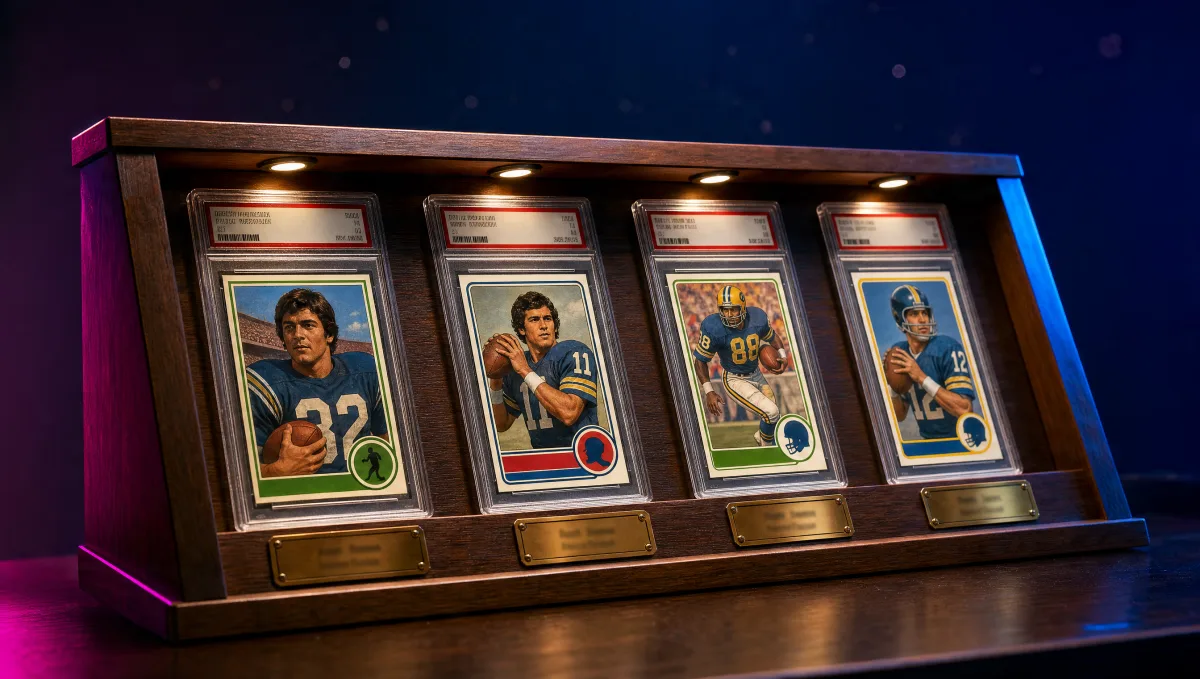
Joe Montana, Jerry Rice, Walter Payton & Steve Young Cards
Four Hall of Famers and three structurally different cardboard eras meet in one beat — the 1976 Topps Walter Payton #148, the 1981 Topps Joe Montana #216, the 1986 Topps Jerry Rice #161, and the 1986 Topps Steve Young #374. These four rookie cards anchor every serious vintage NFL collection: Payton's 1976 is real vintage (printed a full decade before the junk-wax surge), Montana's 1981 is the last great pre-junk-wax NFL rookie, and Rice and Young both sit on the 1986 junk-wax frontier where huge print runs collide with chronic condition issues to make PSA 10 the only meaningful chase grade. This guide walks through what each card is worth in 2026, why the green borders on the 1986 Topps set quietly destroy most raw copies, how to spot the most-counterfeited football card of the 1980s, and whether the raw Rice or Payton sitting in your binder is actually worth grading.
Part of: Complete Football Cards Guide — the pillar overview of 130 years of football cards, from 1894 Mayo Cuts through the April 2026 Panini → Fanatics NFL license transition.
Why these four players define vintage 49ers and Bears collecting
These four rookies anchor 1970s–1980s NFL hobby history — three as the 49ers dynasty trio (Montana's four Super Bowls, Rice's 22,895 receiving yards, Young's Super Bowl XXIX win) and Payton as the 1985 Bears Super Bowl Shuffle anchor who held the NFL all-time rushing record from 1984 until Emmitt Smith broke it in 2002 (Payton died in 1999 at 45, leaving a posthumous demand floor that defines his 1976 Topps RC). The cardboard story underneath spans three structurally different eras:
- True vintage (1976 Topps Payton) — pre-junk-wax by a decade, small print run, chronic centering. Gem-mint copies are structurally scarce on both axes.
- Pre-junk-wax (1981 Topps Montana) — the last clean year before production volumes exploded. Low-grade copies common; PSA 9s and 10s retain meaningful value.
- Junk-wax frontier (1986 Topps Rice and Young) — printed in volumes that make PSA 7–8 near-flat, but dark green borders and centering defects keep PSA 10 at roughly 0.2% of population.
The 1981 Topps Joe Montana #216 — anchor of the quartet
The 1981 Topps Joe Montana #216 is Montana's only recognized rookie card, sitting late in the 528-card 1981 Topps Football set after his first NFL season. Per Old Sports Cards and All Vintage Cards, recent 2026 comps cluster:
- Raw clean copies: roughly $50–$150
- PSA 8: roughly $300–$500
- PSA 9: roughly $1,600–$2,000
- PSA 10: averages $40,000–$50,000, peak sales near $80,000–$85,000
- PSA 10 population: small fraction of 33,000+ total graded copies
The card is not structurally scarce in low grade — print runs were large enough that PSA 7s and 8s are widely available. The scarcity is condition-driven: the 1981 Topps print run was notorious for shifted cuts (60/40 centering more common than 50/50), corner chipping, edge wear, and print snow.
The 1986 Topps Jerry Rice #161 — the junk-wax frontier card
The 1986 Topps Jerry Rice #161 is Rice's only recognized rookie card and the single biggest long-tail keyword in the entire vintage NFL cluster. It depicts Rice on a dark-green-bordered field-design card after his 1985 rookie season (49 receptions, 927 yards) — the 1,570-yard breakout came in 1986, after the card shipped. Per All Vintage Cards, Old Sports Cards, and PWCC auction records:
- Raw clean copies: roughly $20–$100
- PSA 8: roughly $80–$150
- PSA 9: approximately $2,000
- PSA 10: roughly $60,000–$90,000 average; public auction record $125,655 at PWCC in 2021
- Population: 25,000+ PSA-graded with ~60 PSA 10s (~0.24%); 62,000+ across all four major TPGs with ~125 PSA 10 equivalents
The PSA 10 chase is brutal for three converging reasons. Dark green borders chip on virtually any contact — binder pages, sleeve insertion, even the pack rip. Centering on the 1986 Topps print run was chronically off. And "snow" (visible print dots in the green ink) is common across the base. Combine those three and most raw 1986 Topps Rice rookies grade PSA 7 or 8 — PSA 10 is the only grade that hits five or six figures. The junk-wax-boundary frame matters: PSA 8 copies are worth $100, not $1,000. If your raw card has visible green-border chipping, off-centering worse than 55/45, or print snow in the green areas, the grading-economics math (see below) does not work.
The 1976 Topps Walter Payton #148 — the only true vintage card on the list
The 1976 Topps Walter Payton #148 sits a full decade before Rice and Young — structurally a different animal. The 1976 Topps Football set was printed in true vintage volumes (small by 1986 standards) and the surviving population is depleted by 50 years of attrition. Per PSA's blog reporting and Sports Collectors Daily:
- Raw clean copies: roughly $30–$200
- PSA 8: roughly $1,000–$2,500
- PSA 9: roughly $5,000–$10,000
- PSA 10: averages $75,000–$100,000
- Public auction record: $228,000 for an SGC Pristine copy in 2021
- Population: 54 PSA 10s out of 12,000+ graded by PSA alone (0.4% hit rate); 27,618 examples across all four major TPGs with a 0.34% gem-mint rate
The Payton 1976 is structurally scarce on both axes — small print run AND a condition-killer print run with severe 1976 Topps cut variance. Off-centering at 60/40 or worse is the default. The card carries a permanent posthumous demand floor (Payton died in 1999 at 45) that every Bears retrospective reinforces.
Counterfeit watch: fake-autographed Payton reprints on eBay are persistent. Per All Vintage Cards, the only legitimate signed version is the 1998 Topps Stars authorized reproduction (~$1,000 when authenticated through PSA, JSA, or Beckett). For where the card sits among NFL all-time leaders, see the most-expensive football cards guide.
The 1986 Topps Steve Young #374 — the quartet's sleeper
The 1986 Topps Steve Young #374 is the lowest-comp card of the four — but for any 49ers dynasty set-build, it's mandatory. Young is depicted in Tampa Bay Buccaneers uniform (his pre-49ers years before the 1987 trade) on the same green-bordered field design as the Rice rookie. Per Sports Card Investor and Old Sports Cards:
- Raw clean copies: roughly $5–$15
- PSA 8: approximately $75
- PSA 9: approximately $1,000
- PSA 10: roughly $30,000–$55,000
- Population: very low PSA 10 count (~10 across PSA alone per Sports Card Investor)
Two earlier Young cards round out the picture. The 1985 Topps USFL #65 (Los Angeles Express uniform, red-white-blue border) clears mid-three-figure PSA 10 values. The 1984 Topps USFL #52 — Young's actual first football card — clears roughly $8,250 PSA 10 per Old Sports Cards. The "true rookie" debate is real, but for set-completion the 1986 Topps #374 remains canonical.
Young's smaller comp vs Montana traces to three things: career arithmetic (one Super Bowl vs Montana's four, shorter résumé), cardboard era (1986 junk-wax volume vs 1981 pre-junk-wax), and a smaller demand base — even though the PSA 10 chase is structurally identical to Rice's (same green-border chipping, centering, and snow issues).
How the four cards compare — a 2026 price + scarcity table
| Player | Card | Print era | Raw clean | PSA 8 | PSA 9 | PSA 10 avg | PSA 10 high | PSA 10 pop |
|---|---|---|---|---|---|---|---|---|
| Walter Payton | 1976 Topps #148 | True vintage | $30–$200 | $1k–$2.5k | $5k–$10k | $75k–$100k | $228k (2021) | 54 / 12k (0.4%) |
| Joe Montana | 1981 Topps #216 | Pre-junk-wax | $50–$150 | $300–$500 | $1.6k–$2k | $40k–$50k | ~$85k | small / 33k |
| Jerry Rice | 1986 Topps #161 | Junk-wax frontier | $20–$100 | $80–$150 | ~$2k | $60k–$90k | $125,655 (2021) | ~60 / 25k (~0.24%) |
| Steve Young | 1986 Topps #374 | Junk-wax frontier | $5–$15 | ~$75 | ~$1k | $30k–$55k | ~$55k | ~10 / 12k (~0.08%) |
Sources: Sports Card Investor (prices), Old Sports Cards (set-level top-10), All Vintage Cards (sales), PSA Card Facts (population). Every card is common in low grade and brutal in high grade — the defining feature of late-vintage and early-junk-wax NFL cardboard. Print runs were large enough that PSA 7s and 8s trade at near-flat values, but production-stage condition issues kept PSA 10s at fractions of one percent. Grade is the single most important variable in the entire quartet. For real-time comp tracking, see Card Ladder and Beckett.
Why grade is everything (and the 1986 Topps green-border problem)
PSA 10 is the only meaningful chase grade across the entire quartet. The structural reasons trace to three different print runs:
- 1986 Topps green-border problem. Dark green borders chip on virtually any contact. Combined with centering chronically off (60/40 more common than 50/50), the typical raw 1986 Rice or Young grades PSA 7 or 8 — not 9 or 10. PSA 10 is roughly 0.2% of total Rice population.
- 1981 Topps centering issue. Shifted cuts produced 60/40 and worse centering across a meaningful slice of the print run — a Montana that looks clean to the naked eye often grades PSA 8.
- 1976 Topps cut variance. Per Sports Collectors Daily's set retrospective, perfectly centered copies of any card in the set are the exception rather than the rule.
- Compounding factors. Soft corners, print snow, surface scratches, and edge wear stack independently. PSA grades on the weakest dimension — a card with PSA 10 centering but PSA 8 corners grades PSA 8 overall.
Most raw copies of any card in this quartet will not grade PSA 9 or PSA 10, no matter how clean they look at arm's length. For the full PSA-vs-SGC-vs-CGC service comparison, see the Football Cards pillar.
Should you grade your raw card? The 2026 grading math
The section every Old Sports Cards and All Vintage Cards page skips. The simple rule: grade only when expected PSA 9 or 10 resale comfortably clears the $15–$30/card submission fee plus shipping and insurance. Per-card:
- 1976 Topps Walter Payton (raw): Worth grading even at PSA 8 (clears $1,000+). Structurally scarce enough that middling grades carry value. Grade if it looks clean — PSA 9 ($5k–$10k) or 10 ($75k+) upside justifies a $25 fee.
- 1981 Topps Joe Montana (raw): Worth grading if well-centered with sharp corners. PSA 9 clears $1,600+ and PSA 8 clears $300+. Grade if it looks PSA 8 or better — but verify authenticity first (counterfeit section below).
- 1986 Topps Jerry Rice (raw): Worth grading only if you genuinely believe it's PSA 9 or 10. PSA 8 at $100 barely clears fees. Inspect green borders for chips, centering for 50/50 or 55/45, and green-area print snow. If any flaw, hold raw or sell raw.
- 1986 Topps Steve Young (raw): Same logic as Rice. PSA 8s sell $75, PSA 9s sell $1,000. Economics work only on a true PSA 9 or 10 candidate.
Two notes: many vintage collectors lean SGC for the 1976 Payton and even the 1981 Montana — SGC has positioned itself as the vintage-specialty competitor. And bulk-submission pricing (10+ cards) materially improves the math on borderline candidates.
Counterfeit and authentication red flags (especially the Montana)
The 1981 Topps Joe Montana is the single-most-counterfeited football card of the 1980s. Per PSA's "Mastering Montana" article, three tells identify counterfeits under casual inspection:
1981 Topps Joe Montana fake tells:
- Fuzzy text and graphics. Counterfeits show blurriness on the player name, team name, and stat-line text. The real card prints crisply.
- Print dots in solid-ink color areas. The real card has solid ink in red and gold blocks. Fakes show visible halftone dots.
- Wrong cardstock. Real 1981 Topps stock has specific weight and a slight fiber texture; fakes are often printed on bright-white modern stock that doesn't match period off-white.
Across the quartet:
- Reprint markers. Authorized reprints (1998 Topps Stars Payton, "1976 Topps Reprint" runs, Topps Heritage tributes) are clearly labeled with "REPRINT" on the back.
- Fake autographs on the Payton. Per All Vintage Cards, the only legitimate signed Payton is the 1998 Topps Stars authorized reproduction (authenticated through PSA, JSA, or Beckett).
- Buy slabbed or from established dealers. Heritage Auctions, Goldin, PWCC, and Dean's Cards are reputable channels. Cert numbers from PSA, CGC, or SGC resolve on the grader's own site — verify every cert before paying high-grade prices.
How to start a 49ers / Bears / 1980s NFL vintage collection in 2026
- Pick a target grade tier. PSA 7–8 for budget builders ($300–$2,500 per card); PSA 9 for serious collectors ($2,000–$10,000); PSA 10 only for $30,000–$100,000+ per slab.
- Buy in order of accessibility. Start with Young (lowest comp), then Rice, then Montana, then Payton (hardest chase). The dynasty narrative builds without front-loading the most expensive card.
- Authenticate every purchase above $500 raw. Slabbed only above that threshold — the 1981 Topps Montana counterfeit problem alone justifies it.
- Watch the Payton population. 54 PSA 10s is the smallest gem-mint pop of the four; new auctions move comps materially.
- Avoid junk-wax non-rookies. Hundreds of Montana, Rice, Payton, and Young cards from 1987–1995 trade $5–$25 in any grade. Buy for enjoyment, not scarcity.
- For the modern chase, ship via packs with published odds. Pullmarket runs football packs with provably fair odds, third-party graded fulfillment, and a Pullmarket Vault custody model per Terms §5.5. Your pull is real cardboard graded by PSA, SGC, or CGC — hold in the Vault, ship home, trade, or sell back for Pullmarket Gems (store credit, not cash). See How It Works for the full flow.
Where to go next
For the modern QB story that picks up where Montana and Young left off, see the Tom Brady football cards guide and the Patrick Mahomes rookie card guide. For where these four cards sit among all-time leaders, see the most-expensive football cards guide. For the current-year modern parallel chase, see the 2025 Donruss Optic Football guide. For the full hobby orientation, see the Football Cards pillar.
Pullmarket doesn't sell pre-1990s vintage singles — but the modern chase that runs alongside the vintage hunt ships through Pullmarket football packs with published odds and real third-party-graded fulfillment under the Pullmarket Vault custody model (per Terms §5.5).
Frequently asked questions
The 1981 Topps Joe Montana #216 (his only recognized rookie card) is worth roughly $50–$150 raw, $300–$500 in PSA 8, $1,600–$2,000 in PSA 9, and an average of $40,000–$50,000 in PSA 10 with peak public sales near $85,000. The 1981 Topps print run had chronic centering and print-defect issues, so high grades are condition-driven rather than print-run-driven. Authenticate carefully — the card is the single-most-counterfeited 1980s NFL rookie.
Yes — in print volume but not in PSA 10 scarcity. The 1986 Topps set sits on the junk-wax frontier: print runs were large enough that PSA 7–8 copies are worth $20–$150 with no scarcity floor at those grades. But the set's dark green borders chip on contact and centering issues are chronic, so PSA 10s sit at roughly 0.2% of total population. The PSA 10 record stands at $125,655 from a 2021 PWCC sale. The card is junk-wax-volume by print run but condition-scarce by grade — and PSA 10 is the only meaningful value tier.
The 1976 Topps Walter Payton #148 rookie is by far his most valuable. PSA 10s average $75,000–$100,000, with a 2021 SGC Pristine public sale at $228,000 (per PSA's blog and Sports Collectors Daily). PSA 10 hit rate is approximately 0.4% of all graded copies (54 PSA 10s out of 12,000+ at PSA alone) because off-centering plagues the entire 1976 Topps Football print run. Payton's posthumous demand floor since 1999 reinforces the trophy-tier price.
Three reasons stack: career comp (Young won one Super Bowl to Montana's four with a shorter résumé), cardboard era (1986 junk-wax volume vs 1981 pre-junk-wax), and demand-base size (Young's collector following is smaller). Young still hits $30,000–$55,000 in PSA 10 — strong by any measure — but a tier below Montana's $40,000–$85,000 range. PSA 9 sits near $1,000 vs Montana's $1,600–$2,000.
Per PSA's "Mastering Montana" article, three tells: fuzzy text and graphics (real card prints crisply, fakes show fine-detail blurriness); print dot patterns in solid-ink color areas (real card has solid red and gold ink, fakes show halftone dots); and wrong cardstock weight or texture (real stock has specific weight and aged off-white color). When in doubt, buy slabbed only from PSA, SGC, or CGC with a verifiable cert.
Only if you genuinely believe it's PSA 9 or PSA 10. PSA 8 sells for $100, which barely clears the $15–$30 grading fee plus shipping. Inspect green borders for chipping, centering for 50/50 or 55/45, and green-area print snow. If any are flawed, hold raw or sell raw. Same logic applies to the 1986 Topps Steve Young — grade only a true PSA 9 or 10 candidate.
Yes, but values drop sharply. Montana has no other recognized rookies — Topps skipped him in 1980 (late Notre Dame draft pick). The 1986 Topps Joe Montana #156 (a veteran-issue card) sits at $4,000–$5,000 PSA 10 per Old Sports Cards. Young's pre-NFL USFL cards run from $1,000 (1985 Topps USFL #65) to $8,250 (1984 Topps USFL #52) in PSA 10 — collector-interesting but not canonical NFL RCs.
Pullmarket is an online collectible-card pack marketplace for instant online rips, graded-card chases, secure inventory, and shipping eligible cards to your door. Open card packs online at Pullmarket, or learn about Pullmarket LLC.