Downtown Football Cards: Confirmed Years and Variations
Downtown football cards are illustrated inserts that entered 2018 Donruss Football and expanded into separate Donruss, Donruss Optic, and Clearly Donruss checklists. There is no universal Downtown pack or checklist: identify a card by year, full product, named branch, card number, parallel or physical format, and grade. The source-backed ledger covers 38 distinct issues from 2018 through 2025; two 2024 branches are confirmed only at existence level. Product-sheet terms such as case hit or SSP do not by themselves disclose a numeric pull rate.
This guide uses an August 10, 2026 research cutoff. Its central dataset tracks one year-product-branch combination or distinct physical issue per row. It is not a player-by-player master checklist, current price guide, or claim that every possible Downtown release has been found.
What Are Downtown Football Cards?
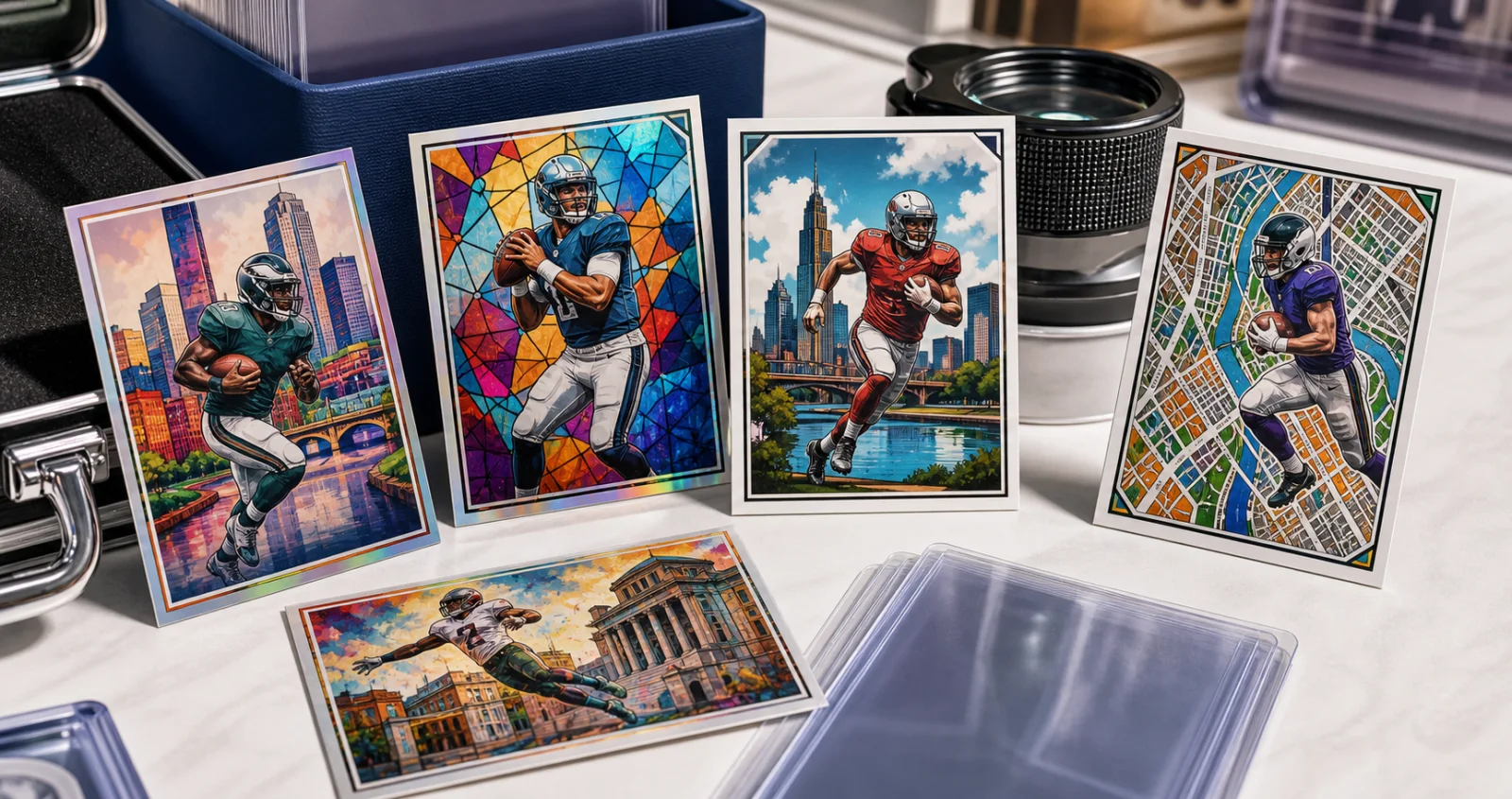
Football's first Downtown cards arrived in 2018 Donruss. Panini gave the players city-specific scenes rather than a recycled base-card design, which explains the insert's name and much of its appeal. The name alone is still a poor catalog label: a useful record also needs the year and complete product, followed by the branch, card number, format or parallel, and grade when one exists.
The original release documents are unusually helpful here. Panini's 2018 Donruss preview calls out the football debut and the city-linked original art. The 2018 Donruss sell sheet independently places the insert in that product. Together they establish the starting year without asking a later checklist to speak for the debut.
Downtown already occupied two product records in its first football year. Donruss Optic carried the insert in 2018, but its cards belong to a separate product and checklist.
Panini’s 2018 Optic box-opening article described 10 new Downtown players. Beckett’s 2018 Optic checklist files them under Donruss Optic Football. A listing that says only “2018 Downtown” has therefore omitted a decision-changing field.
A seller can write a player name, 2018, and Downtown and still leave out the one detail that changes the checklist. Donruss and Donruss Optic are not interchangeable. On a slab, read the complete label; on a raw card, use the back and the relevant checklist. If neither resolves the product, leave the card unidentified instead of borrowing a match from the other 2018 set.
That is the practical limit of shorthand such as "2018 Panini Downtown." The broader football card guide covers the rest of the identification stack, but this case can stop at the missing product name.
Downtown Football Card Years, 2018–2025
The inspected record contains a supported Downtown issue in every year from 2018 through 2025. Its 38 rows count releases, branches, and separate physical issues, not players. Thirty-six rows have itemized support. Two 2024 Optic branches are retained as existence-only because the product record names them but did not supply enough detail for a complete row. Absence from this bounded ledger means "not established in the sources inspected," not "never made."
Downtown Football Identity Ledger, 2018–2025
This is a release ledger with an August 10, 2026 cutoff. It draws on 34 inspected sources and separates 36 verified rows from two existence-only rows. The complete CSV ledger and JSON ledger with row-level citations are available for checking or reuse.
In the condensed table, "located" means that a checklist was found; it does not imply that its count was established. A dash is an unfilled evidence field, not a zero. Format labels such as standard, Optic, and clear identify the issue category but do not assign dimensions that the source never published.
| # | Year and full product | Branch or issue | Issue kind and format | Checklist or parallel evidence | Configuration or denominator boundary | Evidence status and source |
|---|---|---|---|---|---|---|
| 1 | 2018 Donruss Football | Downtown! | Standard branch | 20 cards; DT-1–DT-20 | Hobby preview; “case hit” is not a numeric guarantee | Verified — Panini |
| 2 | 2018 Donruss Optic Football | Downtown! | Optic branch | Separate 10-player checklist | Product confirmed; no row-specific rate used | Verified — Beckett |
| 3 | 2019 Donruss Football | Downtown! | Standard branch | 20-card checklist | Four premium insert families collectively fell roughly once per case | Verified — Panini |
| 4 | 2019 Donruss Optic Football | Downtown! | Optic branch | Checklist located | Hobby-exclusive SSP; no numeric rate | Verified — Panini |
| 5 | 2020 Donruss Football | Downtown! | Standard branch | 40-card checklist | Promoted in retail and blasters; no per-box guarantee | Verified — Panini retail sheet |
| 6 | 2020 Donruss Optic Football | Downtown! | Optic branch | Checklist located; Gold Vinyl /1 documented | “Rare case hit” is nonnumeric for the ordinary insert | Verified — Panini Optic sheet |
| 7 | 2021 Donruss Football | Downtown! | Standard branch | 40 cards; DT-prefixed identifiers | No row-specific configuration or rate established | Verified — TCDB |
| 8 | 2021 Donruss Optic Football | Downtown! | Optic branch | 40 cards; Black Pandora /25, Gold /10, Gold Vinyl /1 | Serial numbers apply to those parallels, not the ordinary insert | Verified — Beckett |
| 9 | 2021 Clearly Donruss Football | Downtown! | Clear-card branch | Product checklist located | No numeric branch rate established | Verified — Beckett |
| 10 | 2022 Donruss Football | Downtown! | Standard branch | 30-card checklist | Two SSPs per case covered a combined promoted group | Verified — Panini hobby sheet |
| 11 | 2022 Donruss Football | Super Bowl Downtown | Named themed branch | Separate checklist located | Hobby-only; combined SSP statement is not a branch rate | Verified — Panini hobby sheet |
| 12 | 2022 Donruss Optic Football | Downtown! | Optic branch | 30 cards; Black Pandora /25, Gold /10, Gold Vinyl /1 | Parallel numbering does not reveal the ordinary insert rate | Verified — Beckett |
| 13 | 2022 Donruss Optic Football | Super Bowl Downtown | Named themed branch | Branch checklist located | No branch-specific numeric rate established | Verified — Beckett |
| 14 | 2022 Clearly Donruss Football | Downtown! | Clear-card branch | 30 cards; Platinum Holo /1 | No numeric branch rate established | Verified — Beckett |
| 15 | 2023 Donruss Football | Downtown! | Standard branch | Product checklist located | No row-specific numeric rate established | Verified — Panini |
| 16 | 2023 Donruss Football | International Downtown | Named themed branch | 10-card checklist | No branch-specific numeric rate established | Verified — Beckett |
| 17 | 2023 Donruss Football | Super Bowl Downtown | Named themed branch | Branch checklist located | No branch-specific numeric rate established | Verified — Beckett |
| 18 | 2023 Donruss Optic Football | Downtown! | Optic branch | 20 cards; D-1–D-20; numbered parallels documented | No ordinary-insert rate established | Verified — TCDB |
| 19 | 2023 Donruss Optic Football | International Downtown | Named themed branch | Branch checklist located | No branch-specific numeric rate established | Verified — Beckett |
| 20 | 2023 Donruss Optic Football | Super Bowl Downtown | Named themed branch | Branch checklist located | No branch-specific numeric rate established | Verified — Beckett |
| 21 | 2023 Clearly Donruss Football | Downtown! | Clear-card branch | 30 cards; Platinum Holo /1 | No numeric branch rate established | Verified — Beckett |
| 22 | 2024 Donruss Football | Downtown! | Standard branch | Product checklist located | No row-specific numeric rate established | Verified — Beckett |
| 23 | 2024 Donruss Football | Downtown! Horizontal | Horizontal branch; landscape | 20 cards; Gold /10 and Black /1 | Numbered parallels do not reveal the ordinary issue’s rate | Verified — Beckett |
| 24 | 2024 Donruss Football Costco Bundle | Downtown 5x7 | Separate oversized physical issue | 21-card 5x7 checklist | Bundle evidence applies to the oversized card, not standard Downtown | Verified — TCDB |
| 25 | 2024 Donruss Optic Football | Downtown! | Optic branch | 25 cards; Black Pandora /25, Gold /10, Gold Vinyl /1 | SSP wording is nonnumeric | Verified — Panini |
| 26 | 2024 Donruss Optic Football | Downtown Legends | Named themed branch | Itemized checklist and parallel structure located | SSP wording is nonnumeric | Verified — Beckett |
| 27 | 2024 Donruss Optic Football | International Downtown | Named themed branch | Count, numbering, and parallels unresolved | No branch configuration or rate established | Existence only — Beckett |
| 28 | 2024 Donruss Optic Football | Super Bowl Downtown | Named themed branch | Count, numbering, and parallels unresolved | No branch configuration or rate established | Existence only — Beckett |
| 29 | 2024 Donruss Optic Football | Downtown Duos | Multi-subject branch | 15 cards; numbered parallel structure located | SSP wording is nonnumeric | Verified — Panini |
| 30 | 2024 Clearly Donruss Football | Downtown! | Clear-card branch | Itemized checklist located | No numeric branch rate established | Verified — Beckett |
| 31 | 2024 Clearly Donruss Football | Downtown Legends | Clear-card themed branch | 10 cards; Platinum /1 | No numeric branch rate established | Verified — Beckett |
| 32 | 2024 Clearly Donruss Football | Downtown Duos | Clear-card multi-subject branch | Itemized checklist located | No numeric branch rate established | Verified — Beckett |
| 33 | 2025 Donruss Football | Downtown! | Standard branch | Itemized checklist located | No row-specific numeric rate established | Verified — Beckett |
| 34 | 2025 Donruss Football | Horizontal Downtown | Horizontal branch; landscape | 20 cards; Gold /10 and Black /1 | Numbered parallels do not reveal the ordinary issue’s rate | Verified — TraderCracks |
| 35 | 2025 Donruss Football Costco Bundle | Oversized Downtown | Separate oversized physical issue | Oversized checklist verified; dimensions and number namespace unresolved | Bundle route does not imply a standard-size Downtown | Verified — TraderCracks |
| 36 | 2025 Donruss Optic Football | Downtown! | Optic branch | 25 cards; branch-specific numbered parallels | Unnumbered print run was not announced | Verified — Beckett |
| 37 | 2025 Donruss Optic Football | Downtown Legends | Named themed branch | Separate subjects, numbers, and parallel structure | Unnumbered print run was not announced | Verified — Beckett |
| 38 | 2025 Donruss Optic Football | Downtown Duos | Multi-subject branch | 15 two-subject cards; separate numbering and parallels | Unnumbered print run was not announced | Verified — TCDB |
Known-gap register
| Unresolved field | Boundary at the research cutoff |
|---|---|
| Ordinary-card dimensions | Not established for Donruss, Optic, or Clearly Donruss; the 2024 5x7 issue is the only measured format published here |
| Ordinary Downtown pull rates | No branch-specific numeric rate established |
| 2024 Optic International and Super Bowl | Existence supported; count, numbering, and parallels unresolved |
| 2025 Clearly Donruss Downtown | Not verified by a competent source inspected for this release |
| 2025 Optic International and Super Bowl | Not verified in the inspected 2025 Optic source |
| 2026 and autograph lineage | No 2026 checklist or stable cross-year Downtown autograph program established |
2018–2020: Donruss, Optic, and the Retail Shift
The first year already contained the split that causes so many bad listings. Donruss and Optic both used Downtown, yet their checklists were separate. By 2019 their release language had separated too: Panini grouped the Donruss insert with four premium families, while Optic was described as a hobby-exclusive SSP.
Then the 2020 Donruss retail sheet put Downtown into retail promotion and called out blasters. That one document is enough to reject the habit of treating every Downtown as a hobby pull.
The words on one sell sheet cannot migrate to another product. "Hobby-exclusive" belongs to the cited 2019 Optic record; "retail and blasters" belongs to 2020 Donruss. A useful pack history keeps those statements attached to their original year and product.
2021–2023: Clearly Donruss and Named Location Branches
The run of verified Donruss and Optic records continues across all eight years in the ledger. Clearly Donruss joins it from 2021 through 2024 as its own transparent-card product. In other words, Clearly belongs in the product field; it is not a casual description of a normal Donruss or Optic finish.
Branch names became another required field. Super Bowl Downtown has a separate 2022 Donruss checklist record, and International Downtown appears in the verified 2023 records. Deleting “Super Bowl” or “International” from a marketplace query changes which cards qualify for the result set.
Numbering remained tied to the product. A DT-prefixed Donruss card and a D-prefixed Optic card can both be Downtown issues without belonging to one continuous numbering system.
2024–2025: Horizontal, Oversized, Legends, and Duos
The 5x7 measurement belongs to one issue: the 2024 Costco Downtown, cataloged on a 21-card checklist. Do not carry that size into the 2025 Costco record; that issue is verified as oversized, but its exact dimensions remain unstated. Orientation is a different catalog field. Donruss has separate horizontal checklists in both 2024 and 2025.
Optic also separated Downtown, Legends, and Duos into named branches. The 2025 Duos checklist contains 15 multi-subject cards, which cannot be filed as ordinary parallels of the main Downtown checklist. The 2025 Donruss Optic football guide continues that exact-product research.
The missing 2025 Clearly row is intentional. It records a research boundary, not a conclusion that the product could never exist.
What Packs Have Downtown Football Cards?
There is no single answer to "which packs have Downtowns?" The answer changed with the release. The 2018 Donruss evidence is a hobby configuration; the 2020 Donruss material promotes retail and blasters; the oversized cards belong to separate bundle products. The table below keeps each statement with the product that actually supports it.
| Evidence record | Confirmed route | What the source does not prove |
|---|---|---|
| 2018 Donruss | Hobby configuration: 10 cards per pack, 24 packs per box, 18 boxes per case | That “case hit” guarantees one Downtown in each case |
| 2018 Donruss Optic | Separate Optic product with its own checklist | That a player in Donruss also appears in Optic |
| 2019 Donruss | Hobby product; four premium insert families collectively averaged roughly one per case | A Downtown-specific rate |
| 2019 Donruss Optic | Hobby-exclusive SSP | A numeric print run or per-box probability |
| 2020 Donruss | Retail and blaster promotion | Hobby origin, blaster exclusivity, or one card per box |
| 2020 Donruss Optic | Optic product sheet; rare case-hit wording | A numeric ordinary-Downtown rate |
| 2022 Donruss | Hobby-only Super Bowl Downtown branch | That the combined two-SSP statement belongs entirely to this branch |
| 2024 Costco bundle | One separately cataloged 5x7 issue | A standard-size Downtown or equivalent checklist identity |
| 2025 Costco bundle | Oversized Downtown issue | Exact dimensions or a standard-card guarantee |
For a sealed-product search, start with the year and complete product name. Only then choose the hobby box, retail format, blaster, or special bundle named by the evidence. The sports-card pack guide explains the configuration differences in more detail.
Pullmarket's live football category is a separate shopping surface, not evidence about Panini collation. It can show what is offered now, but it cannot add Downtown to a historical product or supply an individual-card probability that Panini never published.
On a current pack page, rely on that page's examples and published tier odds. Treat a Downtown example as relevant only when it is actually displayed there; do not carry a branch or rarity claim from this history into an unrelated pack.
Donruss vs Donruss Optic vs Clearly Donruss Downtown
Donruss Football, Donruss Optic Football, and Clearly Donruss Football each maintain their own Downtown record. A player can appear in more than one without creating a checklist match between them. The product name decides which branches, parallels, and sealed-product claims are relevant.
| Product family | Construction category used in the ledger | Verified Downtown years | Examples of separate records | Buying consequence |
|---|---|---|---|---|
| Donruss Football | Conventional Donruss insert issue | 2018–2025 | Main Downtown, Super Bowl, International, horizontal | Match the exact Donruss year and branch before using a checklist |
| Donruss Optic Football | Optic-branded issue | 2018–2025 | Main Downtown, Super Bowl, International, Legends, Duos | Optic checklists and numbered parallels remain separate from Donruss |
| Clearly Donruss Football | Transparent-card product issue | 2021–2024 | Main Downtown, Legends, Duos | “Clearly” is part of the product identity, not a generic finish description |
The product comparison is about identity, not measurements. The source set distinguishes conventional Donruss, Optic, and Clearly issues but does not provide dimensions for their ordinary cards.
Nothing in the inspected material makes one family permanently scarcer, more valuable, or more desirable. That judgment belongs to an exact-card comparison. A numbered Optic parallel and an unnumbered Donruss insert are different objects even when the artwork subject matches; a Clearly card introduces another product again.
A checklist match in one family cannot fill a missing entry in either of the other two product records, even when the subject and year match.
Use the 2025 Donruss Optic guide for that product’s checklist structure. If the decision is about pack formats rather than one card identity, return to the sports-card pack comparison.
What Counts as a Downtown Card Variation?
Sellers use "variation" for several unrelated things. In this ledger it may mean a named checklist branch, a parallel inside a branch, or a separate physical issue such as a horizontal or oversized card. Those are not cosmetic distinctions: they can change the checklist, the meaning of a serial number, and the set of sales that make sensible comparisons.
| Class | Verified examples | What changes | What does not follow automatically |
|---|---|---|---|
| Named checklist branch | Super Bowl, International, Legends, Duos | Subjects, card numbers, theme, and sometimes parallel structure | That it is a color parallel of the main checklist |
| Parallel | Black Pandora, Gold, Gold Vinyl | Finish and, where stated, serial-numbered print run | The print run of the unnumbered card |
| Distinct issue or format | Horizontal, 2024 5x7, 2025 oversized | Orientation, physical issue, checklist, or package route | Equivalence to a standard-size Downtown |
Named Checklist Branches
Super Bowl Downtown is not simply a finish added to the main 2022 Donruss checklist. The Donruss hobby sheet gives it a separate hobby-only branch. International Downtown receives its own later rows, and Panini’s 2024 Optic announcement names Downtown, Downtown Legends, and Downtown Duos separately.
Duos makes the difference visible without relying on finish terminology: each card has two subjects. Its verified 2025 Optic checklist contains 15 cards. A sale from that checklist is not a direct match for a main-branch Downtown just because both cards share the year and product.
The source review did not establish a universal autograph branch. It found oversized issues and unrelated Donruss autograph families, but no stable cross-year Downtown autograph program. An autograph claim therefore needs evidence tied to its exact year and product.
Serial-Numbered Parallels
The 2020 Optic product sheet assigns Gold Vinyl the 1/1 designation under Downtown. That number belongs to the Gold Vinyl parallel. It supplies neither the print run nor the pull rate of the ordinary unnumbered Downtown card.
2023 Donruss Optic Football — Downtown — D-2 C.J. Stroud — Gold /10
In that title, D-2 works only inside the 2023 Donruss Optic checklist. “Gold /10” identifies the parallel and distinguishes it from the unnumbered D-2. Black Pandora /25 belongs in the same final position when the exact checklist supports it.
Horizontal and Oversized Issues
Horizontal Downtown has its own orientation checklist in the verified 2024 and 2025 Donruss records. “Landscape version” is not enough to establish a one-to-one relationship with a portrait card; the exact subject and number still have to be checked.
The 2024 Downtown 5x7 checklist records 21 oversized cards as a separate physical issue. The bundle’s card statement applies to that 5x7 checklist, not to standard Downtown. A 2025 bundle issue is also verified as oversized, but the sources did not establish its dimensions. The 2024 measurement cannot be copied into the 2025 record.
Why Uptowns Stays Outside the Downtown Ledger
Beckett gives Uptowns its own checklist sections in the 2024 and 2025 Optic records. The sources support two co-issued checklist names. They do not support placing Uptowns inside the Downtown ledger as a branch or parallel, or treating it as a replacement, successor, or descendant.
The geographic naming may support a visual comparison, but it cannot supply the missing lineage evidence. An Uptowns search result therefore cannot fill a Downtown entry in the 2025 Optic product record.
How to Use a Downtown Checklist and Card Number
A checklist lookup works from the release inward. Settle the year, complete product, and branch before reading the number. Then require the printed subject and number to agree with the same row. If the player matches but the product does not, the search has found a different card rather than a near match.
Read 2023 Donruss Optic Football Downtown D-2 C.J. Stroud from the outside in:
- 2023 Donruss Optic Football fixes the year and complete product. It excludes the 2023 Donruss and Clearly Donruss checklists.
- Downtown chooses the main Optic branch rather than International or Super Bowl Downtown.
- D-2 must exist inside that branch’s numbering sequence.
- The checklist subject at D-2 must be C.J. Stroud.
The TCDB 2023 Optic checklist supplies the cross-check. It contains 20 D-prefixed entries: D-1 is Bryce Young, D-2 is C.J. Stroud, and D-20 is Jerry Rice.
The checklist settles the core identity, not every possible detail. Inspect the finish and serial number next to determine whether the card is unnumbered, Black Pandora, Gold, Gold Vinyl, or another documented version. Check the physical issue as well. If the card is graded, add the grader and numeric grade after the Panini checklist identity has been resolved.
Card-number prefixes help only inside their product context. The 2021 Donruss checklist uses DT-prefixed identifiers; 2023 Optic uses D-prefixed identifiers. Neither prefix creates a universal Downtown numbering system.
Stop when the label and checklist disagree. A Donruss slab does not match an Optic entry merely because the year and player line up. The football card identification guide applies the same evidence order to other inserts and parallels.
Are Downtown Football Cards Rare or Case Hits?
Some Downtown releases were marketed as case hits, SPs, or SSPs, but those labels do not create one universal rarity rule. Use the exact wording for the named year, product, branch, and configuration, and do not convert a nonnumeric or pooled statement into a Downtown-specific probability.
| Release | Source language | Defensible reading |
|---|---|---|
| 2018 Donruss | Rare case-hit insert | Product-level marketing classification; not a stated numeric guarantee |
| 2019 Donruss | Four premium insert families collectively fell roughly once per case | The pooled frequency cannot be divided into a Downtown rate |
| 2019 Donruss Optic | Hobby-exclusive SSP | Product and channel classification without a published print run |
| 2020 Donruss | Retail SP promoted in blasters | Retail route supported; no per-blaster guarantee |
| 2020 Donruss Optic | Rare case hit | No numeric ordinary-insert rate published |
| 2022 Donruss | Two SSPs per case for a combined promoted group | Not a Downtown- or Super Bowl-specific rate |
| 2024 Donruss Optic | Downtown, Legends, and Duos called SSP inserts | Separate branches; no branch-specific number |
| 2025 Donruss Optic | Unnumbered print runs not announced | Numbered parallels cannot supply the missing total |
“Case hit,” “SP,” and “SSP” are descriptive rarity language unless the source also supplies a usable numerator, denominator, and population. A case-level phrase can identify how a manufacturer positioned an insert without promising one copy in every case.
Panini’s 2019 Donruss preview covered Downtown, Rated Rookies Premium, Team Supreme, and Nicknames as one group. The 2022 hobby sheet likewise applies its two-SSP statement to a combined promoted group. Neither total can be allocated to Downtown without additional evidence.
This distinction also separates historical sealed products from current online packs. Published Pullmarket tier odds describe the current Pullmarket pack; they do not reveal Panini’s branch-level collation. The sports-card pack guide explains why the denominator must travel with the product being evaluated.
How Much Are Downtown Football Cards Worth?
A Downtown sale is a usable comp only when eight fields line up: year, full product, named branch, card number, subject, parallel or physical format, grade, and sale date. Without a dated completed sale for that identity, the evidence does not support a current price or “most valuable” ranking.
A player-and-year match is only a candidate. First read the product exactly as cataloged: Donruss, Donruss Optic, and Clearly Donruss remain separate. Keep the named branch too. A Legends, Duos, International, or Super Bowl card does not become a main-checklist sale because the player appears in both places; a Duos comparison also needs both subjects.
Next reconcile the number and the physical issue. The product checklist must assign that number to the subject shown. An unnumbered card, numbered parallel, horizontal card, 5x7 issue, and other oversized release each call for their own comparisons.
Condition closes the identity match. Graded sales need the same grading company and numeric grade. Raw cards should be compared with raw cards using visible condition evidence. Finally, retain the completed-sale date so an old transaction is not presented as a current market reading without qualification.
A 2024 5x7 card is not a direct comp for an ordinary-format card. A Gold Vinyl /1 is not a substitute for the unnumbered insert. A PSA 10 sale does not directly price a raw copy or a slab from another grader simply because both labels name the same player.
A grader record can help confirm those identity fields. For example, a PSA certification record identifies a 2021 Panini Donruss Downtown #DT-14 Barry Sanders card by year, product, insert, number, subject, certification, and grade. Any recorded transaction remains evidence for that exact slab and date, not the entire Downtown family.
No qualifying sold-price or population dataset was supplied for this guide. Current price rankings, population totals, investment forecasts, and “cheapest” or “most expensive” lists are therefore excluded. Once the exact identity is stable, the selling sports cards online guide explains how to document a card and compare suitable completed sales.
How to Identify Fake Downtown Football Cards and Check a Slab
Check the card’s product identity before checking the slab. Then compare the certification record with the physical card, full label, holder, security features, and available certification images. A valid certification number alone does not eliminate counterfeit risk.
Start with the photographed card and holder, not a certification screenshot:
- Name the card first. Copy the year, product, branch, card number, finish, and serial number from the card or full slab label. Open the checklist for that exact product. Its subject and number must agree with the object shown.
- Enter the certification number yourself. Use the issuing grader’s official lookup instead of relying on an image supplied by the seller.
- Place the returned record beside the slab photos. Check the year, product, subject, card number, grade, label type, and barcode details against the photographed holder.
- Inspect the holder on its own evidence. A database result cannot settle the label, hologram, QR code, holder weld, or tamper evidence. Compare those features with the grader’s security documentation. If certification images exist, match them to both the card and holder. Seller context matters too; resolve any unexplained difference before relying on the slab or its sale history.
PSA Cert Verification explicitly warns that genuine certification numbers can be copied. A successful database result confirms what PSA recorded under that number; it does not prove that the physical holder in front of the buyer is the same object.
PSA’s security reference documents label, hologram, QR-code, holder-weld, tamper-evidence, and certification-image checks. Independent reporting from Sports Collectors Daily explains why the card, slab, and seller context must be assessed together.
A mismatch is a stop signal, not a cue to average conflicting evidence. The graded cards guide covers raw-versus-graded decisions after the identity and holder checks are complete.
Compare Downtown Research With Current Football Packs
A historical lineage guide does not make a pack link useful by itself. The live destination must be treated as a separate category whose own pack details disclose what is currently available.
Open the current football category, choose a pack, and verify its displayed examples, raw-or-graded mix, and published tier odds on that exact page. No current evidence in this article establishes a Downtown listing.
The category resolves the research-to-inspection handoff without making an inventory promise. The reader can use the identity fields in this guide to evaluate any relevant example that happens to appear, then review that pack’s disclosures. A visible example still would not disclose an exact-card probability or guarantee a Downtown pull.
Every Pullmarket pack publishes its tier odds before purchase. Current outcomes may be raw or third-party graded, unlike sealed products that normally contain raw cards. The examples and odds describe the Pullmarket pack shown, not Panini’s historical product collation.
Every pull is a real physical collectible. Owners may hold it in the Vault, ship it, trade where enabled, or accept a market-based buyback in non-cashable Pullmarket Gems store credit. Pullmarket uses a hybrid fulfillment model: some cards are in Pullmarket custody, while others are reserved against verified supplier or partner-vault inventory and sourced on demand at redemption.
The how it works page explains those ownership choices, while Is Pullmarket Legit? covers fulfillment and remedies if the exact displayed card cannot be supplied as originally shown. The online card packs guide compares the broader opening model without treating it as equivalent to sealed Donruss or Optic.
Frequently asked questions
Not on the evidence used for this guide. The 2024 Donruss checklist records Horizontal Downtown as a separate 20-card landscape branch with its own checklist and numbered parallels. That is different from applying a finish such as Gold or Black to a card within another branch. Match the horizontal card to the horizontal checklist instead of assuming that it shares a card number, subject list, or direct market comparison with the portrait issue.
No. The 2024 Costco bundle contains a separately cataloged 5x7 Downtown issue with a 21-card checklist. Its package guarantee applies to that oversized issue, not to a conventional-size Downtown from a Donruss pack. A 2025 Costco issue is also verified as oversized, but the inspected evidence did not establish its exact dimensions. Keep year, package route, physical format, checklist, and card number attached when identifying or comparing either issue.
No. Gold Vinyl 1/1 is a serial-numbered parallel. The printed serial number establishes the population of that parallel only. It does not reveal the print run or pull rate of the unnumbered Downtown card on the same checklist. Record the ordinary checklist identity first, then append the parallel and serial number. A sale for the 1/1 should not be used as a direct comparison for the unnumbered issue.
No. A successful PSA certification lookup shows the database record associated with that number, but PSA warns that valid numbers can be copied. Compare the returned year, product, subject, card number, and grade with the physical card and complete label. Then inspect the holder, hologram, QR code, weld, tamper evidence, and any certification images. An unresolved mismatch should stop the transaction.
The inspected 2024 and 2025 Optic records list Uptowns as a separate checklist. They do not establish Uptowns as a Downtown branch, parallel, replacement, successor, or descendant. The names invite a visual or thematic comparison, but that is not enough to merge their identities. Search and catalog Uptowns under its own product checklist rather than using it to fill a missing Downtown row.
A signature does not establish a Downtown autograph issue. Look for the signed card on the checklist for its exact year and product. If that checklist does not name it, the signature needs competent authentication on its own evidence. Horizontal cards, oversized issues, and numbered parallels are different kinds of variation; none establishes an autograph checklist.
Browse online sports card packs. New here? See how Pullmarket works.