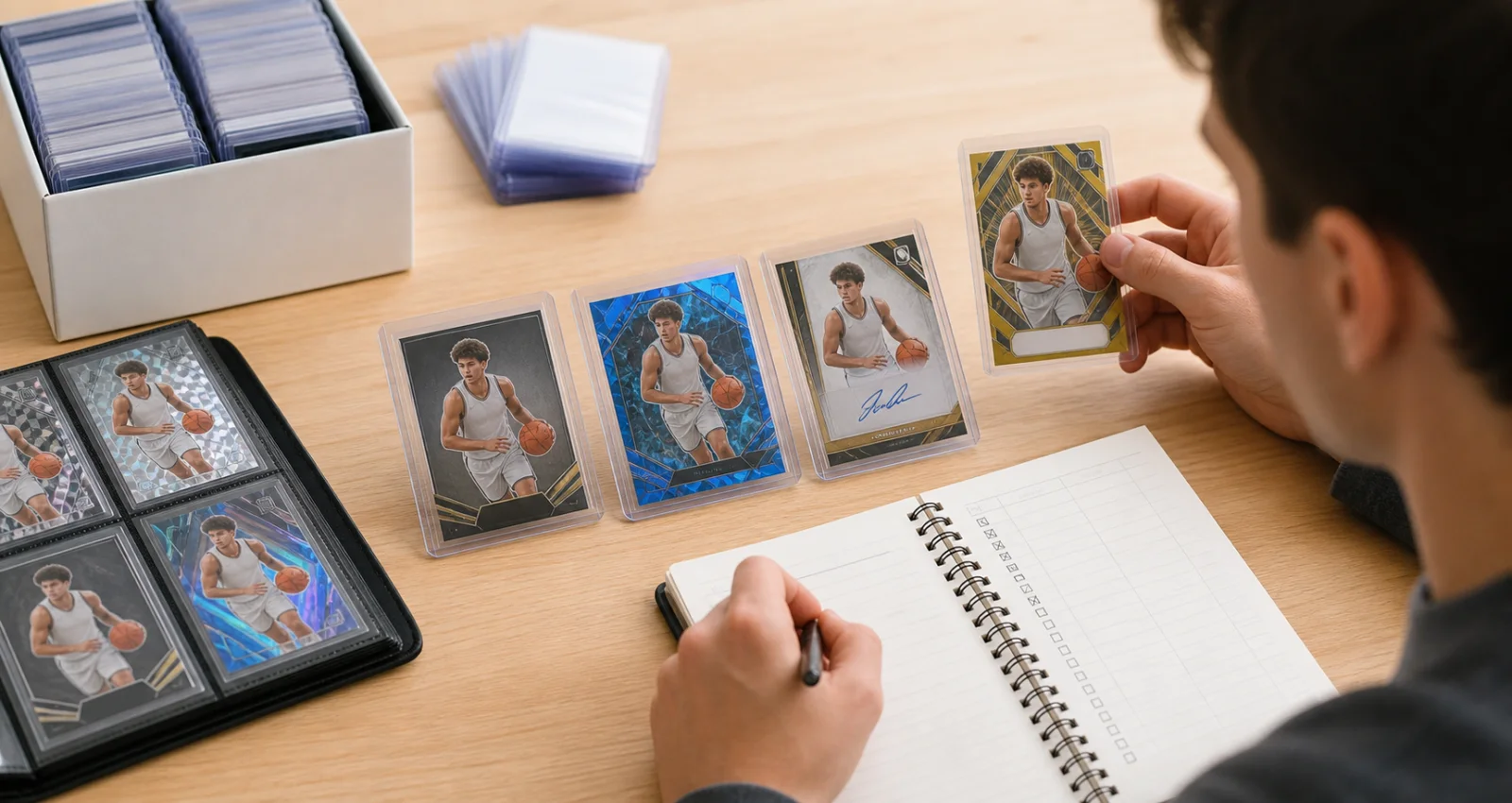
Cooper Flagg Rookie Card Guide: #201 vs Chrome #251
The manufacturer, league, grader, and checklist sources reviewed for this guide do not establish one hobby-wide universal Cooper Flagg "true rookie." The clean NBA-era checklist anchors are 2025-26 Topps Basketball #201, 2025-26 Topps Chrome Basketball #251, and Topps Chrome Updates Basketball #151. They are separate base or base-update identities, not parallels of one card. Earlier college, event, and online milestone issues occupy different places in his card lineage.
Before checking a price, identify the year, manufacturer, product, checklist family, number or code, card class, team or college context, and grade. That field set prevents a shiny parallel, checklist autograph, aftermarket-signed base card, or Duke issue from being compared as though it were the same object as Topps #201.
This guide's field reference was observed on August 10, 2026. It includes 29 decision-changing, source-backed identities under stated rules. It is not every Cooper Flagg card, parallel, grade, serial-numbered copy, relic, or marketplace listing.
Cooper Flagg Card Numbers at a Glance
Cooper Flagg's principal NBA base numbers are #201 in 2025-26 Topps Basketball, #251 in 2025-26 Topps Chrome Basketball, and #151 in Topps Chrome Updates Basketball. A number is not a complete identity: keep the product, checklist family, card class, and context attached. Codes such as FS-CF can even recur in different products.
The reference below keeps that context intact. Its 29 rows include selected pre-NBA cards, online milestone issues, NBA base anchors, representative inserts, and every Flagg autograph or autograph-relic row extracted for this scope from the three checked official Topps PDFs. One disputed Bowman U NOW numbering row was excluded rather than forced into the table. Most parallels and many online issues are also outside the denominator.
| Phase | Product and checklist family | Number or code | Card class | What the identity establishes |
|---|---|---|---|---|
| Pre-NBA | 2024 Topps Chrome McDonald's All-American, base | #78 | Base | Event presentation before an NBA team context |
| Pre-NBA | 2024-25 Bowman Chrome University Basketball, base | #16 | Base | Duke college presentation before the NBA debut |
| Draft milestone | 2025 Topps NOW Basketball, Draft | #D1 | Online exclusive | NBA Draft-night issue; not a pack-issued flagship base card |
| NBA debut milestone | 2025-26 NBA Topps NOW, NBA debut | #6 | Online exclusive | First-game commemoration in Dallas context |
| Flagship | 2025-26 Topps Basketball, base | #201 | Base | Dallas Mavericks flagship NBA rookie checklist identity |
| Flagship | Contemporary Marks | CM-CF | Autograph | Flagship autograph-program identity |
| Flagship | Havoc Marks | HM-CF | Autograph | Flagship autograph-program identity |
| Flagship | New Applicants Autographs | NA-CF | Autograph | Flagship autograph-program identity |
| Flagship | Rookie Photo Shoot Autographs | RP-CF | Autograph | Flagship autograph-program identity |
| Flagship | 1980-81 Topps Basketball Rookie Autographs | 80B2R-CF | Autograph | Flagship autograph-program identity |
| Flagship | Flagship Real One Rookie Autographs | TFRR-CF | Autograph | Flagship autograph-program identity |
| Flagship | 1980-81 Topps Chrome Basketball Rookie Autographs | 80CR2-CF | Autograph | Flagship autograph-program identity |
| Flagship | Shopping Spree Signatures | SSA-CF | Autograph | Flagship autograph-program identity |
| Chrome | 2025-26 Topps Chrome Basketball, base | #251 | Base | Dallas Mavericks Chrome rookie checklist identity |
| Chrome | Advisory | AD-1 | Insert | Chrome insert; not base #251 |
| Chrome | Topps Chrome Autographs Rookies | TCAR-CF | Autograph | Chrome autograph-program identity |
| Chrome | Topps Autograph Issue Rookies | TAIR-CF | Autograph | Chrome autograph-program identity |
| Chrome | Next Stop Signatures | NS-CF | Autograph | Chrome autograph-program identity |
| Chrome | Future Stars Autographs | FS-CF | Autograph | Chrome autograph-program identity |
| Later online milestone | 2025-26 NBA Topps NOW, Rookie of the Year | ROTY | Online exclusive | Award commemoration; not a base-set number |
| Chrome Updates | Topps Chrome Updates Basketball, base update | #151 | Base update | Dallas Mavericks Updates rookie checklist identity |
| Chrome Updates | Alter Egos | AE-2 | Insert | Updates insert; not base #151 or Chrome #251 |
| Chrome Updates | Glass Canvas | GC-23 | Insert | Updates insert; not base #151 or Chrome #251 |
| Chrome Updates | Topps Chrome Autographs | TCA-CF | Autograph | Updates autograph-program identity |
| Chrome Updates | Rookie Autographs Lava Lamp | RA-CF | Autograph | Updates autograph-program identity |
| Chrome Updates | 1980-81 Topps Basketball Autographs | 80TBA-CF | Autograph | Updates autograph-program identity |
| Chrome Updates | Future Stars Autographs | FS-CF | Autograph | Updates autograph identity sharing a code with original Chrome |
| Chrome Updates | Chromographs | CH-CF | Autograph | Updates autograph-program identity |
| Chrome Updates | NBA Debut Patch Autographs | DPA-CF | Autograph-relic | Updates physical autograph-relic checklist identity |
The three controlling sources are the official 2025-26 Topps Basketball checklist, Topps Chrome Basketball checklist, and Topps Chrome Updates Basketball checklist. Those PDFs establish the product-level rows. They do not turn the 29-row table into an exhaustive registry.
#201, #251, and #151 are three different cards
Topps #201 is the flagship base identity. Chrome #251 belongs to a separate Chrome base checklist. Updates #151 belongs to the later Chrome Updates base-update checklist. None is a surface treatment applied to another number. A seller who calls #251 the "Chrome version of #201" may be speaking loosely about player and season, but a catalog or comp record must retain the actual product and number.
The number also says nothing about print quantity. Card #251 is not limited to 251 copies. A separate stamp such as 07/25 would identify a numbered copy within a stated run; that copy would still need its product, base or parallel family, and full card identity.
Why prefixes matter
Prefixes often identify a checklist family. AD-1 is Flagg's Advisory insert in the checked Chrome list. DPA-CF is his NBA Debut Patch Autograph identity in Chrome Updates. FS-CF demonstrates the danger of searching a code alone: the checked Chrome and Chrome Updates checklists both use it for a Future Stars Autograph row. Product plus code resolves the collision.
For broader terminology before applying these fields, the basketball card guide separates rookies, inserts, parallels, variations, and autographs.
What Year Is a Cooper Flagg Rookie Card? Release Chronology
Most NBA-context Cooper Flagg rookie searches point to the 2025-26 season, while earlier 2024 and 2024-25 cards document his pre-NBA stage. The sequence matters more than forcing every issue into one rookie bucket: event and Duke cards came before his NBA/Dallas identities, followed by online milestones, flagship #201, Chrome #251, and Chrome Updates #151.
The NBA's 2025 Draft record states that Dallas selected Flagg from Duke with the first overall pick. That event supplies a useful context boundary. A Duke card and a Dallas Mavericks card can both be meaningful Flagg collectibles, but they document different points in the player's career and should not be treated as checklist substitutes.
Before the Mavericks
The checked source set supports two selected pre-NBA identities after excluding the unresolved Bowman U NOW numbering row. Topps Chrome McDonald's All-American #78 presents Flagg in an event product. Bowman Chrome University Basketball #16 presents him in a Duke college lane. Neither row is used here as an NBA team-presented rookie or as proof of a universal prospect-card hierarchy.
Collectors often use terms such as prospect card, pre-rookie, collegiate card, or early card around this material. Those labels are conventions, not interchangeable checklist classes. The clean catalog description is the one on the source: year or season, manufacturer, product, number, card class, and presentation context. A collection organized around Duke may prioritize #16. A collection organized around Flagg's NBA rookie products may begin later. Both choices are coherent when the rule is written down.
Do not infer an exact release date where the checked source only establishes a product phase. The table therefore uses chronology roles rather than inventing day-level precision for every early issue.
Online milestones are not pack-issued base cards
Topps NOW cards occupy another lane. Draft card #D1, NBA debut card #6, and the later ROTY issue commemorate named moments through online products. Their codes and published print runs can be useful for identification, but they do not become Topps Basketball #201, Chrome #251, or Updates #151.
This distinction matters in a search result. A listing title might include "Flagg rookie," "NBA debut," and a low card number while omitting the product. The photographs and card back may reveal a Topps NOW issue rather than a pack-issued flagship base card. Neither form is automatically better; the buyer simply needs to know which form is being offered.
Flagship, Chrome, and Updates
The official flagship checklist supplies #201 and labels the Dallas row as a Rookie. The official Chrome checklist supplies #251 in its own base section and separates Refractors, variations, inserts, and autographs into other families. The official Updates checklist supplies #151 as a base-update row and adds later insert and autograph families.
Only Chrome has an exact release date cleared in the working ledger: December 18, 2025. The other product roles are supported without forcing unverified exact dates into evergreen prose. This keeps chronology useful without making a fragile release-calendar claim.
What "True Rookie" Means for Cooper Flagg
"True rookie" is collector shorthand, not a complete Cooper Flagg card identity. The checked sources do not establish one hobby-wide authority or one universally binding winner. If your rule favors the mainstream flagship NBA base, #201 fits that definition. If your rule favors Chrome, #251 is the Chrome base. State the rule and retain the exact product.
A useful rookie rule answers three questions: what context counts, what product form counts, and how many cards the rule can include. For example:
- Flagship NBA base rule: choose 2025-26 Topps Basketball #201 because it is the Dallas Mavericks Rookie row in the flagship base checklist.
- Chrome base rule: choose 2025-26 Topps Chrome Basketball #251 because it is the base Chrome checklist entry, while keeping Refractors and variations separate.
- NBA-season set rule: collect #201, #251, and #151 as three distinct NBA-era checklist anchors rather than forcing one to erase the others.
- Career-lineage rule: retain early event, Duke, online milestone, flagship, Chrome, and Updates identities in separate chronological slots.
Each rule produces a different collection. The error is not choosing one; it is presenting a private convention as an official universal fact.
That same rule is useful when reading the basketball rookie, parallel, and insert terms: a hobby label can describe a collecting lane, but it cannot replace the year, product, checklist family, number, and card class printed or documented for the actual object.
The phrase rookie card also does not settle whether a card is a base card, insert, autograph, or autograph-relic. The official Topps checklists mark many Flagg rows as Rookie across several families. That printed designation helps identify the row, but it does not collapse the families into one card. It certainly does not make an aftermarket-signed #201 identical to CM-CF or another manufacturer-checklisted autograph.
Be careful with slab labels as well. PSA's inspected certification record describes one card as 2025 TOPPS #201 COOPER FLAGG. That is a card-specific catalog label, not proof that every marketplace item using "2025 Topps" is the same version. The label, the pictured card, the certification record, and the source checklist should agree.
Cooper Flagg Base Rookie Card Types
A base card is a main-checklist identity such as Topps #201 or Chrome #251. A parallel is a documented treatment connected to a checklist entry. An insert belongs to another named subset, such as Chrome Advisory AD-1. A variation changes a documented feature. An autograph belongs to a named signature program. Classify first; compare later.
Base card: The base row is the ordinary checklist identity before a parallel or variation is applied. In this guide, #201 and #251 are base identities. Updates #151 is a base-update identity, which preserves its later product role instead of pretending it is the same checklist as either earlier base.
Parallel: A parallel is a documented treatment associated with a base card or another checklist entry. Finish, color, pattern, and serial numbering can matter, but a reflective surface alone does not prove the parallel name. Match the visual and stamped details to the product checklist. A Chrome Refractor is not relabeled as a Panini Silver Prizm, and neither term describes the ordinary Chrome base.
Variation: A documented image or design variation is distinct from the standard version. An unfamiliar photo is a clue, not proof. Check the relevant variation list, card back, codes, and trustworthy product references.
Insert: An insert belongs to a named subset. Chrome AD-1 is an Advisory insert. Updates AE-2 and GC-23 belong to Alter Egos and Glass Canvas. All feature Flagg, but none should be entered or comped as base #251 or base-update #151.
Autograph: A manufacturer-checklisted autograph belongs to a named signature program and has its own code. A base card that Flagg signs later remains the base-card identity plus an aftermarket signature unless a qualified authentication or grading record establishes more. It does not transform into TCAR-CF, TCA-CF, or another checklist-issued autograph.
Autograph-relic: The Updates DPA-CF row belongs to NBA Debut Patch Autographs. It is a physical autograph-relic checklist identity and a 1/1 program row in the checked source. It is not a promotional cash incentive, a game of chance, or a promise that the card can be pulled through Pullmarket.
Raw versus graded: Raw and graded describe the copy's holder and assessment state, not a new checklist family. A PSA 8 #201 and raw #201 can share the same underlying card identity while requiring separate condition and comp groups. The graded-versus-raw card guide explains the practical difference.
The fastest field test is to ask what would make two copies stop being comparable. A different product, checklist number, card class, parallel, autograph status, grade, or sale date is usually enough. If the listing does not show the back, serial stamp, or slab label needed to answer, ask for better photographs.
Cooper Flagg Rookie Autographs by Checklist Family
This guide verifies 18 Cooper Flagg autograph or autograph-relic identities across the checked flagship, Chrome, and Chrome Updates checklists: eight flagship, four Chrome, and six Updates rows. That is the denominator for this source-bounded ledger, not the total number of Cooper Flagg autographs ever issued.
The count excludes parallels within these programs, most online issues, relic-only cards, ambiguous multi-subject rows, individual serial-numbered copies, aftermarket signatures, and unverified product branches. A collector using the list later should recheck the manufacturer sources because new products can add identities without changing the historical accuracy of this version.
Flagship autograph programs
The official Topps Basketball checklist supplies eight Flagg autograph families in this ledger:
| Program | Code | Identification note |
|---|---|---|
| Contemporary Marks | CM-CF | Flagship autograph program; not base #201 |
| Havoc Marks | HM-CF | Separate flagship signature family |
| New Applicants Autographs | NA-CF | Rookie-marked flagship autograph row |
| Rookie Photo Shoot Autographs | RP-CF | Named photo-shoot signature program |
| 1980-81 Topps Basketball Rookie Autographs | 80B2R-CF | Retro-themed flagship autograph family |
| Flagship Real One Rookie Autographs | TFRR-CF | Real One program identity |
| 1980-81 Topps Chrome Basketball Rookie Autographs | 80CR2-CF | Chrome-themed family inside the flagship checklist |
| Shopping Spree Signatures | SSA-CF | Named flagship signature subset |
The table explains why "Topps Flagg rookie auto" is not enough for a catalog or comp. Two cards can share the manufacturer, player, NBA season, and autograph status while belonging to different checklist families and carrying different codes.
Chrome autograph programs
The original Chrome checklist supplies four scoped autograph identities: Topps Chrome Autographs Rookies TCAR-CF, Topps Autograph Issue Rookies TAIR-CF, Next Stop Signatures NS-CF, and Future Stars Autographs FS-CF. The independently inspected Beckett Chrome checklist also separates base, Refractor, variation, insert, and autograph sections, which supports the same classification discipline.
None of these four is merely a signed Chrome #251. The checklist family and code create a distinct manufacturer-issued autograph identity. A listing should show enough of the card front, back, signature statement, and any redemption or certification details to connect it to the claimed program.
Chrome Updates and DPA-CF
The Updates checklist contributes six autograph or autograph-relic identities: Topps Chrome Autographs TCA-CF, Rookie Autographs Lava Lamp RA-CF, 1980-81 Topps Basketball Autographs 80TBA-CF, Future Stars Autographs FS-CF, Chromographs CH-CF, and NBA Debut Patch Autographs DPA-CF.
The repeated FS-CF code is the most useful teaching example in the ledger. One row belongs to original Chrome and another to Chrome Updates. Searching the code without the product can combine unlike cards. The exact identity should read, for example, 2025-26 Topps Chrome Updates Basketball, Future Stars Autographs, FS-CF, not simply "Flagg FS-CF auto."
DPA-CF is different again because the official Updates source places it in the NBA Debut Patch Autographs branch. Record it as an autograph-relic identity. Keep any sale, grading, or ownership evidence attached to that exact physical card; headline reporting about the card does not supply a general value for other Flagg autographs.
For signed or graded examples, the PSA vs CGC vs SGC guide helps keep grading-company and holder context separate from the checklist identity.
How to Verify a Signed Cooper Flagg Rookie Card or Slab
Verify a Cooper Flagg card with a four-way match: the physical card, seller description, manufacturer or reliable checklist, and any grader certification record must agree on year, product, number or code, card class, version, autograph status, and grade. If one field conflicts, stop and resolve it before paying or selecting comps.
- Name the product before the number. Write
2025-26 Topps Chrome Basketball #251, not justFlagg 251. For an autograph, add the program and code. - Inspect the front and back. Look for the product name, number or code, team or college presentation, copyright line, finish, signature language, serial stamp, and any variation clues. Stock photographs cannot verify the offered copy.
- Classify the card. Decide whether it is base, base update, parallel, variation, insert, online exclusive, autograph, or autograph-relic. Do not leave the class as generic "rookie."
- Open the controlling checklist. Match the player and code inside the correct product and family. A code appearing in another product is not enough.
- Check the autograph claim. Determine whether the signature is manufacturer-checklisted, authenticated after signing, or merely asserted by the seller. Record whether a grader assessed the card, the autograph, or both.
- Verify a graded copy. Match grader, certification number, set description, number or code, parallel, grade, and any autograph notation. Then compare the database record with the actual pictured slab.
- Record unresolved conflicts. A title that says #201 while the card back shows an insert should not be "close enough." Save the conflict and exclude the item until resolved.
PSA certification 153506042 provides a concrete label example for #201. The PSA record catalogs 2025 TOPPS #201 COOPER FLAGG and lets a buyer compare the certification data with the slab being offered. A database match is still not a substitute for inspecting the pictured card and holder.
Marketplace titles are discovery clues. They are not proof of print run, rarity, licensing context, autograph program, or authenticity. Words such as "rare," "short print," "rookie auto," and "eBay 1/1" need card- or checklist-level support. Likewise, a serial number on one copy does not establish the print run of an ordinary base card.
When preparing a listing of your own, preserve the same fields and photograph the evidence. The guide to selling sports cards online covers comparable-sale and presentation decisions, while graded cards provides a current route for browsing pack options that may include raw or third-party-graded outcomes.
How to Compare Cooper Flagg Rookie Card Values
There is no defensible single Cooper Flagg rookie-card value. Compare completed sales only after matching product, number or code, base or variant class, parallel, autograph status, grade, venue, and sale date. A raw #201, PSA 8 #201, Chrome #251 Refractor, and checklist autograph are four different comp groups.
Start with an identity line, not a price search. A usable line might read:
2025-26 Topps Basketball, Cooper Flagg, #201, base, raw, no autograph, observed August 10, 2026.
For a slab, replace raw with the grader and complete grade. For a parallel, name the exact documented parallel and serial numbering when present. For an autograph, name the product, program, code, signature form if supported, and whether the card or autograph received a grade.
Then apply the same rules to every sale:
- Use a completed transaction, not an active asking price.
- Confirm the sale represents one identifiable card rather than a lot with no allocation.
- Match card class, parallel or variation, autograph status, and grade.
- Record sale date, venue, currency, buyer's premium, shipping treatment, and whether an accepted offer is disclosed.
- Separate raw and graded copies. Separate grading companies and numeric grades.
- Exclude or flag returns, duplicate records, title-photo conflicts, altered cards, and undisclosed offer prices.
- Report the number of usable sales and the observation window beside any summary.
A dated #201 PSA 8 example
The packet contains one exact transaction suitable for teaching the method. A PSA 8 2025 Topps #201 sold through Fanatics Collect for $13.20 including buyer's premium on July 20, 2026. The dated lot record and PSA certification identify the grade, card, venue, and date.
That transaction does not establish today's value for a raw #201, PSA 9, PSA 10, Chrome #251, parallel, insert, or autograph. It is one observation. Its real instructional value is showing which fields must travel with a number.
A secondary SportsCardsPro record for #201 can help locate historical market entries, but each underlying transaction still needs an exact-match audit. A database category is not permission to blend editions or grades.
Avoid investment language and forecasts. The source packet does not support a universal most-valuable ranking or future performance claim. A card may be desirable because it completes a run, matches a team collection, carries a preferred design, documents a milestone, or has a verified signature. Those are collection decisions, not guaranteed financial outcomes.
The graded-versus-raw comparison can help decide whether a holder and third-party condition opinion are useful for the exact copy. When selling, compare recent sold cards under the same identity rules rather than pricing from the broadest Flagg search.
Best Cooper Flagg Cards by Collection Goal
The best Cooper Flagg card depends on the collection rule. Choose Topps #201 for a flagship NBA base slot, Chrome #251 for the Chrome base lane, Updates #151 for a later update slot, a Duke card for pre-NBA context, a named insert for design, or a checklist-issued autograph for a verified signature program. Do not treat that choice as an investment ranking.
| Collection goal | Card lane to inspect | Evidence to require | Main mistake to avoid |
|---|---|---|---|
| One flagship NBA base | 2025-26 Topps Basketball #201 | Official base row, card front/back, exact number | Calling every Topps rookie #201 |
| One Chrome NBA base | 2025-26 Topps Chrome #251 | Chrome base row and exact product | Mixing Refractors, variations, or inserts into base comps |
| NBA-season checklist trio | #201, #251, and Updates #151 | Three product-specific checklist rows | Treating #151 or #251 as a #201 parallel |
| Duke or pre-NBA history | McDonald's All-American #78 or Bowman Chrome University #16 within this scope | Product, number, and college/event context | Calling a pre-NBA issue an NBA team-presented base |
| Online career milestones | Topps NOW #D1, #6, or ROTY | Exact online product and event code | Comping online issues as pack-issued flagship cards |
| Design-led insert | Chrome AD-1, Updates AE-2, or GC-23 | Named subset and product | Calling the insert a base-card variant without evidence |
| Manufacturer-checklisted signature | One of the 18 scoped autograph identities | Product, program, code, and signature evidence | Treating an aftermarket-signed base as the checklist auto |
| Graded copy | Exact card plus grader, cert, and complete grade | Certification record matched to pictured slab | Assuming a grade changes the checklist identity |
| Raw copy | Exact card plus clear condition photographs | Front, back, corners, edges, surface, and disclosure | Comparing raw condition to a slab grade as though identical |
The matrix is intentionally not a ranked list. A Chrome-focused collector can rationally prefer #251. A flagship run can rationally begin with #201. A Duke collection can rationally stop before the NBA products. A signature collector needs a program-level identity rather than a generic signed card. Write that collection rule before shopping and the results become much easier to filter.
Condition belongs after identity. If two copies share every checklist field, then centering, corners, edges, surface, print quality, eye appeal, autograph quality where applicable, and holder preference can separate them. If the identities differ, condition should not be used to disguise that mismatch.
Method and Update Boundary
The 29-identity reference was built from card-level rows and chronology evidence observed on August 10, 2026. Official Topps PDFs control #201, #251, #151, the selected inserts, and the 18 scoped autograph identities. NBA supplies the draft boundary. PSA and Fanatics Collect support the worked slab and transaction example. Beckett and SportsCardsPro are secondary checks, not replacements for exact manufacturer rows.
The guide omits one conflicting Bowman U NOW numbering record, most parallels, most Topps NOW issues, relic-only branches, ambiguous multi-subject cards, individual serial-numbered copies, grades as separate identities, and Panini details that lacked an exact checked first-party Flagg row. Those exclusions keep the denominator reproducible. Future updates should add a row only when the product, family, code or number, class, context, exact source locator, and observation date can all be recorded.
Frequently asked questions
The checked sources do not establish one hobby-wide universal true rookie. Under a flagship NBA base rule, 2025-26 Topps Basketball #201 is the clean choice. Under a Chrome base rule, #251 is the Chrome identity. A collection can also retain Updates #151 as a separate later base-update card. State the rule rather than presenting a collector convention as an official universal ruling.
#201 is the base Flagg row in 2025-26 Topps Basketball. #251 is the base row in 2025-26 Topps Chrome Basketball. #151 is the base-update row in Topps Chrome Updates Basketball. They belong to three product checklists. None is a parallel of another, and each needs its own comp group.
The principal NBA-context products in this guide are from the 2025-26 season. Earlier 2024 and 2024-25 event or Duke products document pre-NBA stages. Because marketplace titles can abbreviate seasons, verify the exact product and checklist row instead of relying on a year alone.
PSA certification 153506042 uses 2025 TOPPS #201 COOPER FLAGG for one graded copy. Treat that as a card-specific catalog description and match it to the pictured slab and official checklist. The shortened label does not make every listing described as "2025 Topps" the same card, parallel, or grade.
No. Topps #201 is a base checklist identity. A manufacturer-checklisted autograph belongs to a named program with its own code, such as CM-CF or TCAR-CF. A #201 signed later remains a signed example of the base card unless separate authentication evidence establishes the signature; it does not become one of those checklist-program cards.
Eighteen autograph or autograph-relic identities are included: eight from flagship Topps Basketball, four from Topps Chrome, and six from Chrome Updates. That count applies only to this August 10, 2026 source-bounded ledger. It excludes program parallels, many online issues, aftermarket signatures, unverified branches, and later releases.
A grade describes a copy under one grader's assessment; it does not make different cards equivalent. Product, checklist number, parallel, insert or autograph status, serial numbering, grader, sale venue, and date can all differ. Compare completed sales only after those identity fields match.
Browse online sports card packs. New here? See how Pullmarket works.