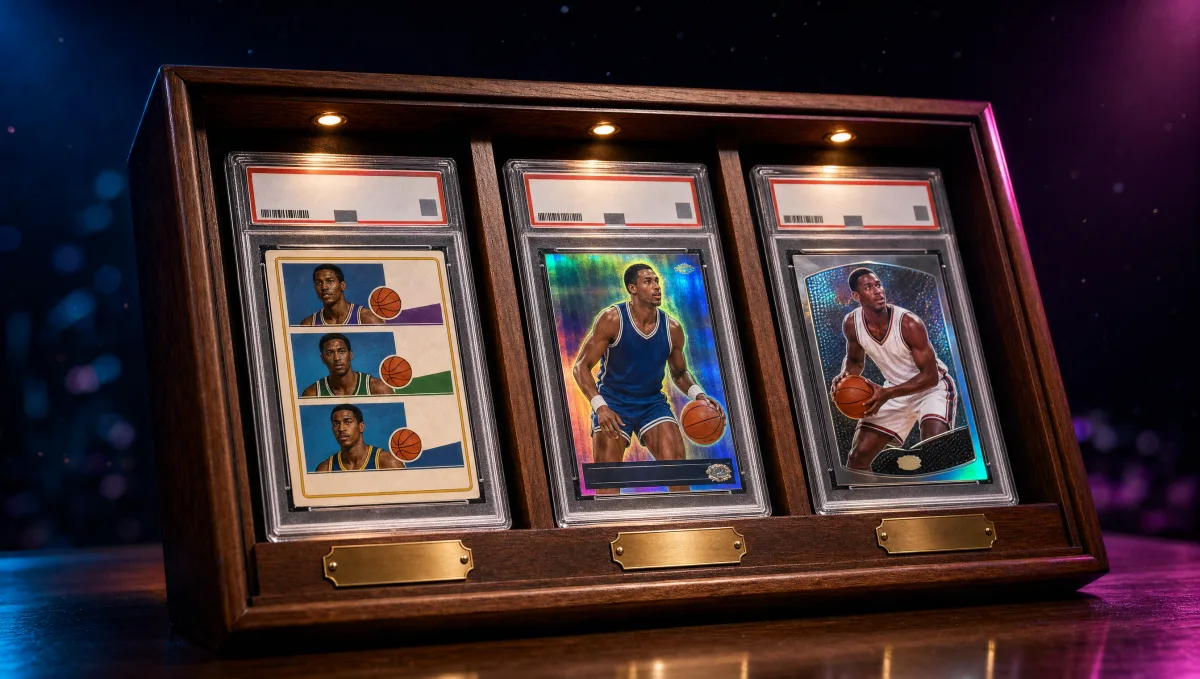
Kobe Bryant, Larry Bird & Stephen Curry Rookie Card Trio
Three Hall of Famers, three decades of NBA dominance, and three rookie cards that anchor any serious modern-NBA-vintage collection — the 1980-81 Topps Larry Bird / Julius Erving / Magic Johnson #6 shared rookie, the 1996-97 Topps Chrome Kobe Bryant #138, and the 2009-10 Topps Chrome Stephen Curry #101 numbered /999. They are rookies of three legends issued across thirty years of NBA cardboard history, but Topps Chrome is the surprising thread that ties Kobe (1996) and Curry (2009) together, with Bird's 1980-81 Topps perforated 3-in-1 panel sitting as the structural ancestor of the entire chase. This guide walks through what each card is worth in 2026, why Chrome is the through-line, the practical tells on the most-counterfeited modern NBA card (the 1996-97 Chrome Kobe), how the perforated Bird/Magic format actually works and why scoring it destroys the card, and whether the raw rookie sitting in your binder is worth submitting to PSA, SGC, or CGC.
Part of: Complete Basketball Cards Guide — the pillar overview of 80 years of basketball cards, from 1948 Bowman through the October 2025 Panini → Topps/Fanatics NBA license transition.
Why these three players define modern NBA vintage collecting
Larry Bird (1979–1992 Celtics, three NBA titles, MVP 1984–86), Kobe Bryant (1996–2016 Lakers, five rings, 2008 MVP, posthumous demand floor following his January 2020 death at 41), and Stephen Curry (2009–present Warriors, four titles, two MVPs, the all-time NBA three-point leader) are the three NBA legends whose rookie cards bracket the entire modern-vintage era. The cardboard story underneath spans three structurally different production realities:
- True vintage (1980-81 Topps Bird/Erving/Johnson #6) — pre-Chrome by sixteen years, small print run, and the only Topps NBA set ever to use the three-player perforated panel design. Intact-panel scarcity is the defining condition variable.
- Peak Chrome (1996-97 Topps Chrome Kobe #138) — the inaugural Topps Chrome NBA set, signature metallic borders, and the moment Chrome cemented itself as the modern NBA rookie standard. The most-counterfeited modern NBA card on the open market.
- Modern Chrome (2009-10 Topps Chrome Curry #101 /999) — same metallic-border Chrome aesthetic thirteen years later on a numbered /999 print run that proves the Chrome lineage and closes the 30-year arc.
Together they tell one story: NBA rookies issued in three different cardboard eras, with Chrome as the surprising through-line.
The 1980-81 Topps Bird / Erving / Johnson #6 — the perforated 3-in-1 rookie
The 1980-81 Topps Basketball #6 is a single Topps card with three perforated panels featuring Larry Bird, Julius Erving (the Team Leader veteran legend), and Magic Johnson side by side on one undivided sheet. The canonical rookie card is all three panels intact — scored or separated panels grade as damaged. Per PSA's "Magic and Bird Era Begins" Set Registry article and All Vintage Cards' Bird/Magic pillar:
- Raw clean copies (intact panels): roughly $300–$1,000
- PSA 7: roughly $1,000–$1,500
- PSA 8: roughly $3,000–$5,000
- PSA 9: roughly $9,000–$16,000
- PSA 10: averages $100,000–$125,000 with public records at $114,000–$125,000 per PWCC and Goldin sale activity
- Population: approximately 14,700 total graded across PSA, SGC, and Beckett (PSA ~9,800, SGC ~1,100, Beckett ~3,800) per All Vintage Cards
Other 1980-81 cards collectors should know briefly: the 1981 Topps #4 Bird solo card (his first standalone card; PSA 10 sales have hit $14,600–$23,900 per Old Sports Cards), the 1980-81 Topps Bird/Cartwright/Drew variant, and the 1980-81 Topps Magic scoring leader subset. For where Bird sits among all-time basketball card record sales, see the most-expensive basketball cards guide.
The 1996-97 Topps Chrome Kobe Bryant #138 — the iconic Chrome rookie
The 1996-97 Topps Chrome Kobe Bryant #138 is Kobe's most important rookie card and the peak-Chrome anchor of the trio. Late-set placement (#138 out of 220), signature high-gloss metallic silver borders, and Kobe pictured in Lakers purple-and-gold #8 from his rookie season after the Charlotte Hornets draft-day trade. Per Old Sports Cards, Sports Card Investor, and PSA Cardfacts:
- Raw clean copies: roughly $200–$800
- PSA 8: roughly $500–$1,200
- PSA 9: approximately $3,000
- PSA 10: averages roughly $40,000 with peak public sales in the $60,000–$100,000 range following Kobe's January 2020 passing
- Population: 830 PSA 10s out of 5,622 total graded (~14.8% gem-mint rate) per PSA Cardfacts
The Refractor parallel is the real grail. The 1996-97 Topps Chrome Refractor #138 is functionally a different card with approximately 400 total graded and 63 PSA 10s. Per Old Sports Cards, the Refractor is "without a doubt the most sought-after Kobe rookie card in the hobby" — a BGS 10 sold $33,500 back in 2017, and PSA 10 Refractors have crossed six figures in recent sale activity.
The set context matters. 1996-97 Topps Chrome also contains the Allen Iverson, Steve Nash, and Ray Allen rookies — per Sports Card Investor, the set's rookie class "potentially rivals Michael Jordan's 1984 class." The same set also has Jordan, Olajuwon, and Garnett base cards. It is the inaugural Topps Chrome NBA set and the moment Chrome cemented itself as the modern NBA rookie standard.
Sister sets — Kobe's other key 1996-97 rookies collectors should know:
- 1996-97 Skybox E-X 2000 Kobe Bryant #30 — base PSA 9 around $2,000; the Credentials /499 parallel PSA 10 has cleared $13,000 per Old Sports Cards.
- 1996-97 Bowman's Best Kobe Bryant #R23 — most affordable iconic Kobe RC, ~$300 PSA 9; the Atomic Refractor parallel commands a premium.
- 1996-97 Fleer Metal Kobe Bryant #137 and the 1996-97 Ultra Platinum Medallion (PSA 10 has sold over $100,000 per All Vintage Cards) round out the elite tier.
Chronic condition issues: chrome surface scratches and "snow" (print dots) on the metallic silver borders are the PSA 10 killers. Centering on the 1996-97 Chrome print run was generally clean, but corner chipping on silver borders is common. Counterfeits are the single biggest authentication risk on this card — see the dedicated section below.
The 2009-10 Topps Chrome Stephen Curry #101 — the modern Chrome anchor
The 2009-10 Topps Chrome Basketball #101 numbered /999 is Curry's iconic affordable rookie card and the modern-vintage closer of the trio. Curry pictured in Warriors blue-and-gold from his rookie season after the 7th-overall pick from Davidson, same metallic-silver-bordered Chrome cardstock as Kobe's 1996-97 — visually unmistakable Topps Chrome aesthetic, thirteen years apart. Per Sports Card Investor:
- Raw clean copies: last sold $1,888 in June 2025
- PSA 8: last sold $11,000 in April 2026
- PSA 9: last sold $16,100 in May 2026; current ask $25,000–$30,000
- PSA 10: averages $48,216 across recent gem-mint sales
- Print run: /999 with approximately 200–300 graded so far; PSA 10s scarce due to chrome-surface condition sensitivity
The Refractor parallels are the real chase on the modern side:
- Refractor /500 — recent PSA 10 sales: $60,000 (Oct 2024), $68,000 (June 2024), and $96,000 at Heritage Auctions in August 2022.
- Gold Refractor /50 — premium chase; five to six figures in PSA 10.
- Superfractor /1 — the one-of-one grail.
But the Chrome RC is not Curry's grail card. The 2009-10 Panini National Treasures Logoman Rookie Patch Autograph 1/1 sold for $5.9 million in July 2021, currently sitting at #3 on the all-time basketball card sales list and detailed in the most-expensive basketball cards guide. The Logoman is the one-of-one trophy; the Topps Chrome /999 is the iconic affordable RC every collector chases first.
Sister Curry RCs collectors should know: the 2009-10 Bowman Chrome Curry (refractors are the chase), the 2009-10 SP Authentic Curry Rookie Auto with on-card autograph (multi-thousand-dollar floor at any grade), the 2009-10 Topps #321 base non-Chrome flagship (PSA 10 has hit $18,000 per Sports Card Investor), and the 2009-10 Panini National Treasures RPA /99 at the autograph + patch grail tier.
Curry's RC closes the modern-vintage frame exactly thirteen years after the 1996-97 Topps Chrome Kobe, same Chrome aesthetic, same condition-scarce reality — a clear lineage from one era-defining rookie to the next.
Why Topps Chrome is the thread between Kobe and Curry
Topps Chrome launched in NBA basketball with the 1996-97 set, marrying Topps' Bowman Chrome refractor technology to the NBA license. It anchored the 1996 rookie class (Kobe, Iverson, Nash, Allen) and cemented Chrome as the modern NBA rookie standard. Thirteen years later, the same Chrome aesthetic carried Curry's 2009-10 rookie card on a numbered /999 print run that closes the lineage.
- The Refractor parallel. Both Kobe's 1996-97 #138 and Curry's 2009-10 #101 have Refractor parallels — the rainbow-prismatic version that catches light at every angle. Both carry roughly 5× to 10× the value of their base Chrome counterparts in PSA 10.
- The Chrome aesthetic. Metallic silver borders, glossy player photo, condition-sensitive chrome surface, and ascending parallels: Refractor → Atomic Refractor → Gold Refractor → Superfractor. The visual language has not materially changed in thirty years.
- Bird's 1980-81 Topps RC predates this entire universe by sixteen years — which is why it is the structural ancestor of the Chrome era, not a Chrome card itself. The perforated 3-in-1 panel solves the same product problem (give collectors a chase card inside a base set) with a completely different mechanic.
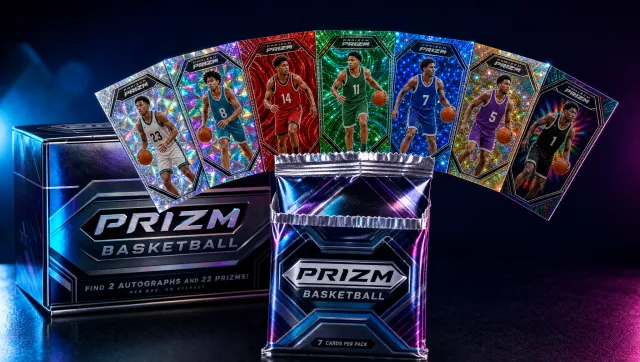
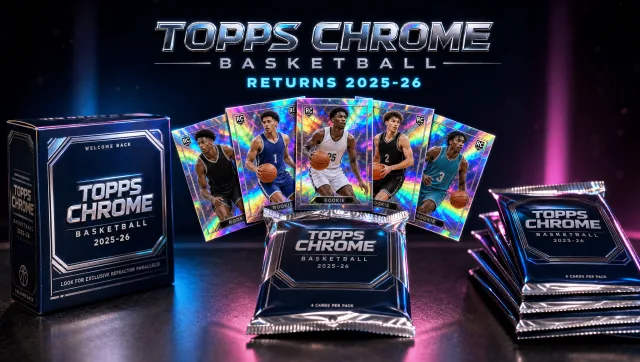
For deeper coverage of the Topps Chrome NBA universe in the current year, see the 2025 Topps Chrome Basketball guide and the Panini Prizm basketball guide for the parallel Panini-era chase.
How the three cards compare — a 2026 price + scarcity table
| Player | Card | Era | Raw clean | PSA 8 | PSA 9 | PSA 10 avg | PSA 10 high | PSA pop |
|---|---|---|---|---|---|---|---|---|
| Larry Bird (shared) | 1980-81 Topps #6 | True vintage | $300–$1,000 | $3k–$5k | $9k–$16k | $100k–$125k | $114k–$125k | ~9,800 PSA total graded (low % PSA 10) |
| Kobe Bryant | 1996-97 Topps Chrome #138 | Peak Chrome | $200–$800 | $500–$1.2k | ~$3k | ~$40k | $60k–$100k | 830 / 5,622 (~14.8%) |
| Stephen Curry | 2009-10 Topps Chrome #101 /999 | Modern Chrome | ~$1,888 | ~$11k | ~$16.1k | ~$48k | $96k (Refractor /500 at Heritage 2022) | ~200–300 graded (est.) |
Sources: Sports Card Investor (current price data), Old Sports Cards (Kobe set-level top-10 and pop counts), All Vintage Cards (Bird/Magic pop and sale records), PSA Cardfacts (canonical population reports). For real-time comp tracking across the trio, see Card Ladder and Beckett.
The pattern is clear. Every card on the list is condition-scarce in high grade. Bird/Magic scarcity is print-run-and-attrition-plus-intact-panel; Kobe Chrome scarcity is iconic-demand-driven at PSA 10 population ~14.8% (high by chase-card standards, but the iconic factor still dominates); Curry Chrome scarcity is /999 print-run plus chrome-surface fragility. Grade is the single most important variable in the trio's value equation, and the spread between PSA 9 and PSA 10 is brutal across all three cards.
Why grade is everything (and the chrome-surface problem)
PSA 10 is the meaningful chase grade across the entire trio, but for very different structural reasons by card:
- The chrome-surface issue (1996-97 Kobe + 2009-10 Curry). Topps Chrome cardstock has a high-gloss reflective surface that shows micro-scratches under loupe inspection. "Snow" (print dots) on the metallic silver borders is the chronic PSA 10 killer. A clean-looking Chrome card at arm's length will often grade PSA 8 once it hits the loupe.
- The 1980-81 Topps staining and print-defect issue. The Bird/Magic print run had chronic black-ink staining and print-dot defects on the front of the card. Off-centering compounds this; a clean PSA 8 intact-panel card is already a serious chase, before you get to PSA 9 or PSA 10 territory.
- The perforated-edge issue (Bird/Magic only). Even an intact three-panel card needs the perforations themselves to be undamaged. Torn, weakened, or partially-separated perforations grade as edge damage at every major service.
- Compounding factors. Soft corners, surface scratches, and snow stack independently across all three cards. PSA grades on the weakest dimension — a card with PSA 10 centering but PSA 8 corners grades PSA 8 overall.
Most raw copies of any card in this trio will not grade PSA 9 or PSA 10, no matter how clean they look at arm's length. The grading-economics math (below) flows from this single reality. For the full PSA vs SGC vs CGC service comparison, see the Basketball Cards pillar.
Counterfeit and authentication red flags (especially the Kobe Chrome)
The 1996-97 Topps Chrome Kobe Bryant #138 is one of the most-counterfeited modern NBA cards, and the open web has no good single source on detection. The tells below are the practical red flags used in the hobby community — not authoritative documentation, so route every six-figure transaction through PSA, SGC, or CGC slabs rather than raw.
1996-97 Topps Chrome Kobe fake tells:
- Chrome surface depth. The real card has a deep mirror-like chrome finish that reflects light evenly. Fakes show duller, flatter chrome that does not catch the rainbow under angled light the way a genuine Chrome card does.
- Refractor rainbow pattern under angled light. Refractor parallels show a specific prismatic rainbow pattern when tilted to a strong light source. Fake refractors show inconsistent, banded, or muted rainbow patterns.
- Cardstock weight and rigidity. Fakes are often slightly thinner or warped compared to period-correct 1996-97 Topps Chrome stock. The real card has a specific weight and rigidity that feels heavier than a modern base card.
- Back stat-block font kerning. Fakes often show slightly off-kerned typography on the player name, position, and stat lines. The real card prints crisply with consistent letter spacing across the name and stat block.
- The NBA 50th Anniversary parallel confusion. Per All Vintage Cards, a darker NBA 50th Anniversary parallel of the 1996-97 Topps Chrome Kobe exists, and first-time buyers sometimes misidentify the parallel as the base RC and overpay. Check the back for the NBA 50 logo before paying base-RC prices.
Tells across the trio generally:
- Reprint markers. Legitimate reprints (modern Topps "Vintage" reprints, manufacturer-authorized signed reproductions) carry "REPRINT" or disclaimer text on the back. If you see it, the card is not the vintage piece.
- Buy slabbed above $500 raw. PWCC, Heritage Auctions, Goldin, Dean's Cards, and PSA Verified Members are reputable channels for vintage submissions. Cert numbers from PSA, CGC, or SGC resolve on the grader's own site — verify every cert before paying high-grade prices.
Should you grade your raw card? The 2026 grading math
The actionable section every Old Sports Cards and All Vintage Cards page skips. The simple rule: grade only when expected PSA 9 or PSA 10 resale comfortably clears the $15–$30/card submission fee plus shipping and insurance.
Per-card framework:
- 1980-81 Topps Bird/Erving/Johnson #6 (intact-panel raw): Worth grading even at PSA 7 ($1,000+ resale) if your card genuinely has intact, undamaged perforations across all three panels. Grade if perforations are clean and the card shows no obvious black-ink staining or print snow. Many vintage collectors lean SGC for vintage specialty submissions on this card.
- 1996-97 Topps Chrome Kobe #138 (raw): Worth grading only if you genuinely believe it's PSA 9 or PSA 10. PSA 8 at $500–$1,200 is break-even-ish on grading fees once you add shipping and insurance. Look for chrome surface free of micro-scratches, clean silver borders without snow, dead-on centering, and sharp corners. If any of those are flawed, hold raw or sell raw. Authenticate first — confirm the back is not the NBA 50th Anniversary parallel.
- 2009-10 Topps Chrome Curry #101 (raw): Worth grading at PSA 8 or better given the recent appreciation curve (PSA 8 last sold $11,000 in April 2026). Same chrome-surface scrutiny as Kobe — micro-scratches and snow on the metallic borders are the killers, and centering issues sneak in on the /999 print run.
Two notes. Many vintage collectors lean SGC for the 1980-81 Bird/Magic — SGC has positioned itself as the structural vintage-specialty competitor to PSA. And bulk-submission pricing (10+ cards in one batch) materially improves the math on borderline candidates across all three cards. For the full grading-service breakdown, see the Basketball Cards pillar.
How to start a modern-NBA-vintage trio collection in 2026
- Pick a target grade tier and stick to it. PSA 7–8 for budget builders (roughly $500–$5,000 per card across the trio); PSA 9 for serious collectors ($3,000–$16,000 per card); PSA 10 only for the truly well-capitalized at $40,000–$125,000+ per slab.
- Build in order of accessibility. Start with Curry (most modern, smallest comp band, easiest first chase), then Kobe Chrome (peak demand but stable population), then Bird/Magic (true vintage chase, highest comp). Building in that order gives you the lineage narrative without front-loading the most expensive card.
- Authenticate every Kobe Chrome purchase above $500 raw. Slabbed only above that threshold — the Kobe Chrome counterfeit problem is real, and the NBA 50th Anniversary parallel confusion catches first-time buyers. PSA, SGC, and CGC certificate numbers resolve on each grader's site.
- For the Bird/Magic, only buy intact-panel copies. Scored or separated panels are not the canonical RC and grade as damaged at every major service. The three perforations must be undamaged and the card must read as a single piece, not three.
- Watch the Curry Chrome appreciation curve carefully. PSA 8 jumped from roughly $3,000 in 2023 to $11,000 in 2026 — that is a fluid market, and the only honest framing is "current state, not guaranteed appreciation."
- Avoid the modern-era non-rookies. Kobe, Bird, and Curry all have hundreds of non-rookie cards from 1997–2016 (Kobe), 1981–1992 (Bird), and 2010–present (Curry) that trade $5–$50 in any grade. Buy them for personal collection enjoyment, not value.
- For the modern chase that runs alongside the vintage hunt, ship via packs with published odds. Pullmarket runs basketball packs with provably fair odds, third-party graded fulfillment, and a Pullmarket Vault custody model per Terms §5.5. Your pull is real cardboard graded by PSA, SGC, or CGC — hold it in the Vault, ship home, trade, or sell back for Pullmarket Gems (store credit, not cash). See How It Works for the full flow.
Where to go next
For the LeBron James rookie story that picks up where Kobe left off, see the LeBron James rookie card guide. For the next generation of NBA rookie chases, see the Wemby rookie card guide and the Caitlin Clark rookie card guide. For where these three cards sit among all-time leaders, see the most-expensive basketball cards guide (Curry's $5.9M National Treasures Logoman is on the top-15 list). For the modern Topps Chrome chase, see the 2025 Topps Chrome Basketball guide and the Panini Prizm basketball guide. For the full hobby orientation, start at the Basketball Cards pillar.
Pullmarket does not sell pre-2010 vintage singles. The modern chase that runs alongside the vintage hunt ships through Pullmarket basketball packs with published odds and real third-party-graded fulfillment under the Pullmarket Vault custody model (per Terms §5.5).
Frequently asked questions
The 1996-97 Topps Chrome #138 is Kobe's iconic flagship rookie card. PSA 10s average around $40,000 with peak public sales in the $60,000–$100,000 range following his January 2020 passing; PSA 9 sits around $3,000 and raw clean copies run $200–$800. The 1996-97 Topps Chrome Refractor parallel is the real grail — a BGS 10 sold for $33,500 back in 2017 and PSA 10 Refractors have crossed six figures in recent sale activity per Old Sports Cards. The PSA population sits at 830 PSA 10s out of 5,622 graded.
Yes. It is a single Topps card #6 with three perforated panels featuring Larry Bird, Julius Erving (Team Leader), and Magic Johnson side by side. Collectors at the time often scored the perforations and separated them into three pieces, but those separated panels grade as damaged at every major grading service. The canonical rookie card is the intact three-panel card. PSA 10 intact panels have sold $114,000–$125,000 per PWCC and Goldin records; PSA 9 intact panels sit around $9,000–$16,000.
Topps printed the 2009-10 Topps Chrome rookies as a numbered /999 chase parallel rather than an unlimited base print run. That limited print, combined with chrome-surface condition sensitivity, is why PSA 10 Curry Chromes average roughly $48,000 and the Refractor /500 parallel has sold up to $96,000 at Heritage Auctions in August 2022. The base #101 PSA 8 sold $11,000 in April 2026, PSA 9 sold $16,100 in May 2026, and raw clean copies last cleared $1,888 in June 2025 per Sports Card Investor.
Check five things: chrome surface depth (real chrome catches light evenly with a mirror finish, fakes look dull and flat), refractor rainbow pattern under angled light (real refractors show a distinct prismatic pattern, fakes show muted or banded patterns), cardstock weight and rigidity (fakes are thinner or warped), back stat-block font kerning (fakes show off-kerned text), and confirm you are not looking at the NBA 50th Anniversary parallel by checking for the NBA 50 logo on the back. When in doubt, buy slabbed only from PSA, SGC, or CGC with a verifiable cert number.
Only if you genuinely believe the card is PSA 9 or PSA 10. PSA 8 sells for $500–$1,200, which barely clears the $15–$30 grading fee plus shipping and insurance. Look hard for chrome surface with zero scratches, clean silver borders without snow (print dots), dead-on centering, and sharp corners. If any of those are flawed, hold the card raw or sell it raw. Always authenticate first — confirm the back is not the NBA 50th Anniversary parallel before submitting.
The 2009-10 Panini National Treasures Logoman Rookie Patch Autograph 1/1 sold for $5.9 million in July 2021, currently sitting at #3 on the all-time basketball card sales list per major auction records. That is the one-of-one trophy card with the actual Logoman NBA shield patch and Curry's on-card autograph. The 2009-10 Topps Chrome #101 /999 covered in this guide is the iconic affordable rookie — PSA 10s average roughly $48,000 — not the all-time grail-tier card. See the most-expensive basketball cards guide for the full top-15 list.
Three reasons stack. Career arc (four NBA titles, two MVPs, all-time three-point leader, single greatest shooter in NBA history), iconic Topps Chrome aesthetic on a /999 print run that makes PSA 10 a genuine condition chase, and the modern-vintage frame — collectors are treating the 2009-10 Topps Chrome as the natural Chrome successor to the 1996-97 Kobe. PSA 10 averages roughly $48,000 in 2026, up from approximately $4,000 in 2023. That is a fluid market and the only honest framing is current state, not guaranteed appreciation.
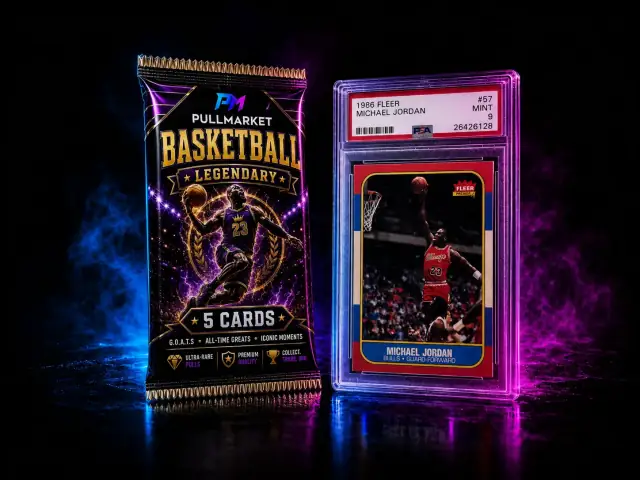
Pullmarket is an online collectible-card pack marketplace for instant online rips, graded-card chases, secure inventory, and shipping eligible cards to your door. Browse online sports card packs, or learn about Pullmarket LLC.