Pokemon Card Set Symbols List and Code Finder
A code, prefix, year, or collector number can narrow a Pokemon card to candidate sets, but one clue is not always unique. Search the text exactly as printed, keep every returned candidate, and confirm the card name, complete collector display, expansion, language, and artwork in the official Pokemon card database. This finder cannot identify a photographed set symbol or logo.
Search the Text-First Pokemon Set Code Finder
Start with the fullest readable English clue: an expansion name, publisher code, collector prefix, year, parent or subset name, database ID, or collector-number denominator. Every matching candidate stays in the result. The finder will not favor the newest set, and it leaves a search unresolved when the card supplies too little text.
A shortlist is useful only if it leads to the correct official card record. A familiar-looking abbreviation is not enough. If all you can make out is the card’s footer, use the broader Pokemon card field guide to identify the fields, then return with the text exactly as shown.
Small details change the search. Keep the slash in 1/86, the letters and leading zeros in TG01 or SWSH001, and the entire database string base1. Do not expand or correct an unfamiliar code. A year can remove impossible releases, but an exact card name and collector display carry more identifying information.
Capitalization may be normalized for matching; the original clue must remain available for comparison. The finder then returns all records that satisfy the supplied fields. Within the current snapshot, that may produce one candidate, several candidates, or none. An unknown string stays unknown rather than being converted into the nearest recognizable code.
Evidence labels used by the finder
| Evidence label | What it contains | What it can establish |
|---|---|---|
| Official-text verified | 25 official records: 16 Scarlet & Violet publisher-code rows through July 2025 and nine prefix, subset, promo, and route-ID cases | The cited name, collector display, publisher notation, route, or relationship appears in official text |
| Community discovery record | 174 English set records from a pinned PokemonTCG data snapshot | Candidate names, series, dates, source IDs, source-reported totals, online codes, and record classes |
| Ambiguous | More than one record shares the supplied clue | Another field is required before choosing |
| Unknown | The available evidence does not resolve the clue | Stop instead of manufacturing a match |
The two evidence layers are deliberately separate. The 25-row map has row-level official-text support. The 174-row index is a broader discovery aid sourced from the PokemonTCG data repository; it is not an official physical-mark catalog.
What each result field means
| Result field | Meaning | Identification limit |
|---|---|---|
| Name | Expansion, subset, or promo-series name | Similar names still require a card-record match |
| Series | Larger release family | A series such as XY is not one specific expansion |
| Year | Year derived from the source release date | Several sets can share a year |
| Publisher code | Short notation verified in official deck-list text | Deck-list use does not prove universal printing on cards |
| Collector prefix | Letters shown in an official collector display, such as TG or GG | A reused prefix needs its parent set |
| API set ID | Community database key, such as base1 | Database syntax is not card-face evidence |
| Official route ID | Website path segment, such as svp | A route is not automatically a collector prefix |
Source-reported printedTotal | Dataset field retained from the pinned source | It is a candidate filter, not audited physical-card proof |
| Record class | Expansion, subset, promo, or supplemental record | It prevents subsets from being flattened into expansions |
| Evidence status | Official-text, community, ambiguous, or unknown | It defines how much confidence the row supports |
The Pokemon TCG API documentation exposes fields including a set ID, name, series, printedTotal, total, ptcgoCode, release date, symbol asset, and logo asset. Those are separate database fields. Their presence in one response does not make them one physical mark.
Identify a Pokemon Card Set by Collector Number
1/86 belongs on a shortlist, not in a finished set field. Official records use it for Snivy in Black Bolt and Sewaddle in White Flare. Keep both candidates. The Pokemon name—or a separately verified BLK or WHT publisher notation—settles the row. Result order does not.
1/86 needs one more clue
Read the card name before filing the set. Snivy closes the lookup as Black Bolt; Sewaddle closes it as White Flare. Without either name, 1/86 leaves this two-row note:
| Candidate | Verified collector display | Publisher code that can disambiguate |
|---|---|---|
| Black Bolt | 1/86 | BLK |
| White Flare | 1/86 | WHT |
Copy the clue as one complete string. Preserve any prefix, leading zero, numerator, slash, and denominator. Separately sourced publisher notation can break the tie when the name is unavailable: BLK points to Black Bolt, while WHT points to White Flare. If the listing supplies none of those extra fields, retain both candidates and mark the lookup unresolved.
Worked match: why TG01 still needs a parent set
TG01 is shared in another way. Four verified Trainer Gallery records use it:
- Flareon — Brilliant Stars Trainer Gallery
- Abomasnow — Astral Radiance Trainer Gallery
- Parasect — Lost Origin Trainer Gallery
- Braixen — Silver Tempest Trainer Gallery
The TG prefix identifies a subset structure. The Pokemon name identifies the card, and the corresponding parent expansion completes the catalog record. Filing any of these cards under TG01 alone loses the release distinction.
A collector number such as 224/198 should stay intact. Its numerator being higher than its denominator is not grounds for rejection; CGC documents that pattern for secret cards in its rarity and collector-number reference. Compare the complete display with the official card record.
Collector numbering answers a catalog question, not a product-odds question. When the decision changes to the chance of pulling a card, consult the Pokemon pack pull-rate evidence.
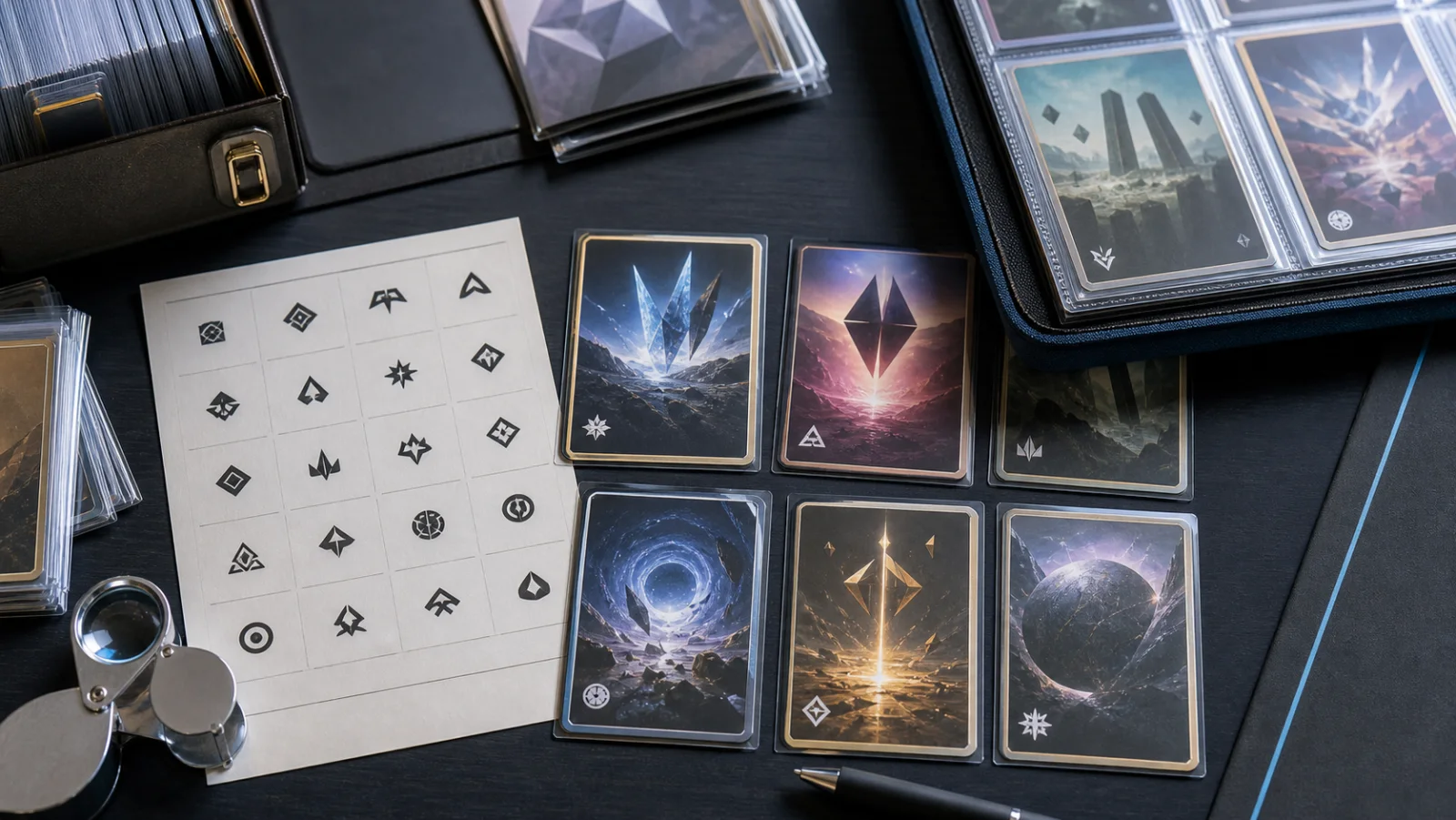
Can This Finder Identify Pokemon Set Symbols or Logos?
No. The finder can search readable text, but it cannot identify a photographed set symbol or logo. It neither displays nor copies, traces, hotlinks, or generates substitute Pokemon marks. When a photograph shows a legible card name or complete collector display, transcribe those characters and use them in the official card search.
If a photograph offers a shape but no readable characters, this finder has nothing it can match. Its sources do not map unfamiliar images to verified records. They also do not establish a single mark position that applies across every era, card class, and layout.
Do not substitute a rarity star, regulation letter, promo stamp, or nearby database code for the unreadable image. Each answers a different question. A visual resemblance is also too weak to override conflicting card text.
When the card name and number are readable, search both in the official English card database. Compare the expansion name, complete collector display, and artwork. If the photograph reveals none of those details, request an uncropped, sharper image rather than forcing a text-only result. Leave the candidate unresolved until readable text appears.
The Pokemon card guide can help identify which printed fields are worth transcribing. This page does not reproduce a visual Pokemon card set symbols list or offer symbol-image output.
Pokemon Codes, Prefixes, and Database IDs Are Different Fields
The following Pokemon set codes are verified as notation used in official publisher deck lists. Their appearance in deck-list text does not prove that each code is printed on every physical card from that expansion.
| Publisher code | Expansion | Publisher code | Expansion |
|---|---|---|---|
SVI | Scarlet & Violet | SFA | Shrouded Fable |
PAL | Paldea Evolved | SCR | Stellar Crown |
OBF | Obsidian Flames | SSP | Surging Sparks |
MEW | 151 | PRE | Prismatic Evolutions |
PAR | Paradox Rift | JTG | Journey Together |
PAF | Paldean Fates | DRI | Destined Rivals |
TEF | Temporal Forces | BLK | Black Bolt |
TWM | Twilight Masquerade | WHT | White Flare |
The evidence comes from official deck strategies for Black Bolt and White Flare, Surging Sparks, and the 2025 Expanded format. Row-level publisher-code verification stops at Black Bolt and White Flare in July 2025.
One Base record contains two compact identifiers with different jobs. base1 is its API set ID in the community source. BS appears in the separate ptcgoCode, or online-code, field. Their shared record does not turn either string into evidence of a physical expansion mark.
Website syntax needs the same separation. The official Scarlet & Violet Promo Cards path uses svp, yet the sampled Sprigatito record displays 1/1 Promo rather than an SVP collector prefix. For Celebrations: Classic Collection, cel25c and a suffix such as _A route the website to a record. Neither automatically describes text printed on the card.
The source of the clue determines the field you should search:
| Clue source | Store it as |
|---|---|
| Official deck list | Publisher code |
| Official collector display | Number or collector prefix |
| Online-game dataset field | Online code |
| Community API response | API set ID |
| Official page URL | Route ID |
| Physical card observation | Printed text or unresolved mark |
A lookup can be technically correct and still support the wrong physical-card claim if that source label is lost. Keep it attached. The Pokemon card guide covers the broader field terminology.
Marks That Answer a Different Question
A rarity star, regulation letter, edition stamp, and set clue may occupy the same small part of a collector’s notes, but they answer different questions. Classify the observed mark before asking which expansion fits. Facts about rarity, legality, print run, or distribution should not be promoted into set evidence.
| Mark or label | What it answers | What it does not establish |
|---|---|---|
| Rarity notation | The card’s rarity classification | Expansion identity |
| Regulation letter | Tournament-legality grouping | Set code |
| First Edition stamp | An early print run within a set | A separate expansion |
| Promo label | The official record’s promotional classification | One universal stamp design |
| Special promotional stamp | A documented distribution or issue | The underlying expansion by itself |
| Expansion mark or set symbol | A possible expansion clue | Authenticity, value, or a database ID |
CGC explains that rarity notation sits near the collector number and reports the card’s rarity. That proximity explains why it is often misread; the nearby star still does not name an expansion.
The official Play Pokemon glossary assigns a regulation letter to tournament legality. Remove that letter from a set-code query rather than treating it as expansion notation.
CGC’s First Edition guide puts the stamp in the print-run category, not the expansion category. Its position can vary among card classes. A First Edition copy and a later printing can therefore belong to the same expansion even though the stamp differs.
Set identity and authenticity part company at an unfamiliar mark. Record any readable catalog text here. Questions about card stock, printing, or surface belong in how to tell if Pokemon cards are fake. The mark by itself is neither a catalog match nor a counterfeit verdict.
Keep Subsets and Promo Series Attached to Their Parent Records
TG01 is a filing collision. It belongs to four verified Trainer Gallery records, so the Pokemon name and parent release must remain beside it:
| Collector clue | Official record context | Parent relationship |
|---|---|---|
TG01 | Brilliant Stars Trainer Gallery | Brilliant Stars |
TG01 | Astral Radiance Trainer Gallery | Astral Radiance |
TG01 | Lost Origin Trainer Gallery | Lost Origin |
TG01 | Silver Tempest Trainer Gallery | Silver Tempest |
GG01 | Crown Zenith: Galarian Gallery | Galarian Gallery subset of Crown Zenith |
SV001 | Shining Fates: Shiny Vault | Shiny Vault subset of Shining Fates |
Parasect files as Lost Origin Trainer Gallery, with TG01 in the collector field and Lost Origin retained as the parent. Flareon, Abomasnow, and Braixen require their own parent releases. GG01 should remain Crown Zenith: Galarian Gallery; GG is not a standalone expansion. SV001 belongs to the Shiny Vault subset of Shining Fates.
Promo entries cannot be normalized into one text pattern. The official Sword & Shield Promo display includes SWSH001. In the sampled Scarlet & Violet promo record, svp belongs to the website route, while the displayed collector number contains no SVP prefix.
Celebrations: Classic Collection stays attached to Celebrations. The site uses cel25c and an _A suffix to retrieve the record. Those strings are website syntax, not replacement catalog names.
Pokemon Set Symbols by Year: Filter the Text-Only Index
Search 2022 TG01 as a filter, not an identification. It removes records outside 2022, but it can still leave several Trainer Gallery parents. The Pokemon name and complete official collector display pick the row. A series label is looser again: it narrows an era family, not a single expansion.
Clues outside the 25 official-text rows can be checked against the wider community index. Its job is to surface candidates, not upgrade them to official-text verification. The August 10, 2026 build is pinned to commit 8b4e387930ead7be6595b4d4c59b7ba7a3a79f08 in the PokemonTCG data repository. The row-set hash for that exact build is:
5b44111a57043bdf6edb6587d7856a3861d1242bab83e9ce159e476cb62f4684
That build contains 174 English records across 17 series families. Base and Pitch Black sit at its two ends.
Use that range to eliminate an impossible era or reopen a known community record. It remains discovery evidence. The 174 rows are not 174 official publisher-code verifications, and they do not document physical symbols.
Online-code coverage is incomplete and sometimes duplicated. The snapshot has 149 records with an online code and 25 without one. Eight values are reused across 16 records. A blank code is a normal dataset state; a reused code must return every linked record.
The printedTotal field collides more often. The snapshot contains 97 distinct source-reported values. Forty-one values occur across 118 records, while 56 records have a value that is unique within this snapshot. Those counts audit a dataset field, not denominators physically printed across every card.
| Filter | Useful for | Insufficient for |
|---|---|---|
| Year | Removing releases from other periods | Proving one expansion |
| Series | Keeping results within an era family | Distinguishing every set in that family |
| Online code | Finding records that use the same source field | Proving card-face printing |
printedTotal | Discovering records with the same source-reported value | Certifying a physical denominator |
| API set ID | Reopening one community record | Identifying an unknown physical mark |
Symbol and logo asset URLs may also appear in the API response. This page does not render them. A stored asset address cannot establish what appears on every physical printing.
Base Set’s Verified No-Symbol Exception
First Edition Charizard 4/102 contains two different clues: its First Edition stamp is present, while the expansion-symbol field is empty. The field being checked is the one labeled by the Pokemon card-parts diagram. Four authenticated PSA pages supply the card-level observations:
- Unlimited Bulbasaur
44/102, PSA certification 77628492 - Unlimited Professor Oak
88/102, PSA certification 79305026 - Shadowless Fire Energy
98/102, PSA certification 115975873 - First Edition Charizard
4/102, PSA certification 100767947
The subjects and print states change across those four pages: Pokemon, Trainer, and Energy cards appear in Unlimited, Shadowless, and First Edition examples. The observation does not change. The expansion-symbol field identified by the rulebook is blank in each case. Together, the pages support one bounded conclusion: English Base Set cards do not carry an expansion symbol.
Do not identify Base Set from blank space. An unknown card must also agree with the English name, /102 collector display, artwork, and print state shown by official or authenticated records. A conflict in any of those fields removes Base Set from the candidate list.
The conclusion stops at English Base Set. It does not establish one symbol location for later eras or different card layouts. If Base, Jungle, Fossil, or another early release remains plausible, use the original Pokemon sets guide for that comparison. Settle the catalog entry before moving to authenticity, condition, or value.
Japanese Cards Need the Official Japanese Database
Japanese text is a routing decision. Stop the English lookup, copy the printed Japanese name, code, and collector number, and search those characters in the official Japanese Pokemon card search.
A seller’s English nickname cannot confirm the record. Request the printed footer before choosing a set. Shared artwork and translated names may suggest a page to inspect, but they do not make English and Japanese numbering, release chronology, or product identity interchangeable.
Keep an English candidate only as a research lead. Final confirmation belongs in the language-specific official database.
How to Identify Pokemon Card Sets in an Official Card Record
The English Sun & Moon record for Incineroar separates the useful fields: exact name, 26/149, expansion context, artwork, and Rare as a distinct rarity label. A candidate must agree with those identity details. A shared year, prefix, code, or denominator cannot repair a conflict elsewhere.
On that Incineroar page, 26/149 is the collector entry and Rare is the rarity label. Sun & Moon supplies the set context. Neither the denominator nor rarity can stand in for the expansion.
Check the fullest card-specific details first. A non-English card belongs in its language-specific database. On an English card, a different name or changed collector display ends the comparison. Preserve every prefix, leading zero, numerator, slash, and denominator.
Subset hierarchy can remove another plausible-looking result. Trainer Gallery, Galarian Gallery, Shiny Vault, Classic Collection, and promo context stay attached to the expansion, subset, or parent named by the official record. Then compare the artwork. If the official page depicts or describes another printing, remove that candidate.
A usable catalog note carries five identity fields: language, exact card name, full collector display, expansion or parent-subset relationship, and artwork. Incineroar’s separate Rare label does not belong in that set-identity key.
A passed record check identifies a catalog entry. It does not authenticate the physical card, determine condition, assign a grade, or settle value.
Card stock, printing, and surface can still conflict after the catalog fields agree. Send those concerns to the Pokemon authenticity guide. If set identity is secure and the open question is format, use the graded-versus-raw comparison.
Browse Current Pokemon Packs After Identification
Before ripping, read the current pack details on Pullmarket’s live Pokemon category. That page shows the displayed card pool, published tier odds, and whether the shown outcomes are raw or third-party graded. Use the set or era you confirmed to guide the browse, but do not treat a historical match as proof of live inventory.
This article has no exact-match evidence showing that Black Bolt, White Flare, a Trainer Gallery card, Base Set, or any other discussed subject is currently pullable. The live pack details determine what is available.
If you are deciding what to rip rather than identifying a card, compare the live details with the best Pokemon pack to buy and the methodology in the Pokemon pack pull-rate guide.
Every Pullmarket pull is a real physical collectible card. Current pools may contain raw cards and cards graded by third-party services; the specific pack details show the applicable outcomes. The concise process is covered in how Pullmarket works.
Data Sources, Versioning, and Update Rules
The finder fails closed: a new row can enter the community index without receiving an official-text badge, while a new official-text row requires a direct source for the exact identifier being claimed.
| Evidence component | Current boundary | Update requirement |
|---|---|---|
| Community discovery index | 174 English records observed August 10, 2026 | Rebuild from a pinned source commit and publish a new row hash |
| Official-text map | 25 records | Attach exact official card, relationship, or publisher-code evidence |
| Publisher-code cohort | Scarlet & Violet through Black Bolt and White Flare | Do not extend beyond July 2025 without new row-level verification |
| Physical expansion marks | No positive mark rows in either text dataset | Require separate card-level evidence |
| Base Set exception | One bounded English no-symbol finding | Preserve the card classes, print states, and link-only evidence |
| Public files | Withheld from this article | Restore only after exact deployed-byte parity passes |
Row-level official publisher-code verification stops at Black Bolt and White Flare in July 2025. Later Mega Evolution-era records, including entries discoverable in the community snapshot, remain community discovery data until the same official evidence standard is met.
Commit 8b4e387930ead7be6595b4d4c59b7ba7a3a79f08 identifies the source behind the 174-row build. Its source date and row-set hash above identify the same snapshot. A change to the rows requires a new version and cannot retain the old snapshot identity.
Fields such as base1, ptcgoCode, and printedTotal use the schema described in the Pokemon TCG API field documentation. Verify expansion names and chronology in the official English expansion index. Use the card database to decide the final card-level match.
Both public files returned 174 rows, but their bytes and hashes did not match the validated artifacts. The matching row count was therefore insufficient. CSV and JSON controls remain absent until the deployed files pass exact byte parity.
Frequently asked questions
Treat the photograph as a source of readable characters, not as a symbol scan. Copy the card name, full collector display, prefix, publisher code, year, or other visible text and compare the resulting candidates with the official English record. A cropped shape with no usable text produces no supported result here. Ask for a sharper, uncropped photograph and leave the lookup unresolved in the meantime.
A denominator groups possible records; it is not a global set ID. /86, for example, appears on official Black Bolt and White Flare records. Snivy resolves to Black Bolt, while Sewaddle resolves to White Flare. Separately verified BLK or WHT publisher notation can make the same distinction. Search position contributes nothing, so neither row should be selected merely because it appears first.
Only the publisher-notation claim is verified. Official deck-list text uses codes including SVI, PAL, BLK, and WHT, so those strings can support a text lookup. The deck lists do not show that each code appears on every corresponding physical card. They also do not establish a universal card-face location for publisher codes.
No-symbol evidence alone cannot identify the card. English Base Set is the bounded exception established here, but the unknown card must still agree on its name, /102 collector display, artwork, and language. Its First Edition, Shadowless, or Unlimited print state must also fit the supporting official or authenticated record evidence.
No. The 174-row index and official-text cohort are English-only. Search the printed Japanese card name, code, and collector number in the official Japanese card database. Similar artwork or an English translation can suggest a candidate, but it cannot confirm Japanese numbering, release chronology, or product identity.
Browse online Pokemon card packs. New here? See how Pullmarket works.