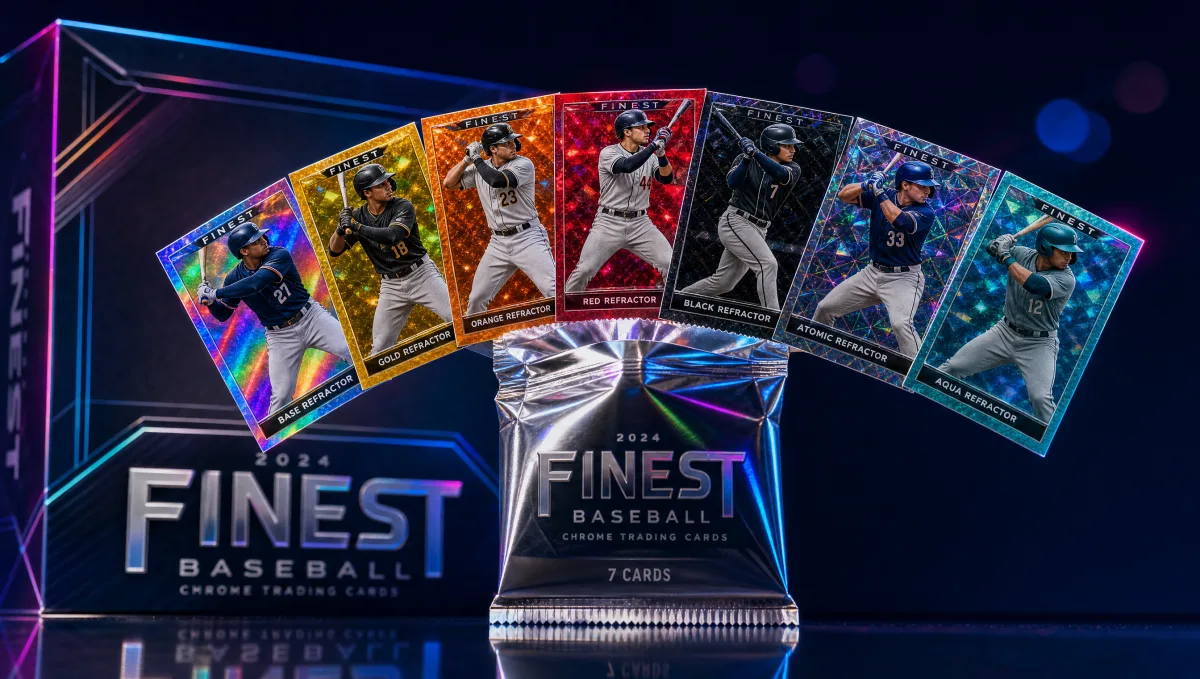
2025 Topps Finest Baseball — Refractor Chaos Decoded
In 1993, Topps released a 199-card chromium set called Finest that introduced two things that would define every premium parallel for the next 33 years: chrome card stock and a shimmer-coated parallel called the Refractor, printed at roughly 241 copies each per BaseballCardPedia. 2025 Topps Finest Baseball — released August 12, 2025 — is the great-great-grandchild of that set, and it has not gotten simpler. Today's Finest ships a 300-card tiered base set, a 16-level parallel ladder, the new Pearl Checkerboard Refractor /60 or less, two autographs guaranteed per hobby box, and the Checkerboard Refractor as its visually distinctive parallel — which is not the Atomic Refractor most collectors think it is. This guide decodes all of it, then makes the honest Chrome-vs-Finest call no authority blog will commit to.
Part of: Complete Baseball Cards Guide — the pillar overview of 130 years of baseball cards, from 1880s tobacco issues through the Fanatics-era modern landscape.
2025 Topps Finest Baseball released August 12, 2025. Hobby boxes carry 6 packs of 10 cards (60 cards total), 2 autographs guaranteed, a 300-card tiered base set across Common, Uncommon, and Rare tiers, and a 16-level refractor parallel ladder topped by a 1/1 SuperFractor. The new 2025-exclusive parallel is the Pearl Checkerboard Refractor numbered to /60 or less per tier. Hobby boxes have historically run $200–$300; check live retail.
1993 Topps Finest invented the refractor — the 33-year origin
The Refractor — chrome's shimmer-coated rainbow parallel — debuted as roughly 241 copies per card in 1993 Topps Finest, the first chromium-stock set in the modern hobby. Topps released the 199-card set as its push into the super-premium tier, competing with Fleer Flair and Upper Deck SP, and broke ground on two fronts that reshaped every premium release since. The first was chromium card stock — mirrored, foil-treated cardboard never used at scale before. The second was the manufactured scarcity of the Refractor, with production publicly disclosed at 4,000 twelve-box cases per Sports Collectors Daily's 1993 Finest history and roughly 241 Refractor copies surviving per card. That single set defined the playbook every modern Topps Chrome, Bowman Chrome, and 2025 Finest release still runs on. The Wikipedia refractor entry traces the definition; Cardboard Connection's refractor guide traces the design evolution.
What 2025 Topps Finest Baseball actually is
2025 Topps Finest Baseball is a hobby-tier chromium release built on a 300-card tiered base set, with 6 packs of 10 cards per box, 2 guaranteed autographs, and a 16-deep parallel ladder. Verified configuration per Beckett and Topps Ripped:
- Release date: August 12, 2025
- Hobby box: 6 packs × 10 cards = 60 cards; 2 autos per box
- Per-case hit: 1 Finest Moments Autograph + 1 short-printed insert (8 boxes per case)
- Base set: 300 cards across Common (100), Uncommon (100), Rare (100)
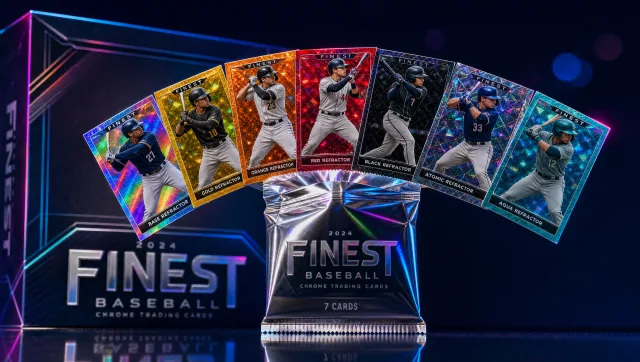
- Parallel ladder: 16 levels per tier, including the new Pearl Checkerboard /60 or less
- Distinctive parallel: Checkerboard Refractor (not Atomic — see Section 5)
- MSRP range: historically $200–$300 hobby; confirm at point of purchase
The set DNA — chromium card stock, heavy-foil Finest design, contemporary photography on a mirrored base — descends directly from 1993. What's new for 2025 is the depth of the parallel ladder, the explicit Common/Uncommon/Rare tier split, and the Pearl Checkerboard variant.
The tiered base set — Common / Uncommon / Rare
The 300-card base set splits into three 100-card tiers with different parallel print runs at each tier, so the same parallel color carries different scarcity depending on which tier card it's printed against. A Rare-tier Magenta of Aaron Judge isn't the same card as a Common-tier Magenta of a depth outfielder:
- Common (100). Highest pack-out rates. Refractor drops roughly 1:5 packs. Where most depth-roster and back-of-checklist names live.
- Uncommon (100). Mid-range print runs, slightly lower refractor pack-out. The sweet spot for player collectors hunting a numbered parallel of their guy without paying Rare-tier premiums — Refractor 1:8 packs.
- Rare (100). Lowest print runs across every color. A Rare-tier Magenta /200 vs Common-tier /350 is roughly 1.75× the scarcity. Refractor 1:96 packs. Most rookie chase cards and superstar veterans live here.
Tiering exists because a flat parallel ladder would price a Magenta of Paul Skenes (rookie chase) into the same scarcity pool as a Magenta of the 25th man on a National League bench. Topps Ripped's tiered-parallel guide is the canonical source.
The 16-level parallel ladder — refractor chaos, decoded
Scarcity reads two ways at once: vertically down the ladder (color rarity within a tier) and horizontally across tiers (the same color is rarer in Rare than in Common). The Checkerboard Refractor is the visually distinctive Finest parallel for 2024–2025 — and is not the Atomic Refractor (which lives in Bowman's Best; see Section 5).
| # | Parallel | Common /n | Uncommon /n | Rare /n | Notes |
|---|---|---|---|---|---|
| 1 | Base | unlimited | unlimited | unlimited | The 300-card foundation |
| 2 | Checkerboard Refractor | 1:2 packs | 1:4 packs | 1:12 packs | Finest-distinctive. New in 2024, expanded 2025. |
| 3 | Refractor | 1:5 packs | 1:8 packs | 1:96 packs | The classic rainbow finish |
| 4 | Magenta Refractor | /350 | /300 | /200 | New for 2025. |
| 5 | Sky Blue Refractor | /325 | /250 | /150 | |
| 6 | Purple Refractor | /250 | /200 | /125 | |
| 7 | Blue Refractor | /200 | /150 | /99 | |
| 8 | Purple Checkerboard | /150 | /99 | /75 | Checkerboard finish |
| 9 | Blue Checkerboard | /99 | /75 | /49 | Checkerboard finish |
| 10 | Pearl Checkerboard | /60 | /40 | /30 | New for 2025. Lowest Checkerboard. |
| 11 | Green Refractor | /75 | /50 | /25 | |
| 12 | Gold Refractor | /50 | /35 | /20 | |
| 13 | Orange Refractor | /25 | /20 | /15 | |
| 14 | Black Refractor | /20 | /15 | /10 | |
| 15 | Red Lava Refractor | /10 | /5 | /3 | |
| 16 | SuperFractor | 1/1 | 1/1 | 1/1 | The single-copy chase |
| (Oil Spill) | Oil Spill Refractor | 1:790 packs | varies | varies | Case hit — oil-slick finish |
A Common-tier Gold /50 is rarer than a Common-tier Sky Blue /325 but more common than a Common-tier Red Lava /10. The Pearl Checkerboard /60 is the new top-of-Checkerboard color for 2025. Sources: Topps Ripped tiered-parallel guide and Beckett's 2025 Finest checklist.
Atomic vs Checkerboard Refractor — the distinction forums get wrong
Atomic Refractor and Checkerboard Refractor are different parallels in different Topps products, and the conflation between them is one of the most common mistakes on hobby forums. The corrective: Atomic Refractor is a Bowman's Best parallel, not a Topps Finest parallel. Atomic debuted in 1996 Bowman's Best with its plaid-and-diamond pattern under the refractor finish, typically numbered to roughly one-quarter the print run of the standard Refractor at the same tier. Cardboard Connection's refractor guide is the canonical source on the distinction.
The Finest-distinctive parallel — the one with the woven checkerboard pattern under the chrome — is the Checkerboard Refractor, introduced for 2024 Topps Finest and expanded for 2025 with the new Pearl Checkerboard. Visually: Atomic is a diamond grid laid over the foil; Checkerboard is a tighter, perpendicular weave. If the pattern is plaid-diamond, it's a Bowman's Best Atomic. If the pattern is square-grid weave, it's a Finest Checkerboard.
The autograph chase — Finest Autos, Moments, Rookie Cup, Gustographs
Every 2025 Finest hobby box guarantees 2 autographs — the layer where Finest separates from Chrome's single-auto configuration. Hard-signed format runs across the core Finest Autographs set and four themed companion sets, per Beckett and Topps Ripped:
- Finest Autographs (135 cards). The core auto checklist — hard-signed on-card. Parallels include Sky Blue /150, Purple /125, Blue /99, Green /75, Gold /50, Orange /25, Black /10, Red /5, SuperFractor 1/1.
- Finest Moments Autographs (34 cards). One per case (8 boxes). Career-moment hard-signed autos. The per-case chase.
- Topps Rookie Cup Anniversary Autographs (11 cards). Rookie-celebration set with parallels through 1/1.
- Topps Rookie Cup Dual Anniversary Autographs (14 cards). Paul Skenes pairs with veterans like Shota Imanaga and Andrew McCutchen.
- Gustographs (31 cards). Horizontal-format autos limited to /25 max, new for the brand.
- Finest Rookie Autograph Relic (20 cards). Auto-plus-relic combo set for rookie hits.
For Pullmarket readers: the 2-auto guarantee plus per-case Finest Moments hit is the biggest differentiator from Chrome. If autograph hunting is the primary goal, Finest is the better-engineered SKU.
The 2025 rookie chase — Skenes, Crews, Chourio, Wood, Sasaki
The 2025 rookie class concentrated around five names that anchor Finest's chase. For current pricing, Card Ladder and Beckett Marketplace carry live comp data:
- Paul Skenes (Pirates, base #103, B-15 Rookies, C-14 Creators). The headline chase. Also on Topps Rookie Cup Dual Anniversary Autographs with Shota Imanaga and Andrew McCutchen.
- Dylan Crews (Nationals, base #125, B-7 Rookies). Co-headline.
- Jackson Chourio (Brewers, base #112, B-16 Rookies). Prospect-graduating-to-star arc.
- James Wood (Nationals, B-6 Rookies). Power-corner outfielder rookie.
- Roki Sasaki (Dodgers). Japanese SP debut card; international demand layered on Dodgers fandom.
- Plus: Luisangel Acuña, Coby Mayo, Jace Jung — secondary names worth tracking.
For pricing, anchor on Card Ladder's trailing-90 data rather than spot eBay listings — early-year rookie comps swing hard on MLB performance updates.
Hobby box vs mega box vs Pullmarket pack
Topps Finest has historically been a hobby-channel-led release with limited mega/retail exposure year-to-year. For 2025, the hobby box is the only format guaranteed to deliver autographs and highest-tier parallels.
| Format | Configuration | Auto guarantee | Best for |
|---|---|---|---|
| Hobby box | 6 packs × 10 cards, 8 per case | 2 autos guaranteed + per-case Moments | Auto hunters, Black /10 and lower-numbered chasers |
| Mega / retail (if shipped) | Smaller pack count, lower price | No auto guarantee | Refractor-rainbow chasers on budget |
| Pullmarket pack | Per-pack ripping against verified inventory, published odds | Real graded singles allocated | Collectors wanting a specific graded pull without buying a $250 box |
Honest call: if you want any guaranteed auto, hobby is the only path. If you want a specific graded pull — a Skenes Refractor in a PSA slab — neither sealed format hands you that; you crack the box, you grade the card, you wait weeks. Pullmarket's Vault model offers a third path. See the Pullmarket trust page for the operating-model disclosure.
Topps Finest vs Topps Chrome — which is the better rip?
No authority blog will commit to this comparison because the brands sit too close — Topps Ripped won't pick favorites, Beckett presents both encyclopedically. Here's the honest framing:
| Factor | Topps Chrome | Topps Finest |
|---|---|---|
| Hobby price range | ~$150–$220 | ~$200–$300 |
| Parallel depth | ~15 levels | 16 × 3 tiers = ~48 base-card permutations |
| Auto guarantee | 1 per hobby box | 2 per hobby box |
| Base set | 200 cards (Series 1) | 300 cards (tiered) |
| Distinctive parallel | RayWave, X-Fractor | Checkerboard Refractor |
| Best for | Set builders, casual rippers | Rainbow chasers, double-auto hunters |
| Secondary market | Deeper, more liquid | Thinner — fewer cards circulating |
Honest verdict: Topps Chrome is the better rip for most collectors. Lower entry, deeper secondary, simpler parallel ladder, easier to liquidate. Most people who ask "Chrome or Finest" should rip Chrome.
Topps Finest is the better rip for a specific buyer: the rainbow chaser who actively wants a deeper ladder, the double-auto hunter who needs the 2-auto guarantee, and the collector who specifically wants the Checkerboard (which Chrome doesn't carry). Neither is "better" in a vacuum — they're tools for different goals. For Chrome detail, see 2025 Topps Chrome Baseball; for the prospect-tier cousin, see the 2025 Bowman Chrome Guide; for the premium single-hit Topps SKU, see Topps Inception Baseball.
How to ID a refractor in hand
Refractor identification is mechanical once you know what to look for — five quick steps tell you which parallel is in your hand without trusting a listing title:
- Tilt the card under direct light. Base Chrome holds its color flat. A refractor shows a rainbow shimmer that shifts as you change angle.
- Look for the surface pattern. Standard Refractor is smooth chrome under the rainbow. Checkerboard shows a tight woven-grid pattern. Pearl Checkerboard adds a milky-pearl color shift.
- Check for Atomic confusion. If the pattern is plaid-diamond — diagonals interlocking like a tartan — it's a Bowman's Best Atomic Refractor, not a Finest parallel.
- Look for oil-slick variant. Oil Spill Refractor shows iridescent purples, blues, and greens that swirl rather than rainbow-shift. Case hit at 1:790 packs.
- Verify the numbering. Numbered parallels print /n on the back, usually bottom edge. Match to the parallel ladder above to confirm tier and color.
For verified graded copies, cert lookups at psacard.com, cgccards.com, and gosgc.com tell you exactly which parallel sits inside the slab.
2026 secondary market — what's actually moving
The 2025 Finest secondary market in early 2026 splits into three bands. For live comp data on any specific card, Card Ladder and Beckett Marketplace are the two aggregate sources hobby buyers should anchor on:
- Rookie autos at the bottom of the ladder. Skenes, Crews, and Chourio rookie autos in Black /10, Red Lava /5, and 1/1 command premiums. Pearl Checkerboard /60 of these rookies tracks similarly.
- Mid-tier color refractors of stars. Aaron Judge, Shohei Ohtani, and Juan Soto in Blue /99 through Gold /50 hold their floor — established stars carry liquid resale.
- Common-tier base parallels of depth players. Weak. The 16-deep ladder fragments demand and a Common-tier Magenta /350 of a back-roster outfielder sits in a thin market.
- Structural risk. Some collectors believe Finest's color-of-color-of-color depth dilutes per-parallel demand vs Chrome's tighter ladder.
- Structural upside. Lower print runs per tier mean fewer copies of any single parallel circulating than the equivalent Chrome SKU.
Rip a real baseball pack on Pullmarket without the $250 box
The collector who wants a 2025 Finest pull but doesn't want to commit $200–$300 to a sealed box has a real alternative: Pullmarket's baseball pack catalog. Every pack publishes its odds before purchase, every pull is a real third-party-graded physical card (PSA, CGC, or SGC), and for each pull you decide whether to hold it in vault, ship it home, trade it, or accept the published 105% sellback in Gems. Full walkthrough on how Pullmarket works; operating-model disclosure on the Pullmarket trust page.
Pullmarket runs a Pullmarket Vault fulfillment model per Terms §5.5 — pulled slabs are managed through the Pullmarket Vault workflow. Either way, every pull is a real third-party-graded slab. Pullmarket Gems is store credit, explicitly not cashable (Terms §9.1). Pullmarket isn't a sweepstakes, lottery, casino, or wagering product.
Ready to rip a real baseball pack?
You don't have to commit $200–$300 to a sealed Finest box to chase a 2025 Topps Finest pull. Pullmarket's curated baseball packs publish their odds before purchase, every pull is a real third-party-graded slab (PSA, CGC, or SGC), and you decide per pull whether to hold in vault, ship home, trade, or sell back for Pullmarket Gems store credit. Modern Topps Chrome, Bowman Chrome, Finest, and Inception singles — that's what's sitting in the catalog right now.
Frequently asked questions
2025 Topps Finest Baseball released August 12, 2025 through hobby distribution. Each hobby box carries 6 packs of 10 cards (60 cards total), 2 autographs guaranteed, with 8 boxes per case and one per-case Finest Moments Autograph plus one short-printed insert. The 300-card base set splits across Common (100), Uncommon (100), and Rare (100) tiers. Hobby pricing at release ran approximately $200–$300; secondary supply via Card Ladder, Beckett Marketplace, eBay, and COMC continues through 2026.
Both are Topps chrome/refractor products, but they target different collectors. Topps Chrome is the flagship modern set ($150–$220 hobby, 200-card single-tier base, 1 auto per box), built for set builders and casual rippers. Topps Finest is the premium refractor product ($200–$300 hobby, 300-card tiered base, 2 autos per box, 16-level parallel ladder), built for rainbow chasers and double-auto hunters. For most collectors, Chrome is the better rip — lower entry, deeper secondary, simpler ladder. For refractor completists, Finest is the answer.
No — they are different parallels in different Topps products. Checkerboard Refractor is the Finest-distinctive parallel, introduced in 2024 Topps Finest and expanded for 2025 (including the new Pearl Checkerboard /60 or less). It shows a tight woven-grid pattern under the chrome. Atomic Refractor is a Bowman's Best parallel from 1996 Bowman's Best, with a plaid-and-diamond pattern, typically numbered to roughly one-quarter the run of the standard Refractor at the same tier. Different products, different mechanics. Cardboard Connection's refractor guide is the authoritative source.
Paul Skenes (Pirates, base #103) is the headline 2025 rookie chase — he also appears on Topps Rookie Cup Dual Anniversary Autographs alongside Shota Imanaga and Andrew McCutchen. Co-headliners: Dylan Crews (Nationals, base #125) and Jackson Chourio (Brewers, base #112). Secondary chases include James Wood, Roki Sasaki, Luisangel Acuña, Coby Mayo, and Jace Jung. Anchor pricing on Card Ladder and Beckett Marketplace — rookie comps move fast on MLB performance updates.
1993 Topps Finest base cards trade in roughly the $5–$50 range for mid-tier players in PSA 9. 1993 Finest Refractors — originally roughly 241 copies each per BaseballCardPedia — are valuable across the board: Hall-of-Fame player Refractors in PSA 9–10 routinely trade for thousands; a 1993 Finest Refractor Derek Jeter rookie in high grade has sold above $100,000 historically. For current comps, check Card Ladder, Beckett Marketplace, and the PSA cardfacts page.
Depends on your goal. The hobby box guarantees 2 autographs and highest-tier parallel pulls, but at $200–$300 it's a premium-priced rip. For set completion, Topps Chrome is cheaper — Finest's tiered 300-card set is harder to chase. For refractor rainbow chasing, Finest's 16-level-per-tier ladder is unmatched in the modern Topps lineup. For double-auto hunting (rookie auto plus Finest Moments), the 2-auto guarantee plus per-case Moments hit is the only modern Topps SKU that delivers both. Buy for your goal, not for hype. Decision support, not investment advice.
Tied at the top: the SuperFractor (1/1) — a single-copy parallel of any card in the base or autograph set — and the Red Lava Refractor /3 in the Rare tier, which carries only three printed copies. The Oil Spill Refractor is a case hit at 1:790 packs in Common-tier and is functionally rarer per-pack than the standard color rainbow, but its print run isn't fixed the way numbered parallels are. New for 2025: the Pearl Checkerboard /30 in the Rare tier is the lowest-numbered Checkerboard parallel.
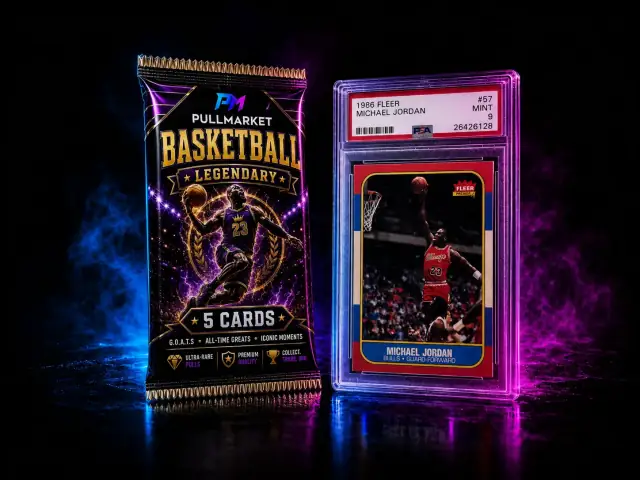
Pullmarket is an online collectible-card pack marketplace for instant online rips, graded-card chases, secure inventory, and shipping eligible cards to your door. Browse online Pokemon card packs, or learn about Pullmarket LLC.